
The Dorian Yates training program, known as Blood and Guts, is a high-intensity routine built on very few sets. Each exercise gets two to three warm-up sets and then one all-out working set taken beyond failure. Each muscle group is trained about once every seven days. The widely published version spreads four training days across a week with three rest days. Below you get the split, the set and rep logic, the intensity techniques, what research says, and how to adapt it without wrecking your joints or your recovery.
Dorian Yates Training Program: The Blood and Guts Split
The Dorian Yates training program explained: the four-day Blood and Guts split, one set to failure, rest days, and how to adapt it safely and track it.
Track Every Hard-Earned Rep
Log workouts as you train, adjust weights using your strength feedback, and follow progress with Athlxpro on iPhone and Apple Watch.
Visit AthlxproTL;DR
- Blood and Guts is a four-day split: shoulders and triceps, back, chest and biceps, then legs, with rest days between.
- Every exercise gets 2 to 3 progressive warm-ups and one working set to failure, usually 6 to 8 reps for most body parts.
- Failure is extended with forced reps, negatives or rest-pause, only on that final set.
- Research suggests failure is not required for growth when volume is matched, so the real lessons are effort, progressive overload and recovery.
- Beginners should learn form first, then borrow the intensity gradually, and log every session.
Table of Contents
- What the Dorian Yates program actually is
- The weekly split
- Sets, reps and warm-ups
- Intensity techniques beyond failure
- Does the research back it up?
- How to adapt the program
- Track everything, like Yates did
- Our perspective
- Running a Yates-style plan in Athlxpro
- Common mistakes with the Yates routine
- FAQ
- Sources
What the Dorian Yates program actually is
Dorian Yates won the Mr. Olympia title six times in a row, from 1992 to 1997. Over that run he typically used one all-out working set per exercise, after progressive warm-ups, and trained each body part once every seven days.
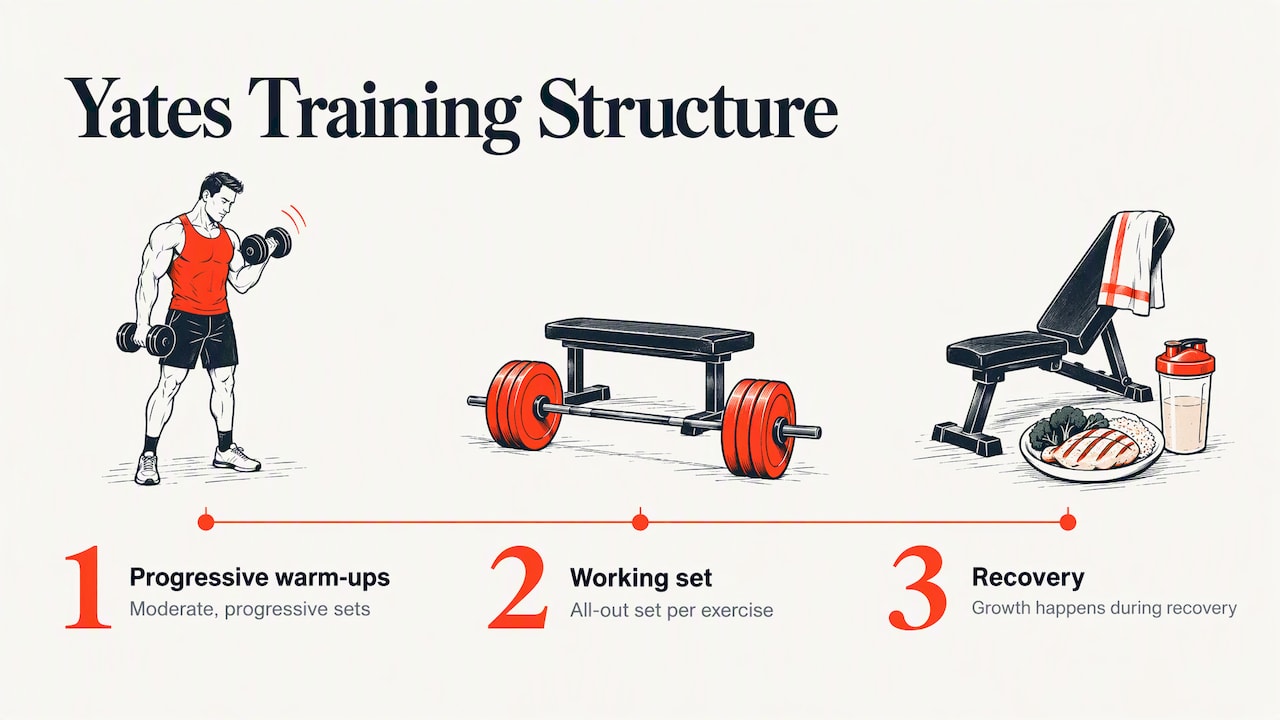
That is the opposite of the high-volume approach most gym-goers know. Instead of three or four sets of ten, you do several carefully chosen exercises per session and put everything into one set each. The warm-ups are not the workout. They are moderate, progressive sets that prepare the muscle and joints for the single set that counts.
The philosophy is simple: the stimulus is brief and brutal, and growth happens during recovery. That is why the weekly structure leaves so much room for rest.
The weekly split
Published versions differ in small details, because Yates changed his training over his career. The version most lifters mean by “Blood and Guts” runs on a seven-day cycle like this:
| Day | Focus |
|---|---|
| Day 1 | Shoulders, traps and triceps |
| Day 2 | Back and rear delts |
| Day 3 | Rest |
| Day 4 | Chest and biceps |
| Day 5 | Rest |
| Day 6 | Quads, hamstrings and calves |
| Day 7 | Rest |
Two things stand out. First, no muscle is trained more than once per cycle. Second, rest days sit before and after the chest and biceps session, so you arrive fresh and leave room to recover. If you search for other versions, you will find rotating six-day splits from his earlier years. Treat those as a different phase, not an error.
The recovery side matches what Yates described: three full rest days per week and each muscle group hit only once.
How long a session takes
Because working sets are so few, sessions are short compared with typical bodybuilding workouts. Expect roughly an hour including warm-ups, rests between exercises and setup. Rest between exercises is long enough that you can go all-out again, since every working set is a maximum effort.
Sets, reps and warm-ups
The structure of every exercise is the same:
- Two to three progressive warm-up sets at moderate intensity. The major exercise of the day may get just one or two, while chest got three.
- One working set to failure.
- Optionally, an intensity technique to push past failure.
Rep ranges were generally 6 to 8 reps for most body parts, with higher reps for legs and abs. That means you pick a weight you cannot lift more than about 6 to 8 times with strict form, then go until the muscle stops.
A sample session
Here is how a back day could be structured using the same logic. Exact exercise choice varies across published versions, so use this as a template, not a record of what Yates did on a particular day:
- A vertical pull (such as a pulldown): 2 warm-ups, 1 working set of 6 to 8 reps.
- A row variation: 2 warm-ups, 1 working set of 6 to 8 reps.
- A second row or machine pull: 1 to 2 warm-ups, 1 working set.
- A deadlift or hyperextension variation: warm-ups, then 1 working set.
- Rear delts: 1 to 2 warm-ups, 1 working set.
Write down the load and reps every time. The method only works if you beat the previous week.
Intensity techniques beyond failure
Reaching failure is the starting point. Yates then used forced reps, rest-pause reps or dropsets to extend the set.
- Forced reps: a spotter helps you grind out extra reps after you cannot complete one alone.
- Negatives: you lower the weight slowly and under control, often with a partner lifting it back up.
- Rest-pause: you stop, rest a few seconds, then squeeze out more reps with the same weight.
- Dropsets: you reduce the weight and keep going.
The key is restraint. These techniques go on the last working set only, not every set. And they are far easier to do safely on machines and cables, which Yates himself recommended for going to failure and beyond when you train without a partner.
Does the research back it up?
Partly, and the nuance matters. A review of resistance training variables notes that training to failure increases metabolic stress and that intensity and volume should be analyzed carefully. The same literature indicates that failure may increase fatigue per set but does not necessarily produce a better muscle-growth stimulus than non-failure training when total volume is equal.
That suggests Yates’s results likely came from intense focus, consistent effort and progressive overload, not from failure by itself.
There is also a recovery cost. An academic review on recovery in resistance training says that higher volume combined with consistent failure sets can sharply compound fatigue, and that these techniques are best used purposefully in specialized phases rather than all the time.
Practical takeaways:
- Low volume works only when effort is truly high and the weights go up over time.
- Very low weekly volume per muscle is a big ask for most people. If you want more than one hard set, adding a second is a reasonable move. Yates himself refined his approach to one hard set and sometimes a second when needed.
- Do not run all-out failure with beyond-failure techniques year-round. Cycle it.
How to adapt the program
Yates trained as a professional bodybuilder in a gym full of equipment and training partners. Most readers are not in that situation. Here is how to take the useful parts.
If you are a beginner
Learn the movements first. Beginners should master proper form before training to failure. Spend your first weeks on technique with sets stopped a rep or two short of failure. Then add failure on safe, stable exercises such as machines, cable work and pulldowns, and leave failure on heavy free-weight squats and bench presses for later, ideally with a spotter.

If you are time-pressed and not competing
Yates said that for the average person interested in health rather than competitive bodybuilding, 45-minute sessions twice a week are enough. A two-day full-body version of the one-hard-set idea is a perfectly sensible starting point.
If you train alone
Choose machines and cables for the failure sets. Use drop sets or rest-pause instead of forced reps, since you need no spotter. Keep free-weight work for the warm-up-heavy compound lifts and stop a rep short.
Sample adaptation for a beginner to intermediate lifter
| Week | Approach |
|---|---|
| 1 to 2 | Learn form, 2 sets per exercise, stop 2 reps short of failure |
| 3 to 4 | Same split, last set on machines taken to failure |
| 5 to 6 | Add one intensity technique on one exercise per session |
| 7 | Easier week: lower effort, same exercises |
This is a template, not a prescription. If you have joint problems, a heart condition or any injury, talk to your doctor or a qualified coach before adding failure training.
Track everything, like Yates did
The single most copyable habit from Yates is not a technique. He says he kept a training log recording routines, poundages, sets, reps, diet, goals and bodyweight. With one working set per exercise, the log is the program: the only way to know a set was a true effort is that it beat the last one.
What to record each session:
- Exercise, load and reps of the working set
- How the set felt, and whether it was truly to failure
- Warm-up loads, so next week’s ramp is consistent
- Bodyweight, sleep and recovery notes
A notebook works. A phone works better, because you can log right after the set while you still remember it.
Our perspective
We built Athlxpro around the same idea that makes Blood and Guts work: effort only counts if you can compare it with last time. Yates’s low-volume system is unforgiving because there is nowhere to hide. One set either beat the previous week or it did not.
That is also why we do not think you should copy anyone’s routine blindly. The right weight next week depends on how this week actually felt. In Athlxpro you tell the app how a session went, and it adjusts weights for the next one, so progression follows a plan. Sleep and heart rate data sit next to your training, because recovery decides whether a brutal set turns into growth or into a stall.
If you want to try Yates-style training, use the intensity. Keep the logging strict. Cycle the hardest techniques rather than living in them.
Running a Yates-style plan in Athlxpro
Athlxpro is a strength training app for iPhone and Apple Watch. You can plan workouts around a split like the one above, log each set instantly from your wrist, and watch the numbers climb. There are 577 exercise videos for checking form, which matters if you are new to training near failure. Athlxpro also offers an AI coach called Alex for training and nutrition advice, and exportable reports if you work with a coach.
The subscription is billed through the App Store, with monthly and yearly plans after a one-week trial. You can start from the Athlxpro page and see the current plan details there.
Build the split, log the working sets, and let the weight progression follow how each session felt. That loop, not any single technique, is what carried Yates’s routine.
Common mistakes with the Yates routine
Treating every set as a failure set. Warm-ups exist to be easy. Go to failure only on the working set.
Using forced reps on everything. Beyond-failure techniques belong on the final set of selected exercises, as the research on recovery demand suggests.
Skipping the rest days. Three rest days a week are part of the design, not a gap to fill.
Not progressing. If the working set does not beat last week’s load or reps, you are repeating the same stimulus. Adjust food, sleep or exercise choice.
Chasing exact exercise lists. Sources disagree on specific exercises and rep targets because he changed his training over time. Pick sound movements for each muscle and be consistent.
FAQ
How often did Dorian Yates train?
In the widely published Blood and Guts version, he trained four days per cycle, with three rest days, and hit each muscle group once every seven days. Earlier in his career he used a different, higher-volume rotation. Check the era whenever you read a routine.
How many sets did Dorian Yates do per exercise?
Two to three progressive warm-up sets, then one working set taken to failure and often beyond it. In some phases he did a second working set when needed. Total working sets per session were low because each one was maximal.
Can beginners use the Dorian Yates workout?
Yes, in a modified form. Learn form first, use machines and cables for failure sets, and train with a spotter on heavy free weights. Add intensity techniques only after several weeks of clean technique.
Is training to failure necessary to build muscle?
No. Reviews suggest failure is not necessarily superior to non-failure training when volume is matched. What matters most is consistent effort, progressive overload and recovery.
Sources
- Training the Yates Way, Muscle & Fitness
- The Age of Intensity: Dorian Yates, Muscle & Fitness
- Blood and Guts Training: Dorian Yates’ HIT Workout Guide
- Resistance training variables on muscle hypertrophy: a review
- The Importance of Recovery in Resistance Training
- Dorian Yates on the Huberman Lab, notes
- Dorian Yates on the Huberman Lab, episode summary
- Blood and Guts: Maximum Muscle Mass Training by Dorian Yates