
Sleep is where much of your recovery happens, and cutting it short can weaken the work you did in the gym. Research links sleep, especially deep slow-wave sleep, to the hormone release and protein balance that muscle repair depends on. Short sleep is linked to more protein breakdown, weaker performance and a higher risk of injury when training load climbs. The right amount varies by person, and the standard 7 to 9 hours is a starting point, not a guarantee.
This guide explains what happens to your muscles overnight, how much sleep lifters may need, what to do when a night goes badly, and how to read sleep data from a watch or app without fooling yourself.
TL;DR
- Deep sleep is linked to growth hormone release, and sleep loss is linked to more muscle protein breakdown, so short nights can undercut your training.
- Seven to nine hours is the usual adult guideline, but a single number is unlikely to be ideal for athletes. Your own sleep need matters.
- Sleep restriction can reduce skill, submaximal strength and anaerobic power, though results vary between studies.
- Consumer sleep trackers tend to overestimate how long you slept, so pair them with how you feel and how your lifts go.
- Persistent insomnia or severe sleep problems call for a sleep specialist, not a longer-sleep experiment.
Table of Contents
- What happens to your muscles while you sleep
- How sleep loss shows up in your workouts
- How much sleep do you need for muscle recovery?
- Ways to sleep better when you train hard
- Tracking sleep: useful, but not the full picture
- When to adjust the workout, and when to see a professional
- Perspective: recovery is data you should act on
- Putting sleep and training in one place with Athlxpro
- A simple weekly routine for lifters
- FAQ
- Sources
What happens to your muscles while you sleep
Hard training creates microscopic damage and uses up fuel. Recovery is the process of repairing that damage and rebuilding a bit stronger. Food, rest days and stress management all play a part, but sleep is the one you do every day without a gym membership.
A 2023 academic review of sleep and muscle recovery points to two main ideas. First, human growth hormone shows up in relatively large amounts in the blood soon after you fall asleep, and the authors suggest that slow-wave sleep (deep sleep) may support recovery. Second, sleep deprivation appears to increase protein breakdown, which works against the protein synthesis your muscles need to rebuild.
Note the careful wording: “may support” and “seems to weaken.” The mechanisms are plausible and supported by sleep-deprivation findings, but nobody can point to one hormone and say it explains everything. What you can take from it is practical: the overnight hours are an active part of your training, not downtime.
Deep sleep and growth hormone
Slow-wave sleep tends to be concentrated in the first part of the night. That is one reason a late bedtime or a chopped-up evening can matter even if your total hours look fine on paper. If you are constantly woken by noise, light, a hot room or alcohol, you may get less of the sleep stage the research links to repair.
Protein breakdown when sleep is short
Muscle size is a running balance between building protein and breaking it down. The review above suggests short sleep tips that balance toward breakdown. Over weeks of hard training with poor sleep, that is the opposite of what you want from the effort.
How sleep loss shows up in your workouts
You do not need a lab to notice it. The first signs are usually in the session, not the mirror.
A 2021 review in the British Journal of Sports Medicine on sleep in athletes reports that sleep restriction can reduce sport-specific skill, submaximal strength and anaerobic power, although results vary across studies. It also reports that sleep extension has been associated with improvements in sport-specific skill and sprint performance.
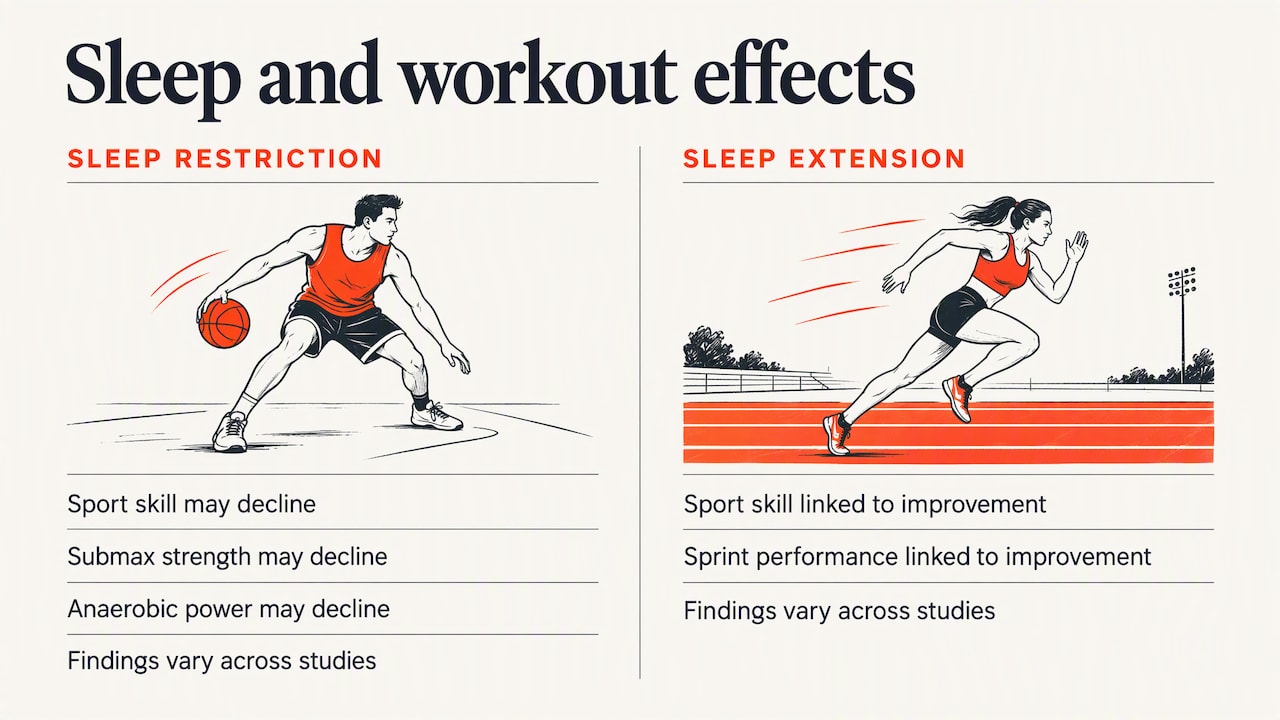
That variation is worth respecting. Some people lift almost normally after a bad night, then fall apart after three. Maximal single efforts can hold up better than repeated sets or technical skill, which is one reason a poor night may not wreck a heavy single but can still make a long session feel awful.
Training load plus short sleep
One of the top-ranked papers on sleep and exercise-induced muscle injury makes a point that deserves attention: the risk of muscle injury rises when sleep duration drops while training load goes up at the same time. Sleep and load are linked. Ramping volume during a short-sleep stretch, such as exam week, a newborn, or a work deadline, is the riskiest combination.
What to expect after a single bad night
One rough night is not a disaster. Most lifters can still train, and you often do better by keeping the session but trimming the extras: fewer back-off sets, a little less intensity on the hardest lifts, and no new personal-record attempts. If you are sleeping badly for several days in a row, that is when a planned lighter week makes sense.
How much sleep do you need for muscle recovery?
The common adult guideline is 7 to 9 hours. That is where most people should aim. But the same BJSM review argues that a one-size-fits-all recommendation of 7 to 9 hours is unlikely to be ideal for athletes, and that advice should take the athlete’s own perceived sleep need into account.
It also describes a small study in which endurance performance was better after three nights of about 8.4 hours of sleep than after habitual sleep of about 6.8 hours. It was a small study, so treat it as a hint rather than a rule. The point is that many people who think they are fine on under seven hours may be performing below what they could.
Is 7 hours enough?
For many people, yes. If you wake up without an alarm fighting you, your lifts are progressing and your mood is stable, seven hours may be your number. If you are training hard, waking tired and stalling on lifts, try gaining 30 to 60 minutes in bed for a couple of weeks and see what changes.
Is 5 hours bad for recovery?
Five hours is well below the guideline for adults, and the evidence above suggests sleep restriction hurts several qualities that matter to lifters. You will find blog posts quoting precise hormone changes from two weeks of 5.5 hours of sleep. Treat exact percentages with caution unless you can trace them to a peer-reviewed paper. What the more careful literature supports is the direction: less sleep, more protein breakdown, poorer performance.
Exercise does not fully cancel this out either. Training can act as a signal that partly offsets the effect of sleep loss on muscle protein building, but the reviewers describe it as unable to replace what enough sleep provides.
Ways to sleep better when you train hard
Big changes are rarely needed. Start with the basics.
- Fix the room. The BJSM review recommends improving the sleep environment by removing light, technology and noise. Blackout curtains, a cool room and the phone on the other side of it are cheap and effective.
- Keep a regular window. A consistent bedtime and wake time helps more than occasionally sleeping long on weekends.
- Use a short nap when you need one. The same review notes that 20 to 30 minute naps can improve sprint performance and peak jump velocity. Keep it short and not too late in the day, so it does not eat into night sleep.
- Spread your protein. An academic review on sleep and athletic performance notes that the best protein intake under sleep stress is still being studied. Reasonable per-meal protein (for example 0.4 g/kg) and consistent distribution across the day may help limit the muscle’s reduced response to protein after poor sleep.
- Schedule hard sessions with sleep in mind. If your week has a bad-sleep night coming, put the heaviest lifting before it or after it, not on top of it.
There is active research here. A 2024 U.S. Army study registered as recovery protein nutrition after sleep loss is testing whether spreading 1.6 g/kg/day of protein evenly supports muscle protein synthesis better than a skewed distribution during recovery from sleep loss. The results are not a reason to change your plan today, but they show where the science is heading.
Banking sleep and extension
Sleeping extra before a hard block (banking sleep) is a popular idea, but the BJSM authors say more research is needed on napping and sleep extension, including banking. Do it if it is easy and feels good, and do not rely on it to make up for chronic short sleep.
Tracking sleep: useful, but not the full picture
Tracking can reveal patterns you would never notice: a rough week of sleep followed by flat lifts, or a consistent late bedtime before your Monday session. It is one of the best uses of the watch on your wrist.
But be honest about what the numbers are. The BJSM review notes that sleep can be assessed with diaries, questionnaires and devices, that polysomnography in a lab is the gold standard, and that consumer devices have limits.
A 2025 study of masters endurance athletes, comparing consumer smartwatches and diaries with research-grade actigraphy, found that watches and diaries tended to overreport total sleep time and sleep efficiency. The authors noted this could give a misleading sense of recovery. A broader review of consumer sleep technology reports the same pattern: devices detect sleep well but are less accurate at spotting wakefulness after you drift off, so they tend to overestimate sleep duration.
How to use sleep data sensibly
- Trust trends over single nights. A watch that reads 7h 20m may be overestimating, but if it reads 6h 10m for five nights, it is probably telling you something real.
- Add a subjective score. Rate how rested you feel from 1 to 5 each morning. The athlete’s perceived need is exactly what the research says should shape advice.
- Look at performance. The best recovery signal for a lifter is still the bar: are your reps and weights moving the way they should?
- Combine metrics. Sleep, resting heart rate and training results together tell a more reliable story than any one of them.
When to adjust the workout, and when to see a professional
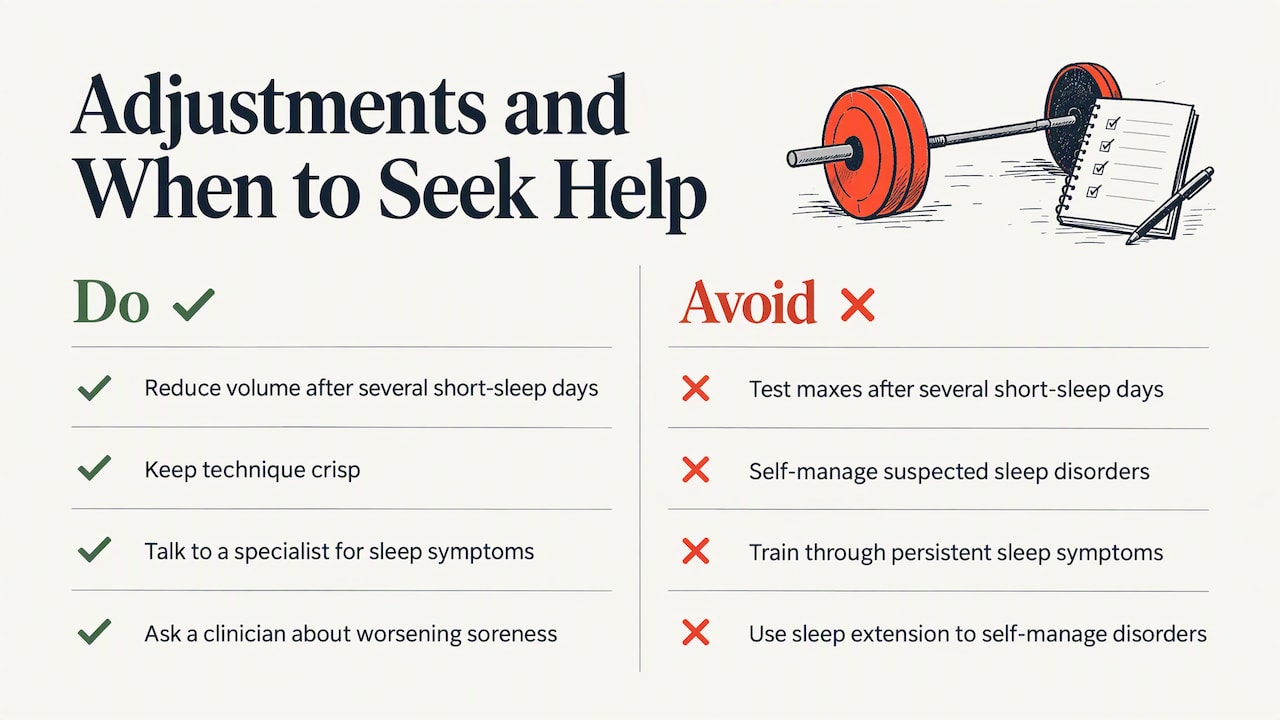
Simple adjustments are enough for most people. When your sleep has been short for several days and your lifts feel heavy, reduce volume, keep the technique crisp and avoid testing maxes. When the sleep returns, so does the intensity.
Some situations call for more than a tweak. The BJSM review says athletes with signs of moderate to severe sleep disorders, such as insomnia, should be referred to a sleep specialist instead of self-managing with sleep extension strategies, which could make an underlying problem worse. If you struggle to fall asleep or stay asleep most nights, snore heavily and wake unrefreshed, or feel exhausted despite spending enough time in bed, talk to your doctor or a sleep specialist. Do not try to train through it.
Similarly, if a muscle pain or soreness keeps getting worse over days rather than easing, that is a question for a physician or athletic trainer, not an app.
Perspective: recovery is data you should act on
We build Athlxpro for people who lift, so we spend a lot of time thinking about why a program that looks perfect on paper fails in real life. Most of the time it is not the exercise selection. It is that the plan ignores how the person actually slept, ate and felt this week.
Our view is simple. A training plan should respond. If you report a session as too easy, the next weights should go up. If it felt too heavy, they should come down. Sleep and heart rate are context for that decision, and they are most useful when you read them next to your own feedback rather than as a verdict from a single score.
We also think lifters should be skeptical of any tracker, ours included, that presents sleep numbers as exact. The research is clear that wearables lean optimistic. So we treat sleep and heart rate as one input among several: the sets you logged, the weights you moved and how you rated the session. When those agree, you can trust the picture. When they disagree, trust the bar and your body, and go see a professional if something seems off.
Putting sleep and training in one place with Athlxpro
If you want to see how your sleep lines up with your training, Athlxpro is a strength training app for iPhone and Apple Watch. You log sets instantly from your wrist, rate how a session felt, and the app adjusts your weights based on that feedback. It also brings in sleep and heart rate metrics, so you can look at recovery next to the work you actually did. Our AI coach, Alex, gives advice on training and nutrition based on your data, and you can export reports to share with a coach.
Subscriptions are monthly or yearly through Apple’s App Store, and you start with a one-week trial. You can see the plans on the Athlxpro site.
A simple weekly routine for lifters
Here is how this can look in practice for someone training three or four days a week.
| Situation | What to do with training | What to do with sleep |
|---|---|---|
| Slept well, feel good | Follow the plan, push the main lifts | Keep your usual schedule |
| One short night | Train as planned, skip max attempts and extra volume | Go to bed earlier, consider a 20 to 30 minute early-afternoon nap |
| Several short nights | Cut volume for the week, keep technique sharp | Fix the room, protect the same bedtime and wake time |
| Sleep problems most nights | Keep training modest | See your doctor or a sleep specialist |
The goal is not perfect nights. It is noticing a pattern early enough to change it before it costs you weeks of progress.
FAQ
How does sleep help muscle recovery?
Deep sleep is linked to growth hormone release, and sleep deprivation appears to increase muscle protein breakdown. Together, that suggests sleep helps the repair and rebuilding that follows training. The research uses cautious language, so think of sleep as strongly supportive rather than a single magic switch.
How many hours of sleep do you need for muscle recovery?
Most adults are advised to get 7 to 9 hours. Sports medicine researchers note that a single range is unlikely to be ideal for every athlete and that your own perceived sleep need should count. If you are training hard and feel flat, try adding 30 to 60 minutes in bed for two weeks.
Is 5 hours of sleep bad for muscle recovery?
Five hours is well under the adult guideline, and sleep restriction can reduce strength, power and skill, although results vary. Exercise can partly offset the effect on muscle protein building but not replace enough sleep. If short nights are frequent, treat it as a recovery problem and lower your training volume.
Can a sleep tracker tell me if I have recovered?
It can show useful trends, but not a verdict. Studies find consumer devices tend to overestimate sleep time and efficiency, which can make you feel more recovered than you are. Use the data alongside how rested you feel and how your lifts are going.
When should I see a doctor about my sleep?
If you have trouble falling or staying asleep most nights, or you feel exhausted even after enough time in bed, see your doctor or a sleep specialist. Sports medicine guidance says athletes with moderate to severe sleep disorders such as insomnia should be referred to one rather than trying to fix it with extra sleep time.
Sources
- Sleep and muscle recovery: current concepts and empirical evidence
- Sleep and recovery in athletes, British Journal of Sports Medicine (2021)
- Sleep and athletic performance: a multidimensional review
- Recovery protein nutrition as a countermeasure for anabolic resistance, ClinicalTrials.gov
- Agreement between research-grade actigraphy and consumer devices in masters endurance athletes (2025)
- The good, the bad, and the ugly of consumer sleep technologies