
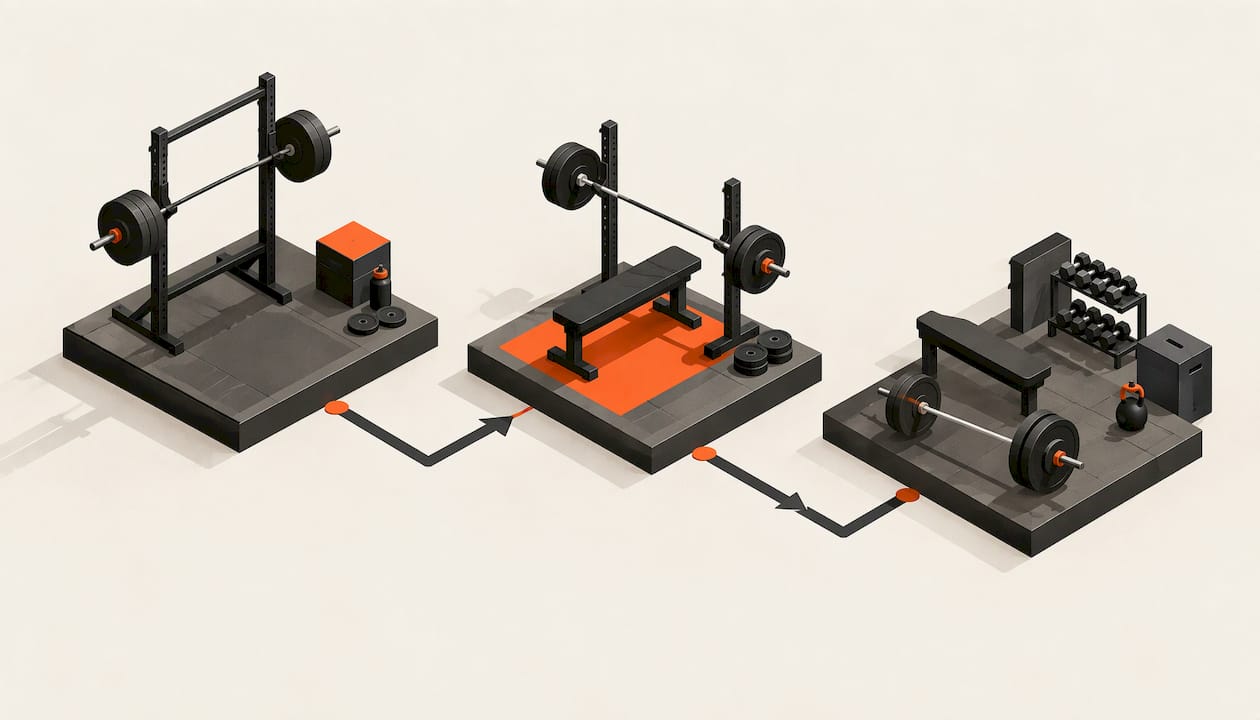
The best beginner lifting plan is a full-body routine you can repeat three days a week, built on a handful of big lifts, with a small weight increase whenever the last session felt manageable. Nothing fancier is needed. Below you get the exact plan, how to choose your starting weights, how to progress, and how an app can take the bookkeeping off your plate.
TL;DR
- Train the whole body three days a week, with at least a day of rest between sessions. Beginners should leave 1 to 3 days between resistance-training sessions.
- Build each session around 5 or 6 compound lifts: a squat, a press, a row, a hinge and a pull.
- Start light, stop with a rep or two in reserve, and add weight only when the last session felt under control.
- Consistency in the first month matters most: a 2026 study of app users found it was the strongest predictor of long-term adherence.
- An app that remembers last week’s weights saves you from starting from scratch every session.
Table of Contents
- Why a full-body routine suits beginners
- How many days a week, and how to space them
- The 3-day beginner lifting plan
- How much weight to start with
- How to add weight over time
- Effort, rest and recovery
- Adjusting the plan to your goals, equipment and schedule
- What to look for in a beginner weightlifting app
- How Athlxpro runs this plan for you
- A four-week roadmap
- FAQ
- Sources
Why a full-body routine suits beginners
When you are new, every lift is a skill. The fastest way to learn a skill is to practice it often. A full-body routine hits each movement pattern three times a week instead of once, so your squat, press and row all get regular practice while you recover between sessions.
It is also forgiving. Miss a Wednesday and you have not skipped “chest day” for the week. You simply do the next session as planned.
The national baseline is modest. The CDC says adults need at least 2 days of muscle-strengthening activity each week. Three days gives you room to improve technique and still have a buffer if life gets in the way.
How many days a week, and how to space them
Three non-consecutive days is the cleanest setup: Monday, Wednesday, Friday, or any pattern with a rest day between sessions. That matches the guidance above of 1 to 3 days between sessions for beginners.
Two days a week also works if your schedule is tight. You will progress a little slower, but you will progress. Athlxpro programs run from 1 to 6 days a week, so the plan can follow your calendar rather than the other way around. Most beginners do best starting at two or three days and adding more only after a couple of months of steady training.
| Schedule | Best for | Pattern |
|---|---|---|
| 2 days | Very busy weeks, getting started | Mon and Thu |
| 3 days | Most beginners | Mon, Wed, Fri |
| 4 days | After 2 to 3 months of steady training | Upper and lower alternating |
The 3-day beginner lifting plan
Alternate two full-body sessions, A and B, so you do A, B, A one week and B, A, B the next. The order follows a standard principle: large muscle groups and multi-joint exercises come before smaller, single-joint ones, so your best effort goes to the lifts that matter most.
Workout A
| Exercise | Sets x reps | Rest |
|---|---|---|
| Squat (goblet or barbell) | 3 x 8 | 2 to 3 min |
| Bench press or push-up | 3 x 8 | 2 to 3 min |
| Seated cable row or dumbbell row | 3 x 10 | 2 min |
| Plank | 3 x 30 sec | 1 min |
Workout B
| Exercise | Sets x reps | Rest |
|---|---|---|
| Romanian deadlift | 3 x 8 | 2 to 3 min |
| Overhead press | 3 x 8 | 2 to 3 min |
| Lat pulldown or assisted pull-up | 3 x 10 | 2 min |
| Biceps curl and triceps pushdown | 2 x 10 each | 1 min |
This is a starting template, not the only correct answer. One published beginner guide suggests 3 to 5 sets of 5 to 8 reps for compound lifts, then 2 to 3 sets of 8 to 12 reps for isolation work. The plan above sits in that neighborhood, with slightly higher reps on compounds because they give you more practice with each movement while the weight is light.
How long a session takes
Plan on roughly an hour. One beginner routine puts a full-body session at 50 to 65 minutes including warm-ups, with 2 to 3 minutes of rest between heavy compound sets. Those long rests are not wasted time. They let you lift the next set properly.
If you only have 40 minutes, drop the last accessory exercise rather than rushing your rest on the big lifts.
Warm up
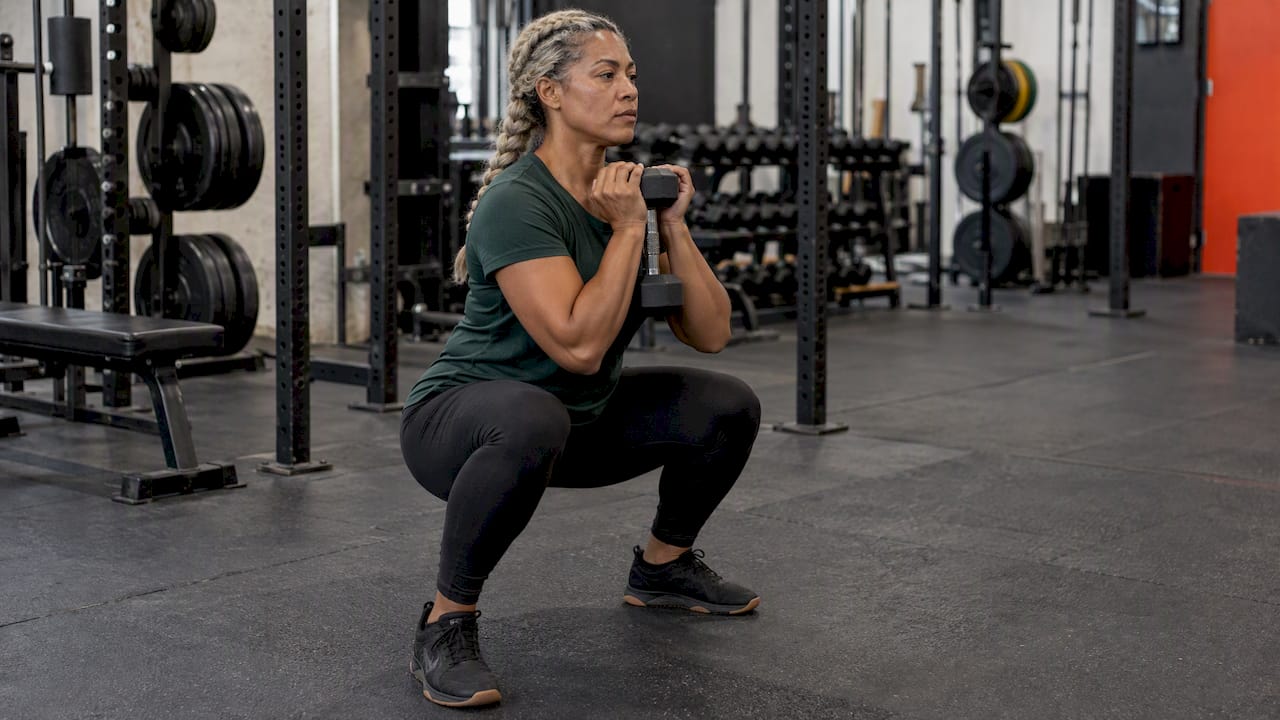
Spend five minutes on easy movement, then do one or two light sets of your first lift before the working sets. For a squat, that might be an empty bar or a light dumbbell for 8 reps, then a medium weight for 5.
How much weight to start with
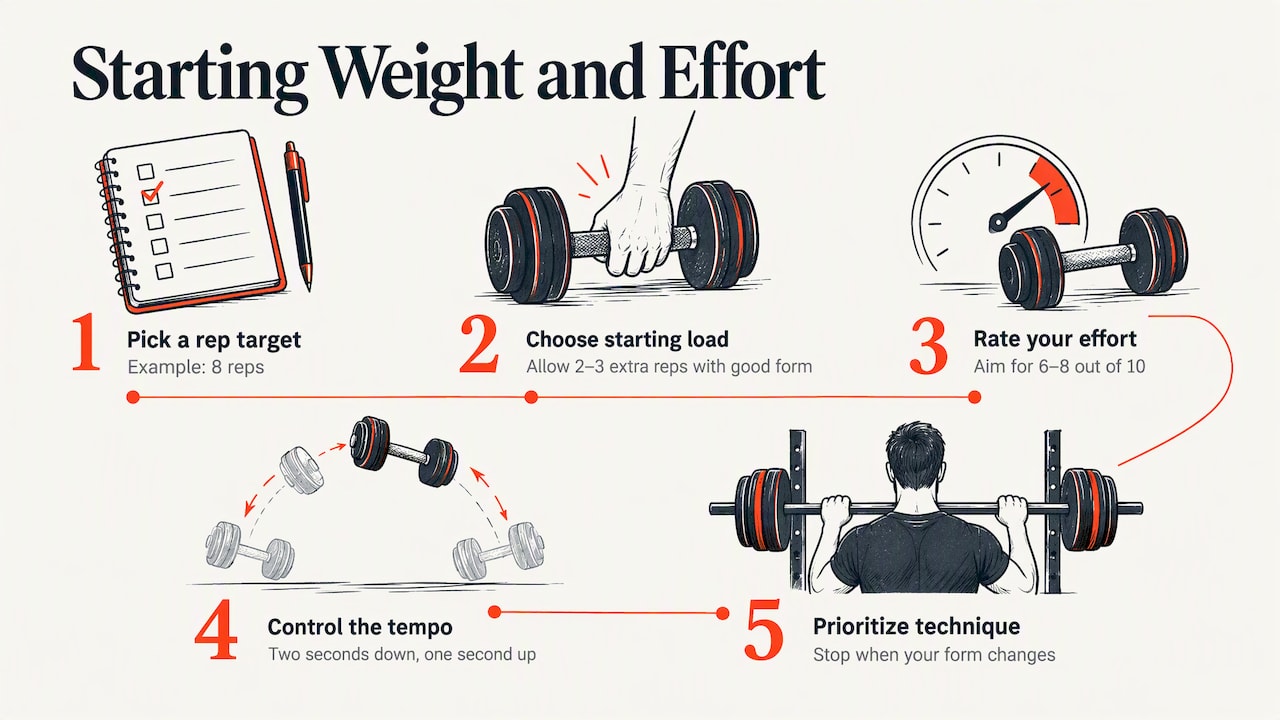
Pick a weight you could lift for 2 or 3 more reps than the number written. If the plan says 8 reps, choose a load that would let you reach 10 or 11 with good form. This is the idea behind effort-based training: you judge a set by how hard it felt, not by an arbitrary number.
A simple scale helps. Rate each set from 1 to 10, where 10 is nothing left. Beginners should live around 6 to 8 on most sets. Coaches use this kind of rating, called RPE, to manage loading and fatigue, because it reflects how you are actually doing that day, which the weight on the bar cannot tell you.
Technique comes first. NASM advises beginners to prioritize range of motion and technique over adding load, using slow, controlled tempos while learning. Count two seconds down and one up, and stop a set when your form changes.
How to add weight over time
Effective programs rely on progressive overload, specificity and variation. For you, that boils down to one rule: do a little more than last time, only when you can do it well.
Here is a practical double-progression method:
- Pick a rep range, such as 8 to 10 reps.
- Start at the bottom with a weight that feels like a 7 out of 10.
- Each session, try for one more rep on each set.
- When all sets hit the top of the range and still felt controlled, raise the weight by the smallest jump available (often 2.5 to 5 pounds) and drop back to the bottom of the range.
- If a session felt rough, repeat the same weight. That is not failure; it is how you keep the streak alive.
Most beginners can add load for several weeks in a row on the big lifts. When progress stalls on one exercise for three sessions, take a lighter week or swap in a close variation, such as a dumbbell press for a barbell press.
Effort, rest and recovery
Going all out every session is the most common beginner mistake. NASM’s guidance is that beginners should avoid maximum effort every session and allow rest days, since adaptation happens during recovery.
Three habits keep you recovering well:
- Leave reps in the tank. One or two good reps in reserve on most sets is plenty.
- Protect your sleep. Poor nights change how a session feels, which is why we wrote about sleep and muscle recovery.
- Treat soreness as information. Mild soreness in your first weeks is normal. Sharp or joint pain is a reason to stop that exercise and see a physician or physical therapist.
If you have a heart condition, a recent injury or any medical concern, check with your doctor before starting a lifting program.
Adjusting the plan to your goals, equipment and schedule
The template flexes. Research on training progression notes that beginners can tailor exercise choice to their goals and available equipment, emphasize multi-joint movements and vary program variables over time.
- Limited equipment: swap barbell lifts for dumbbell or machine versions. A goblet squat, dumbbell press and dumbbell row cover the same patterns.
- Strength focus: keep reps lower on compounds and rest longer.
- Muscle size focus: add an extra set of accessories and use the 8 to 12 rep range.
- Short on time: train two days and keep only the five big lifts.
Once you have three or four months behind you, you can move to a split. Our breakdown of the Dorian Yates training program shows what a high-intensity split looks like, though it is a long way up from where you begin.
What to look for in a beginner weightlifting app
You can run this plan from a notebook. An app helps with the part notebooks do badly: remembering what you lifted last Thursday and deciding what to lift today.
Research is encouraging. A 2025 randomized controlled trial found that in-person supervision produced better strength and body composition results, but that app-guided resistance training is a viable alternative when supervision is not feasible.
Look for these features:
- Fast logging. If entering a set takes more than a few seconds, you will skip it.
- Weight suggestions. The app should tell you what to lift next, based on your last session and how hard it felt.
- Exercise videos. You need to see how the movement is done.
- Progress charts. Seeing weight and volume climb is what keeps you going in week six.
- Wrist-based use. Logging from a watch keeps your phone in your bag.
- Clear privacy rules. Apps using HealthKit are not allowed to use health data for advertising, and you choose which data types an app can read.
Consistency is the reason this matters. In that 2026 study of 389,481 app users, early consistency was the strongest adherence predictor, yet only 10.1% of beginners were still adherent at 12 months. Anything that makes your first 28 days easier is worth having.
How Athlxpro runs this plan for you
Athlxpro is a strength training app for iPhone and Apple Watch. It sets your next weight and reps from your last session and how hard it felt, so you never have to remember last week’s numbers. It also reads your morning check-in: on a bad morning it holds the weight or takes a set off.
Here is what matters for a beginner:
- You log a set in one tap, and a full workout can run on Apple Watch once the plan is on the watch.
- Programs are built on progressive overload and effort-based training, and they run 1 to 6 days a week.
- 577 exercise videos show you how each lift should look.
- Weight and volume charts, records, awards, XP and levels make progress visible.
- Training, food, sleep, steps and heart rate sit on one screen. Alex, our AI coach, sees them, and Apple Health data is shared only with your consent.
- Log food by photo (an AI estimate) or by barcode.
- There are no ads and no analytics SDKs, and health data is never used for ads.
Athlxpro is a subscription, billed monthly or yearly through the App Store. You can see the plans and get started on the Athlxpro page.
A four-week roadmap
| Week | Focus |
|---|---|
| 1 | Learn the lifts with light weights. Stop every set with 3 reps in reserve. |
| 2 | Add a rep per set where form holds. Find the weights that feel like a 7 out of 10. |
| 3 | Make your first small weight jumps on the lifts that are ready. |
| 4 | Keep progressing, repeat any weight that felt heavy, and review your first month of logs. |
The goal for the month is simple: show up for every planned session. Weights and shape follow from that.
FAQ
How many days a week should a beginner lift?
Two or three days a week is enough for most beginners, with a rest day between sessions. Guidance for beginners is to leave 1 to 3 days between resistance-training sessions. Add days later only if recovery feels easy.
Should beginners do full-body workouts or a split?
Full body is the easier starting point. It lets you practice each lift several times a week and makes a missed day cost almost nothing. A split can come after a few months, when you want more volume per muscle group.
How do I know when to increase the weight?
Raise the weight when you reach the top of your rep range on every set and the last reps still looked clean. Use the smallest jump you can. If the session felt harder than usual, repeat the same weight.
Can an app replace a coach?
In-person supervision produced better results in a 2025 trial, but app-guided training was still a viable option when supervision is not available. An app is best used to log, plan and progress consistently.
Sources
- Determination of Resistance Training Frequency (NSCA)
- Adult Activity: An Overview (CDC)
- ACSM Position Stand: Resistance Training Progression Models
- Progression models in resistance training for healthy adults (ACSM position stand)
- Ask the trainer: starting to lift weights (UC Berkeley)
- Beginner Full Body Workout: 3 Days a Week
- Strength Training Routines for Beginners (NASM)
- The Beginner Prescription (RPE and loading)
- Optimizing resistance training outcomes: app-guided training trial, 2025
- Protecting access to users’ health data (Apple Support)
- Predictors of long-term resistance exercise adherence (Frontiers, 2026)