
Three days a week is enough to build muscle and strength, and the best 3 day split for most people is a full-body routine run on alternating days, such as Monday, Wednesday and Friday. Push/pull/legs, upper/lower and body-part layouts also work on three days. The right one depends on how much weekly volume each muscle gets, how you recover and which schedule you will actually keep.
Below you will find the evidence on frequency, four sample weeks, sets, reps and rest numbers, a way to progress each lift, and the mistakes that stall most three-day lifters.
TL;DR
- Three weekly sessions work. When total volume is matched, training frequency does not meaningfully change muscle growth.
- Full body (A/B/A, then B/A/B) is the default pick for beginners and most intermediates. Push/pull/legs and upper/lower suit lifters who want shorter or more focused sessions.
- Aim for about 10 hard sets per muscle group per week for growth, and keep a rest day between sessions.
- Progress by adding reps first, then load. Add weight once you beat your target reps by one or two on two sessions in a row.
- Pick the plan you will stick with. Consistency and effort matter more than a clever layout.
Table of Contents
- Can three days a week build muscle?
- The four 3 day split structures
- Plan 1: Full body, three days
- Plan 2: Push/pull/legs, three days
- Plan 3: Upper, lower and full body
- Plan 4: Body-part split on three days
- How to choose your split
- Placing your three days and your rest days
- Sets, reps and rest that fit three days
- How to progress week to week
- Mistakes that stall three-day lifters
- Running your 3 day split in Athlxpro
- FAQ
- Sources
Can three days a week build muscle?
Yes. The strongest evidence says weekly volume matters more than how you carve it up. A 2019 meta-analysis found that resistance-training frequency does not significantly affect hypertrophy once volume is equated. A 2019 study in trained young men reached the same conclusion: training muscle groups two or three times a week produced similar gains in strength and size when volume matched.
Volume still counts. A 2017 meta-analysis describes a graded dose-response: more weekly sets, more growth. A 2018 review adds that higher frequency helps mostly because it is a practical way to fit in more volume. So on three days you are not at a disadvantage. You just have fewer sessions in which to place your sets, so each session has to be well planned.
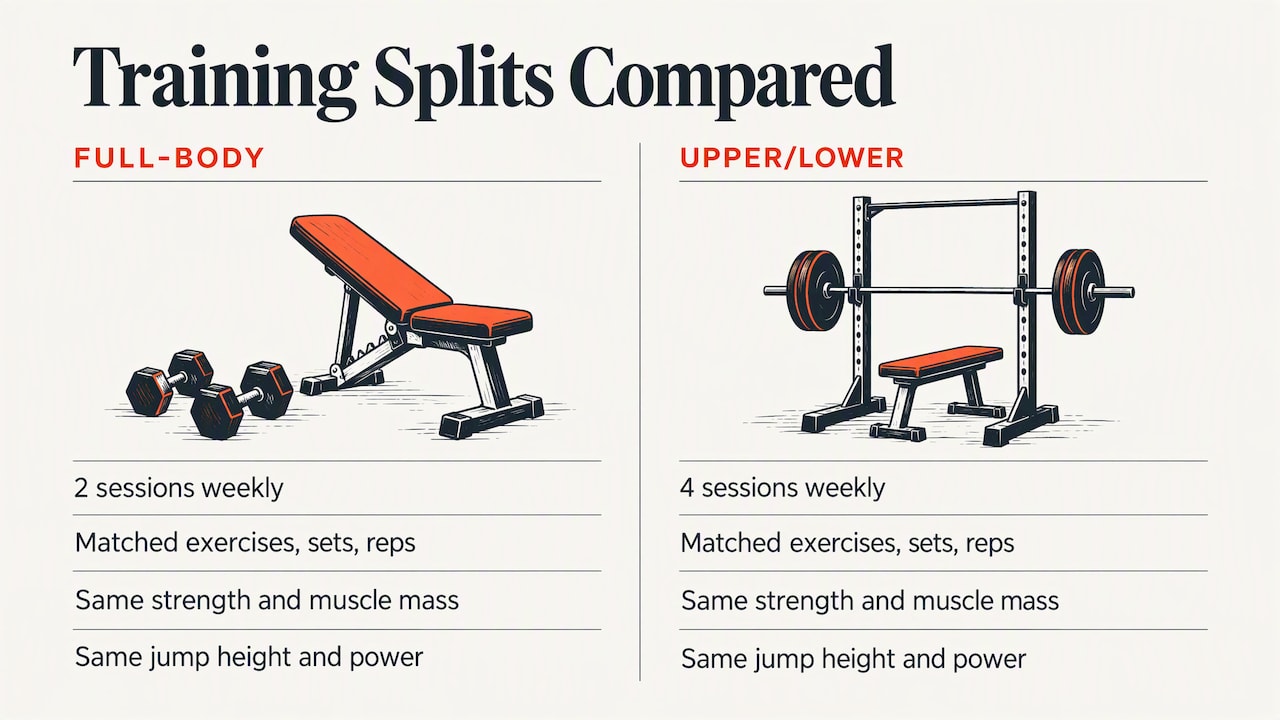
Split type matters even less than people think. In a randomized 12-week trial of 50 untrained women, an upper/lower split over four sessions showed no significant advantage over a full-body routine done twice a week when exercises, weekly sets and reps were matched. Strength, muscle mass, jump height and power came out the same.
The American College of Sports Medicine says in its 2026 update that the biggest gain comes from moving from no resistance training to any resistance training, and that consistency and effort drive results more than complex plans. For general health, the World Health Organization recommends muscle-strengthening work on major muscle groups on two or more days a week. Three sessions clears that bar.
The four 3 day split structures
Every three-day plan is a variation of four layouts. Here is how they differ.
| Split | What each session trains | Times each muscle is hit per week | Best for |
|---|---|---|---|
| Full body | Upper body, lower body and core every session | About 3 | Beginners, busy lifters, anyone who may miss a day |
| Push/pull/legs | Day 1 pushing, day 2 pulling, day 3 legs | About 1 | Lifters who like focused sessions with more exercises per muscle |
| Upper/lower/full | Upper, lower, then a full-body day (or alternating each week) | 1 to 2 | Intermediates who want a middle path |
| Body part | One or two muscle groups per session | About 1 | Experienced lifters chasing high volume per muscle |
A full-body routine trains every region each session and leans on compound lifts. Push/pull/legs groups work by movement pattern. Upper/lower alternates halves of the body. Body-part routines give each session to one or two muscles, usually hitting each about once a week. A summary of common split types describes the same four groupings.
The frequency column is the real difference. With only three sessions, push/pull/legs and body-part plans train each muscle once a week. That can still work if you pack in enough sets, but full body and upper/lower/full spread the same volume across more exposures, which makes each session lighter and easier to recover from. ACSM’s progression guidance also says that recommended frequency depends on volume, intensity, exercise selection, training level and recovery, so no single layout wins for everyone.
Plan 1: Full body, three days
This is the plan most people should start with. Alternate two sessions so the week reads A, B, A, then B, A, B the next week.
Workout A
- Squat, 3 sets of 6 to 8
- Bench press, 3 sets of 6 to 8
- Seated cable row, 3 sets of 8 to 10
- Romanian deadlift, 2 sets of 8 to 10
- Plank, 2 sets
Workout B
- Deadlift or trap-bar deadlift, 3 sets of 5 to 6
- Overhead press, 3 sets of 6 to 8
- Pull-up or lat pulldown, 3 sets of 8 to 10
- Split squat, 2 sets of 8 to 10 per leg
- Dumbbell curl and triceps pressdown, 2 sets each
Each muscle group gets roughly 6 to 9 hard sets in a week from the main lifts, plus extra from the assistance work. Add a set or two to the lagging areas after a few weeks to move toward the volume targets below. Our beginner 3-day full-body routine lays this approach out in more detail for people new to lifting.
Plan 2: Push/pull/legs, three days
Run one push day, one pull day and one leg day each week. Sessions are longer and more focused, with room for several exercises per muscle.
| Day | Main lifts | Accessories |
|---|---|---|
| Push | Bench press 4 x 6 to 8, overhead press 3 x 8 | Incline dumbbell press, lateral raise, triceps pressdown |
| Pull | Barbell row 4 x 6 to 8, pull-up 3 x 8 | Face pull, curl variations, rear delt work |
| Legs | Squat 4 x 6 to 8, Romanian deadlift 3 x 8 | Leg press, leg curl, calf raise |
The tradeoff is frequency: each muscle trains once a week, so a missed session means a muscle goes two weeks without work. If your week is unpredictable, full body forgives more.
Plan 3: Upper, lower and full body
This hybrid gives you one upper day, one lower day and a third day that mixes both. Many lifters alternate the order each week (upper, lower, full, then lower, upper, full), so every region lands twice in some weeks and once in others, and averages out to about 1.5 times.
- Upper day: bench press, row, overhead press, pulldown, arms.
- Lower day: squat, hip hinge, lunge, leg curl, calves.
- Full day: one lift from each pattern, kept lighter than on the dedicated days.
It suits intermediates who feel full-body sessions get too long once they add exercises. Research on split versus full-body routines found matched volume gives matched results, so choose by preference, not by promise.
Plan 4: Body-part split on three days
A body-part week might look like chest and triceps, back and biceps, then legs and shoulders. Each session carries many sets for few muscles, and each muscle is trained once a week. This is the old-school bodybuilding approach. If you want to see the extreme end of it, read our breakdown of the Dorian Yates split, a low-frequency, high-intensity style.
It is not the first choice for beginners, because skill practice benefits from frequent repetition, and a once-a-week pattern is slow to groove.
How to choose your split
Use these filters in order.
- Experience. ACSM’s progression guidance says beginners should train the whole body two to three days a week, and intermediates may use three to four days, including three full-body days. If you have trained less than a year, choose Plan 1.
- Schedule reliability. If you sometimes lose a day, pick full body. Missing one session still leaves every muscle trained.
- Session length. Full body with 5 exercises runs about 45 to 60 minutes. Push/pull/legs and body-part sessions run longer.
- Preference. The 2026 ACSM pronouncement stresses individualizing training around goals, enjoyment and safety to support long-term adherence. A plan you enjoy beats one that looks optimal on paper.
- Moving up. ACSM’s guidance notes that going from novice to intermediate does not require changing frequency. You can focus on exercise selection, volume and intensity instead. You may never need to leave a three-day plan.
Placing your three days and your rest days
Space sessions so you rest a day between them. Monday, Wednesday and Friday is the classic pattern. Tuesday, Thursday and Saturday works the same. If your week is tight, Monday, Thursday and Saturday also works, as long as you are not stacking hard lower-body days back to back.
The off days are not wasted. Easy walking, mobility work or a day off all help you arrive at the next session ready to lift. Sleep is the other half of recovery, and we covered it in sleep and muscle recovery.

If you want to train on more days later, you can. In Athlxpro, plans run from 1 to 6 days a week, so moving from three days to four does not mean starting over.
Sets, reps and rest that fit three days
The numbers below come from ACSM guidance.
- Muscle growth: the 2026 ACSM pronouncement points to about 10 sets per muscle group per week to optimize results.
- Strength: the same document recommends heavier loads, around 80% of one-repetition max, for 2 to 3 sets per exercise.
- Novices: the 2002 ACSM position stand suggests 8 to 12 repetition-maximum loads and 2 to 3 days per week.
- Rest: the same position stand puts heavy multi-joint lifts at 2 to 3 minutes of rest and assistance exercises at 1 to 2 minutes.
A worked example: on full body three times a week, doing 3 to 4 sets of a quad-dominant lift each session gives 9 to 12 weekly sets for that area. On push/pull/legs, you would need all 10 sets in one session, so choose three or four exercises for each muscle on its day.
How to progress week to week
Progression is what turns a plan into results. ACSM describes progression as raising load, adding reps, adjusting rest or adding volume within reasonable limits, per the 2002 position stand. The practical rule from the ACSM progression guide: when you beat your target reps by one or two on two consecutive sessions, raise the load.
Here is how that plays out on a bench press with a target of 3 sets of 8:
- Week 1: 135 lb, you hit 8, 8, 8 and the last set felt hard.
- Week 2: same weight, you hit 9, 9, 8. Keep the weight.
- Week 3: same weight, 10, 9, 9. That is more than one or two reps over target, twice running, so move up.
- Week 4: new weight, reps drop back toward 8, and you start climbing again.
Two habits keep this honest. Write down every set so last week’s numbers are always in front of you, and rate how hard each set felt. A set that left you two reps short of failure is productive, and one grinding to a halt is not something to repeat every week. ACSM notes that training to momentary failure and complex periodization did not consistently change outcomes for the average healthy adult, so you do not need to max out each set.
On a rough day, hold the weight or drop a set. That is not quitting, it is adjusting. The same guidance on moderate starts and gradual progress applies: the WHO says a moderate start with gradual progress is appropriate to reduce the risk of musculoskeletal injury. If you have pain that sharpens during a lift, a joint condition or a medical issue, check with a physician or physical therapist before pushing loads up.
Mistakes that stall three-day lifters
- Too many exercises per session. Three sessions tempt you to cram. Five to six well-chosen lifts beat ten rushed ones.
- Changing the plan every few weeks. Run a plan for at least 8 to 12 weeks before judging it.
- Skipping the log. Without last week’s numbers, progressive overload loses its starting point.
- Chasing advanced methods too early. A 2026 systematic review says advanced training systems should be chosen based on goals, constraints and preferences, not expected to beat simple approaches for everyone.
- Training back to back on hard days. Keep a rest day between sessions.
- Chasing the perfect plan. ACSM’s 2026 update quotes a leading researcher saying the best program is the one you stick with, and that training major muscle groups at least twice a week matters more than perfection.
Running your 3 day split in Athlxpro
Athlxpro is a strength training app for iPhone and Apple Watch, built on progressive overload and effort-based training. It sets your next weight and reps from your last session and how hard it felt, and it adjusts to your morning check-in: on a bad morning it holds the weight or takes a set off. You log a set in one tap, and a full workout can run on Apple Watch once the plan is on the watch.
The app includes 577 exercise videos, weight and volume charts, records, awards, XP and levels. Alex, our AI coach, sees your training, food, sleep, steps and heart rate, and the Apple Health data needs your consent. Athlxpro is a monthly or yearly subscription through the App Store, with a one-week trial first. See the monthly and yearly plans to set up your three days.
FAQ
What is the best 3 day weight training split?
For most people it is a full-body split, run as A/B/A one week and B/A/B the next. It trains every muscle three times a week, tolerates missed sessions and matches ACSM’s beginner and intermediate guidance. Push/pull/legs and upper/lower are solid alternatives when you prefer focused sessions.
Is 3 days of strength training enough to build muscle?
Yes. Research finds that when weekly volume is matched, training frequency makes little difference to hypertrophy. Aim for about 10 hard sets per muscle per week, progress your loads, and keep up the habit.
What is the 3-3-3 rule for workouts?
It is not an established research guideline, and versions vary, so treat it as a rule of thumb. A more reliable frame is three sessions a week, a rest day between them, and 2 to 3 sets for each main lift.
Can I do a 3 day split on consecutive days?
You can, but it works best with a rest day between sessions to allow recovery and adaptation. If you must train back to back, make sure the sessions hit different regions, as in push, pull, then legs, and keep each one moderate.
Sources
- WHO EMRO: Recommended levels of physical activity for health
- How many times per week should a muscle be trained to maximize hypertrophy (2019 meta-analysis)
- Similar muscular adaptations in resistance training performed two versus three days per week (2019)
- Effect of resistance training frequency on gains in muscular strength (2018 review)
- Dose-response relationship between weekly resistance training volume and hypertrophy (2017)
- Randomized trial of split-body versus full-body routines (2022)
- ACSM: Updated resistance training guidelines (2026)
- ACSM: Resistance training prescription for muscle function (2026)
- ACSM: Progression models in resistance training for healthy adults (2002 position stand)
- ACSM: Progression models in resistance training, simplified (2009)
- Effects of advanced resistance training systems on muscle (2026 review)
- Best workout splits: types of splits explained