
To track workouts, write down the same few things after every session: the exercise, the weight, the sets, the reps, and how hard it felt. Then look back at the last session before you start the next one. That is the whole system. A notebook, a spreadsheet or an app can all do it. What matters is that you record the same details every time and use them to decide what to do next.
This guide covers what to log, how to log it quickly, how to read your numbers, and how to keep going when your week gets crowded.
TL;DR
- For lifting, log the weight, sets and reps for every exercise. For cardio, log how often, how hard and how long.
- Add one effort rating per exercise or session. Numbers alone hide whether a set was easy or a grind.
- Look at your last session before you train, and add reps first, then weight, once you hit the top of your rep range.
- Pick the method you will actually use. A log you skip is worse than a simple one you keep.
- Review once a week: spot personal records, stalls and missed sessions.
Table of Contents
- Why a workout log is worth the two minutes
- What to record every session
- Add how hard each set felt
- Track the conditions around the session
- Choose your method: notebook, spreadsheet or app
- Turn the log into progress
- How to recognize a personal record
- Keep the habit when you are busy
- Tracking workouts with Athlxpro
- FAQ
- Sources
Why a workout log is worth the two minutes
Most people who train without a log rely on memory. Memory is bad at this. You remember that bench felt heavy, but not whether you did 135 pounds for 8 or for 9 last Tuesday. Without that number, you cannot tell if you are progressing or repeating the same session for months.
A Massachusetts state guide on physical fitness preparation describes a workout log as a practical way to remember session details, monitor how often you train, allow adequate recovery and track progress. Those four jobs are a good checklist for any system you build. Your log should tell you what you did, how often you did it, whether you rested enough, and whether the numbers are moving.
What to record every session
Start with the basics. Resist the urge to track twenty things. A log with five fields you fill in every time beats a log with fifteen fields you abandon in week two.
For strength training
The same Massachusetts guide says a strength log should capture the amount of weight, the sets and the repetitions for each workout session. In practice, a line in your log looks like this:
- Back squat: 185 lb, 3 sets, 8, 8, 7 reps
- Overhead press: 85 lb, 3 sets, 6, 6, 5 reps
- Seated row: 120 lb, 3 sets, 10, 10, 10 reps
Writing each set’s reps separately, rather than an average, matters. The pattern 8, 8, 7 tells you the weight is about right. The pattern 8, 5, 3 tells you it was too heavy or the rest was too short.
For cardio
The same guide says aerobic work should be logged by frequency, intensity and duration. A 30 minute easy jog on Wednesday and Saturday is a different stimulus from a 30 minute hard interval session, and the log should show it. Add distance if it applies to your activity.
Quick reference
| Type of training | Minimum to log | Useful extras |
|---|---|---|
| Lifting | Exercise, weight, sets, reps | Effort rating, rest time, notes on form |
| Cardio | Frequency, intensity, duration | Distance, split times, heart rate |
| Bodyweight work | Exercise, sets, reps | Variation used, effort rating |
| Any session | Date, how you felt | Sleep hours, body weight, unusual discomfort |
Add how hard each set felt
Two sessions can show identical weights and reps and be completely different experiences. One was smooth, with a couple of reps left in the tank. The other was a grind, and you barely finished. If you only record weight and reps, both look the same on paper.
That is why many coaches add an effort rating. A 2023 review in Sports Medicine reports that internal load measures such as session RPE give a more accurate picture of how an individual responds to training stress than external measures such as volume load alone. The same paper notes that internal and external measures are often used together because each has limits. So log both: what you lifted and how hard it felt.
A simple way to do it:
- After your last work set of each exercise, ask yourself how many more reps you could have done with good form.
- Write that number down next to the set, or rate the set on a 1 to 10 scale.
- Keep the scale the same for months so the numbers stay comparable.
A similar idea shows up in public health research. In a Walk Georgia program evaluation, participants logged activity type, duration, distance where relevant and perceived difficulty on a 5-point scale. You do not need a fancy scale. You need one you will use consistently.
Track the conditions around the session
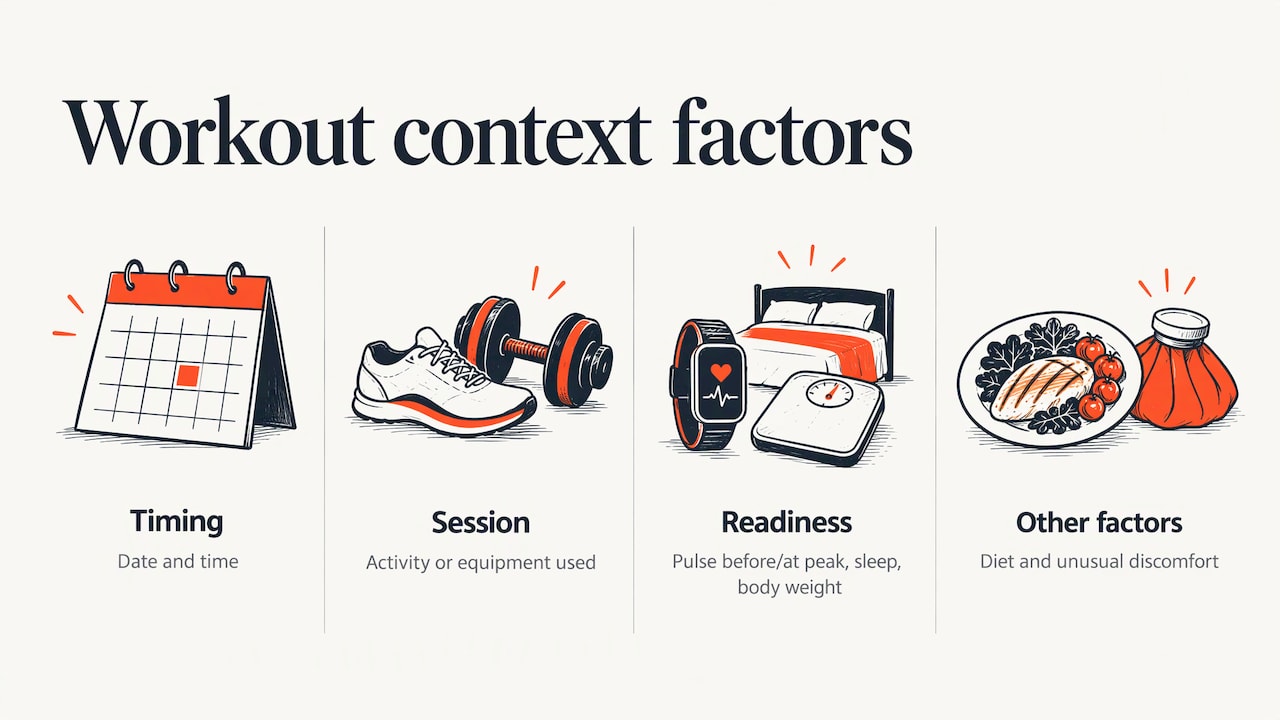
Sometimes a bad session has nothing to do with your program. University of Washington Medicine’s guidance on keeping a training log suggests noting the date and time, the activity or equipment used, and relevant conditions, because these details give you a frame of reference and help you stay consistent.
The same page also suggests recording pulse before exercise and at peak activity, sleep hours, body weight, diet and any unusual discomfort when those factors help explain your performance. You do not have to log all of these every day. Add a short note line to your log and use it when something stands out: slept five hours, new shoes, sore shoulder, trained fasted.
If pain or discomfort keeps showing up in your notes in the same spot, that is the moment to talk to a doctor or physical therapist rather than keep pushing through.
Sleep deserves a special mention, since it often explains a flat week. If you want the background, our article on sleep and muscle recovery goes through what the research says.
Choose your method: notebook, spreadsheet or app
All three work. The right choice depends on how you behave when you are tired.
Paper notebook
A notebook is cheap, has no battery and is easy to start. The downsides are that you have to carry it, you have to flip back to find last week, and charts mean redrawing by hand. It suits people who train the same few lifts and like writing.
Spreadsheet
A spreadsheet gives you charts and formulas. One tab per month with columns for date, exercise, weight, sets, reps and effort is enough. The catch is typing on a phone between sets, which gets old fast. Many people end up filling it in at home from memory, which defeats the purpose.
Workout tracking app
An app wins on speed and on having last session’s numbers in front of you at the moment you need them. The better ones fill in the previous weight and reps, time your rest, and chart your lifts automatically. Look for these things:
- Logging a set takes seconds, not a form.
- Your last session’s numbers appear while you train.
- It works on your wrist if you do not want your phone out.
- You can export your data so it is never locked in.
The trade-off to think about is privacy. Check whether an app shows ads, runs analytics SDKs, or uses health data for advertising.
Turn the log into progress
A log only pays off if you read it. Before each session, look at what you did last time for the same exercise. That number is your baseline.
Use a simple progression rule
An expert explainer in The Conversation recommends recording weight, reps and sets each session, then using those records as a baseline to add reps gradually and increase the weight once you reach the top of your rep range. For example, if your target is 8 to 12 reps:
- Week 1: 100 lb for 8, 8, 8
- Week 2: 100 lb for 10, 9, 8
- Week 3: 100 lb for 12, 11, 10
- Week 4: 100 lb for 12, 12, 12, so next session you go up in weight and start again near 8
This idea is called progressive overload. The American College of Sports Medicine notes that progressive resistance training is necessary for further adaptation, and lists progressive overload, specificity and variation among its main principles. Your log is what makes overload visible, because you can see exactly how much more you did.
What a beginner can aim for
The same ACSM document recommends, for beginners, loads in the 8 to 12 repetition maximum range, with whole-body training two to three days per week. If you are starting out, our 3-day full-body beginner lifting plan gives you a structure you can log from day one.
When the numbers stall
Every lifter stalls. The Conversation piece suggests that if progress stalls for three to four weeks, try an easier week, and if it is still stuck, change one exercise or one session rather than rebuilding everything. Your log shows you which lift is stuck, so you change one thing instead of changing everything at once.
A useful framework for thinking about what to change is FITT-VP. ACSM’s 2026 resistance training pronouncement describes prescription in terms of frequency, intensity, time, type, volume, pattern and progression. Pick one of those levers per change, so you can tell what worked.
The same document stresses that individualization matters more than rigid rules, and that for most adults the main goal is regular participation in resistance training of any kind. A log that shows you turned up consistently is itself a result.
How to recognize a personal record
A personal record, or PR, is simply your best recorded number for a given measure. University of Washington Medicine’s guidance recommends tracking activity-specific measures, strength-training intensity, milestones and personal bests. For lifting, there are three common kinds of PR:
- Weight PR: the heaviest load you have lifted for a given number of reps.
- Rep PR: the most reps you have done at a given weight.
- Volume PR: the highest total of weight times reps in one session or one exercise.
The log makes this easy. Search your history for the same exercise and rep count, and compare. Without a log you only notice a PR if you happen to remember the old number.
Two habits help. Mark PRs in your log with a star or note, so you can scan for them later. And do not chase a PR every week. Most sessions should be solid work. PRs come from months of those.
Keep the habit when you are busy
The most common reason people stop logging is not laziness, it is friction. A few fixes:
- Shrink the log. On a rushed day, log only weight and reps. Add notes later, or never.
- Log during rest, not after. Enter each set while you are resting. By the time you leave, you are done, and you do not have to reconstruct the session from memory.
- Plan before you arrive. Decide the session in advance, so you spend your time lifting, not deciding.
- Lower the bar for missed days. If you forget to log, write down what you remember and move on. A rough entry still beats a blank.
- Use a weekly check-in. Five minutes every Sunday to count sessions and spot PRs keeps the whole system honest.
The ACSM’s resistance exercise infographic notes that resistance training improves cardiorespiratory health, muscle function, strength and power, and lowers mortality risk independent of aerobic exercise, and that minimal-dose programming can be a good way to begin. If your week is tight, a short logged session is better than a long one you skip.
Tracking workouts with Athlxpro
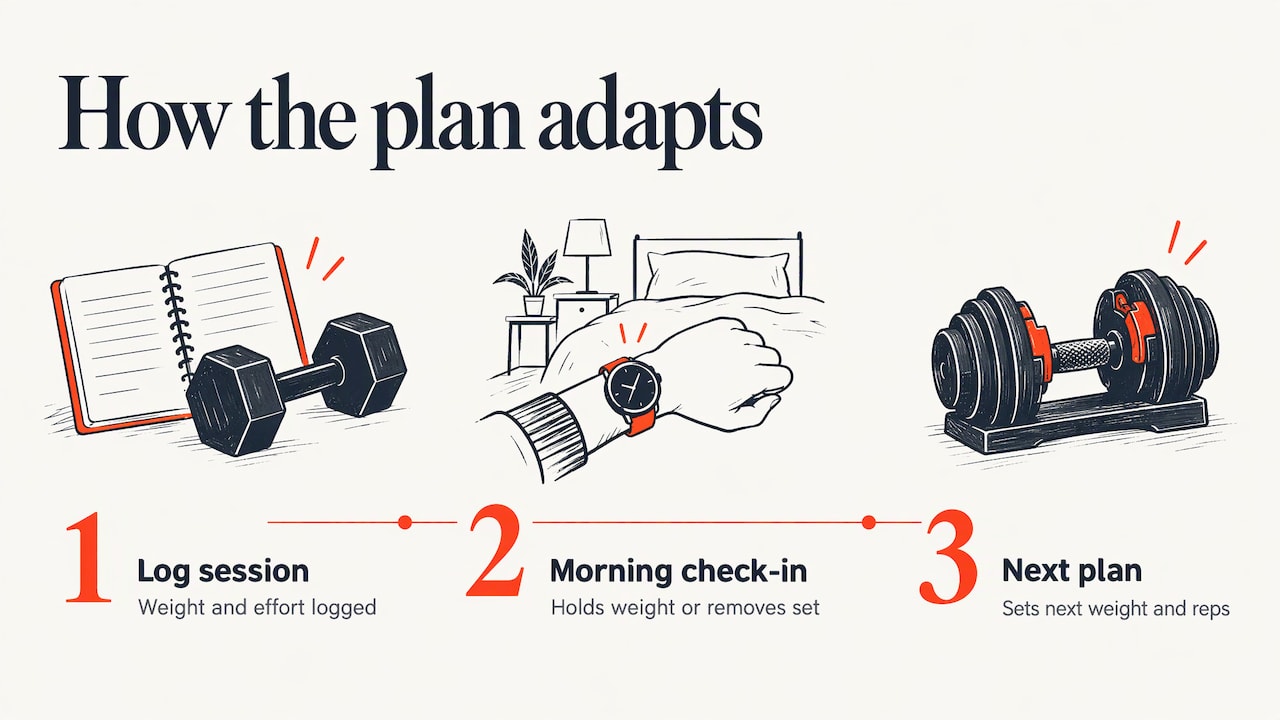
We built Athlxpro for the part most logs leave to you: deciding what to lift next. It sets your next weight and reps from your last session and how hard it felt. It also reads your morning check-in, so on a bad morning it holds the weight or takes a set off. Only your training, how hard it felt and that check-in change the plan. Programs are built on progressive overload and effort-based training.
You log a set in one tap on iPhone, and a full workout can run on Apple Watch once the plan is on the watch.
Your training, food, sleep, steps and heart rate sit on one screen. Alex, our AI coach, sees them, and the Apple Health data needs your consent. You can log food by photo, which is an AI estimate, or by barcode. The app includes 577 exercise videos, records, awards, XP and levels, weight and volume charts, and a community feed where you post a session and see what others lift. PDF and CSV reports and a full JSON export are made on your iPhone. There are no ads and no analytics SDKs, and health data is never used for ads.
Athlxpro is a monthly or yearly subscription through the App Store. You can see both plans on the Athlxpro page.
FAQ
How should I track workouts if I am a complete beginner?
Start with three fields per exercise: weight, sets and reps. Add one effort note after each exercise, such as how many reps you had left. Train 1 to 6 days a week, whatever fits your schedule, and review your numbers once a week. Keep it simple until logging feels automatic.
What is the best way to record gym workouts quickly?
Enter each set during your rest period, not after the session. Use a tool that shows your last numbers so you do not have to look them up. An app that lets you log a set in one tap and works from your wrist saves the most time.
How do I monitor training progress over months?
Compare the same exercise at the same rep range over time. Chart your weight and volume per exercise, mark personal records, and check for three to four weeks without improvement. If you stall that long, try an easier week before changing the program.
Should I track cardio and strength in the same log?
Yes, if you do both. Log lifting by weight, sets and reps, and cardio by frequency, intensity and duration. Having both in one place shows you total training load and helps explain why a lifting session felt heavy after a hard run.
Sources
- Massachusetts Physical Fitness Preparation Guide
- Walk Georgia online physical activity program evaluation, CDC Preventing Chronic Disease
- Methods of Monitoring Internal and External Loads, Sports Medicine
- How and Why to Keep a Training Log, University of Washington Medicine
- Has your fitness hit a plateau? The Conversation
- Progression Models in Resistance Training for Healthy Adults, ACSM
- Resistance Training Prescription for Muscle Function, ACSM
- Resistance Exercise for Health infographic, ACSM