
A personalized workout plan is a training program built around your goal, your experience, your schedule and your equipment, and one that changes as you do. You can write one yourself in about an hour using six decisions, covered below. The hard part is keeping it current week after week, which is where an app that adjusts your weights and reps earns its place.
TL;DR
- Start with one clear goal, then pick how many days you can train consistently. For most people that is 2 to 4 days of resistance training a week.
- Cover every major movement pattern across the week: squat, lunge, push, pull and rotate.
- Progress in small steps: add load or reps a little at a time, and plan recovery as deliberately as the workouts.
- A plan is only personal if it changes. Use last session’s results and how hard the work felt to set the next one.
- Athlxpro does this on iPhone and Apple Watch: it sets your next weight and reps from your last session and your morning check-in.
Table of Contents
- What makes a workout plan personal
- Build your plan in six steps
- Choose exercises that cover the whole body
- How many days a week should you train
- Set sets, reps and effort
- Plan recovery like part of the program
- If you are short on time
- What to look for in a workout plan app
- How Athlxpro personalizes your plan
- Check your plan every four weeks
- FAQ
- Sources
What makes a workout plan personal
A template becomes a personalized plan when it responds to you. Three things separate the two.
First, the plan starts from your inputs: goal, training experience, available equipment, how often you can train, how long each session can run, and which muscle groups you want to prioritize. Human Kinetics lists exactly these factors as the ones that drive exercise selection.
Second, the plan keeps your body in balance. The same source stresses muscle balance between opposing groups, such as chest and upper back, or quads and hamstrings.
Third, and most often missed, the plan changes with results. A 2021 evidence-informed framework for training plans includes a testing and monitoring step and notes that roughly 10% of people respond poorly to a given exercise intervention. That is the reason monitoring matters: the plan that works for your friend may not work as well for you, and you only find out by tracking.
If your plan is a PDF you printed in January, it is a template. If it moves when your performance moves, it is personal.
Build your plan in six steps
The same 2021 framework proposes a six-step approach: define the overall goal, break it into sub-goals, plan how you will test and monitor, choose the interventions, plan the key training variables over the period, and design the detailed weekly plans. Here is that logic translated into something you can do tonight.
1. Pick one primary goal
Strength, muscle size, general fitness and a specific lift all call for slightly different emphasis. Choose one as the lead. Write it as something you can check: a bench press of a certain weight, a set of pull-ups, or simply four workouts a week for twelve weeks.
2. Break it into sub-goals
A twelve-week goal becomes four-week blocks. Each block has one thing to improve: add a rep to each main lift, build the habit of three sessions a week, or move from machines to barbells with good technique.
3. Decide how you will monitor
At minimum, log the weight, reps and effort of every working set. The Merck Manual notes that objective monitoring, through periodic assessments or wearable devices, is critical to a safe and effective program, and that it helps catch early signs of overtraining such as persistent fatigue and joint pain.
4. Choose your exercises
See the next section. The short version: cover the basic movement patterns and keep the list small enough to improve at.
5. Set the variables
Days per week, sets, reps, effort and rest. Details below.
6. Write the weekly layout
Place the sessions so that hard days are separated by recovery and no muscle group is trained hard on consecutive days.
Choose exercises that cover the whole body
ACE describes five basic patterns of human movement: squatting, lunging, pushing, pulling and rotating. Its advice is to build programs around integrated, multi-joint movements instead of leaning only on isolation exercises, which lowers the risk of muscular imbalance and injury.
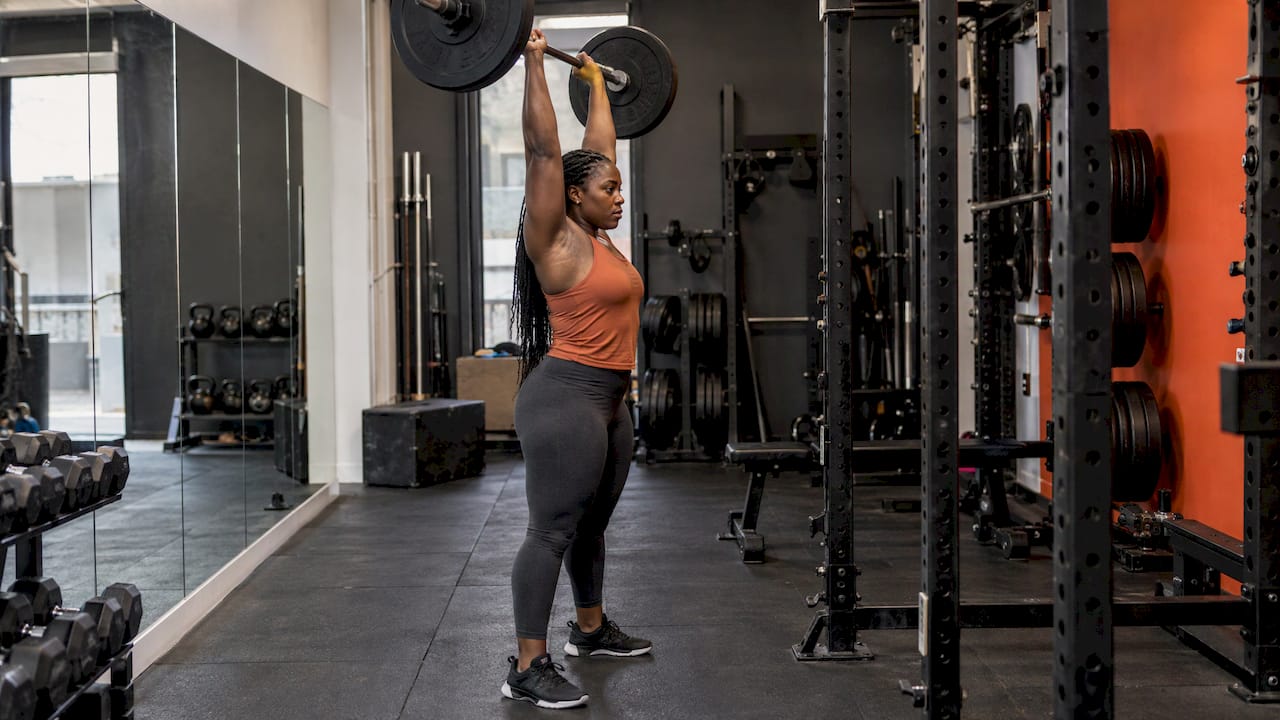
The Human Performance Resource Center (HPRC) frames the same idea as categories: lower-body push or pull, upper-body horizontal push or pull, upper-body vertical push or pull, anti-rotational and rotational movements. It advises including movements from every category and choosing equipment such as resistance bands, cables, dumbbells, barbells or bodyweight based on your current fitness, goals and injuries.
A practical starter list:
| Pattern | Example exercises |
|---|---|
| Squat | Goblet squat, back squat, leg press |
| Hinge or lunge | Romanian deadlift, split squat, walking lunge |
| Horizontal push | Bench press, push-up, dumbbell press |
| Vertical push | Overhead press |
| Horizontal pull | Row, cable row |
| Vertical pull | Pull-up, lat pulldown |
| Rotation or anti-rotation | Cable chop, plank variations |
You do not need every pattern in every workout. A strength coach interviewed on the Huberman Lab podcast, Dr. Andy Galpin, makes the point that balance should be judged across the whole week, not inside each session. If you train four or five days, check that pushing and pulling, front and back, and left and right even out by Sunday.
If you are unsure how a movement should look, form matters more than load. Athlxpro includes 577 exercise videos, so you can check technique before you add weight.
How many days a week should you train
The honest answer is the number you can repeat for months. The evidence gives a useful range.
HPRC recommends resistance training 2 to 3 days per week for all major muscle groups. Its strength guidance lists at least 2 sessions a week, loads of 60 to 80% of your one-rep max, 1 to 10 reps, 2 to 4 sets and 1 to 3 minutes of rest. For anaerobic endurance work it suggests 1 to 2 sessions a week with at least 48 hours of recovery, and for aerobic endurance 3 to 4.
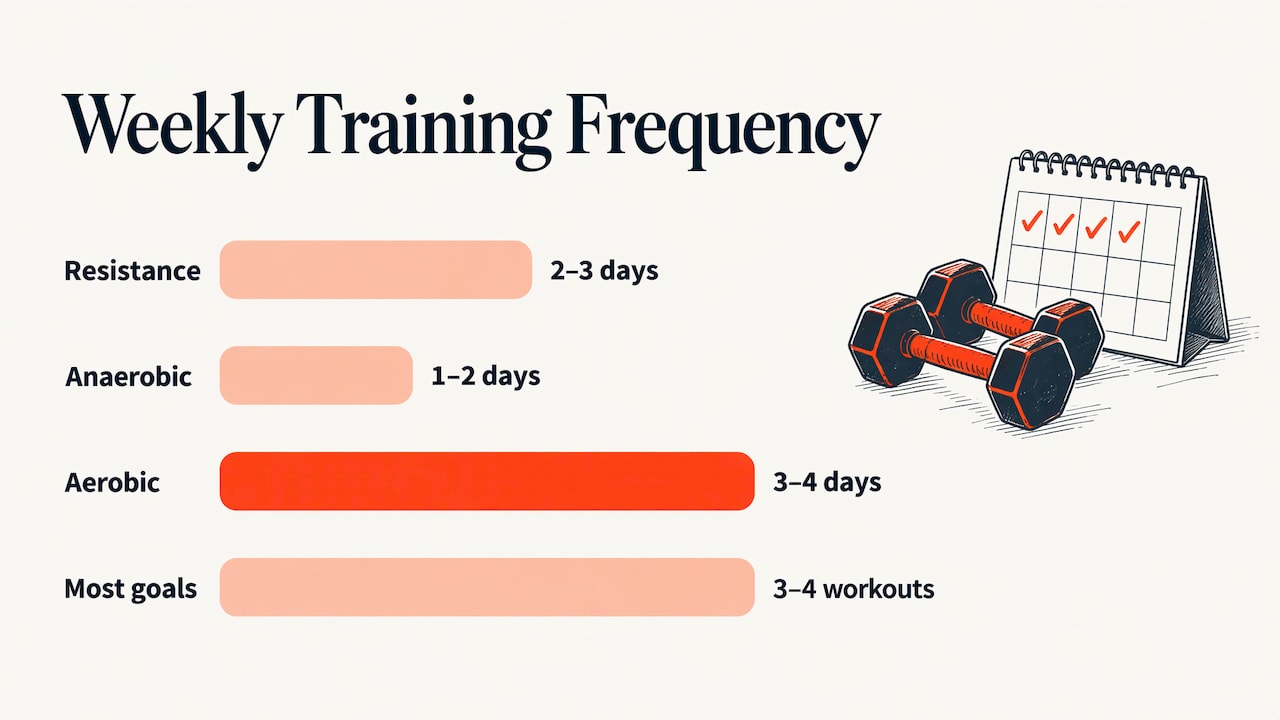
Men’s Health, quoting a certified strength coach, calls three to four workouts a week the sweet spot for most goals, with every muscle group hit at least twice weekly as a minimum.
Splitting the week up changes how those days look. ACE explains that splitting a full-body routine into several workouts adds volume and variety. A four-day plan is typically upper and lower body, each twice a week. A six-day plan often runs three days on and one day off so you still get rest.
| Days a week | Common layout | Who it suits |
|---|---|---|
| 1 to 2 | Full body each session | Very busy weeks, restarting after a break |
| 3 | Full body, rest day between | Beginners, most schedules |
| 4 | Upper, lower, upper, lower | Lifters who want more volume |
| 5 to 6 | Push, pull, legs or body-part splits | Experienced lifters chasing volume |
Athlxpro programs run from 1 to 6 days a week, so the plan can follow your calendar instead of the other way around. If you are new to lifting, our 3-day full-body routine for beginners is a solid place to start. If you prefer high-volume, low-frequency training, see the Dorian Yates split.
Set sets, reps and effort
Two ideas do most of the work: progressive overload and effort.
Progressive overload means gradually asking more of your muscles. The ACSM position stand on resistance training progression says it can be achieved by increasing load, adding repetitions, changing repetition speed, adjusting rest periods or raising volume, or any combination. It also suggests only small increases in volume at first, in the range of 2.5 to 5%, until your body has adapted, and says training variables must be varied over time to keep advancing and avoid overtraining.
Effort-based training adds the other half: how hard a set felt. Two people can lift the same weight for eight reps and have very different experiences. If the last rep felt like there were three more in the tank, the next session should go up. If it was a grind, hold. A simple scale is reps in reserve, the number of reps you could still have done.
A workable rule for most lifters:
- Pick a rep range, such as 6 to 10 for main lifts.
- Work at an effort that leaves you roughly one to three reps short of failure.
- When you hit the top of the range on every set with that effort, add a small amount of weight next time.
- If you miss the bottom of the range, or the sets felt much harder than planned, repeat the weight.
That loop is simple and hard to sustain by memory. Most people lose track of last week’s numbers within a month, which is why a log helps.
Plan recovery like part of the program
Progress happens between sessions. The Mayo Clinic advises building rest time between sessions and mixing in different activities to reduce injury risk. For beginners it also recommends increasing activity by no more than 10% per week and scheduling workouts like appointments. For general health it recommends at least 150 minutes of moderate aerobic activity a week or 75 minutes of vigorous activity, so a lifting plan can sit alongside walking or cardio.
Recovery is also individual. In a 2022 Finnish study, endurance training adjusted to each person’s recovery and training status improved 10-km time by 6.2%, against 2.9% for a fixed prescribed dose. The study covered endurance runners, not lifters, but the principle carries: matching the dose to how ready you are beats following a script blindly. The researchers also saw more high responders (50% against 29%) and fewer low responders in the individualized group.
In practice, that looks like a few habits:
- Take the planned rest days, even when you feel good.
- On a rough morning, cut a set or hold the weight instead of skipping the session.
- Treat persistent fatigue or joint pain as a reason to change the plan, and see a doctor or physical therapist if joint pain lingers.
- Read up on how sleep affects muscle recovery, since it shapes how much you can handle.
If you are short on time
A shorter plan can still work. A 2021 narrative review in Sports Medicine on time-efficient strength training recommends prioritizing multi-joint exercises done on both sides at once, and at least 4 weekly sets per muscle group in a 6 to 15 rep-max range. It also finds that weekly volume matters more than how often you train, and that techniques like supersets and drop sets can roughly halve session time while keeping volume.
For a busy week that means three things: choose fewer exercises, keep them compound, and protect the sets that matter. A 35-minute session you do beats a 90-minute session you skip.
What to look for in a workout plan app
A plan on paper cannot see your last session. An app can. When you compare apps by type, look for these things:
- Progression logic. Does it tell you what to lift next, or only record what you lifted?
- Effort input. Can you say how hard a set felt, and does the next prescription respond?
- Fast logging. If logging takes longer than the set, you will stop.
- Wrist access. Being able to run the workout from a watch keeps your phone in your bag.
- History and charts. Weight and volume over time show whether the plan is working.
- Exports. You should be able to take your data to a coach or keep your own copy.
The point of an adaptive plan is that you never have to remember what you lifted last Tuesday. Generic templates that give the same sets and reps to everyone cannot offer that.
How Athlxpro personalizes your plan
Athlxpro is a strength training app for iPhone and Apple Watch. Its programs are built on progressive overload and effort-based training.
Here is how the personalization works:
- Your last session sets the next one. The app sets your next weight and reps from what you lifted and how hard it felt.
- Your morning check-in adjusts the day. On a bad morning it holds the weight or takes a set off.
- Only training, effort and the check-in change the plan. That keeps the logic clear.
- You log a set in one tap, on iPhone or Apple Watch. Once the plan is on your watch, a full workout can run from it.
Around the plan sits everything else you track. Training, food, sleep, steps and heart rate appear on one screen. Alex, the AI coach, sees your training, food, sleep, steps and heart rate, and the Apple Health data needs your consent. You can log food by photo (an AI estimate) or by barcode. Progress shows up as weight and volume charts, records, awards, XP and levels, and a community feed where you post a session and see what others lift. Reports come as PDF or CSV, plus a full JSON export, all made on your iPhone.
There are no ads and no analytics SDKs, and health data is never used for ads. Athlxpro is a subscription, monthly or yearly, through the App Store, and it starts with a one-week trial.
If you want a plan that moves with you, see Athlxpro and choose a monthly or yearly plan.
Check your plan every four weeks
Whether you use an app or a notebook, review on a schedule. Every four weeks, ask:
- Did the main lifts go up, or at least hold at a lower effort?
- Did I hit the days I planned? If not, shrink the plan before you push harder.
- Is any pattern missing from the week, such as pulling or single-leg work?
- Is fatigue or joint pain building? If so, add rest or reduce volume and talk to a professional if it persists.
- Does the goal still fit, or is it time for the next sub-goal?
A plan that survives these questions is personal in the sense that matters: it reflects what actually happened to you.
FAQ
Can I make my own personalized workout plan?
Yes. Define a goal, choose how many days you can train, pick exercises from each movement pattern, set a rep range and effort level, and log every session. Review it every four weeks and change what is not working.
How many days a week should a personalized plan include?
For resistance training, HPRC recommends 2 to 3 days a week, and many lifters do well on 3 to 4. Choose the number you can keep up, and add days only when the current ones feel manageable.
Is a workout app better than a printed plan?
An app can use your last session and your effort to set the next one, which a printed plan cannot. Athlxpro does this with your last session, how hard it felt and your morning check-in, and you log each set in one tap.
What if I have a bad day?
Adjust the session instead of abandoning it. Hold the weight, drop a set or shorten the workout. In Athlxpro, your morning check-in does this for you by holding the weight or taking a set off.
Do beginners need a different plan?
Beginners usually do best with full-body sessions two to three times a week and small, steady increases. The ACSM position stand advises small volume increases at first while the body adapts.
Sources
- Personalized, Evidence-Informed Training Plans and Exercise Prescriptions (PMC, 2021)
- How to customize resistance training programs (Human Kinetics)
- Overview of Exercise (Merck Manual Professional Edition)
- How to Select the Right Exercises for Your Clients (ACE)
- Use the FITT-VP principle to plan your workouts (HPRC)
- Dr. Andy Galpin: Optimize Your Training Program (Huberman Lab)
- How to Make a Workout Plan (Men’s Health)
- Mastering the Art of the Split Routine (ACE)
- Fundamentals of Resistance Training: Progression (Medicine & Science in Sports & Exercise, 2004)
- Fitness program: 5 steps to get started (Mayo Clinic)
- Individualized Endurance Training Based on Recovery and Training Status (PMC, 2022)
- No Time to Lift? Designing Time-Efficient Training Programs (Sports Medicine, 2021)