
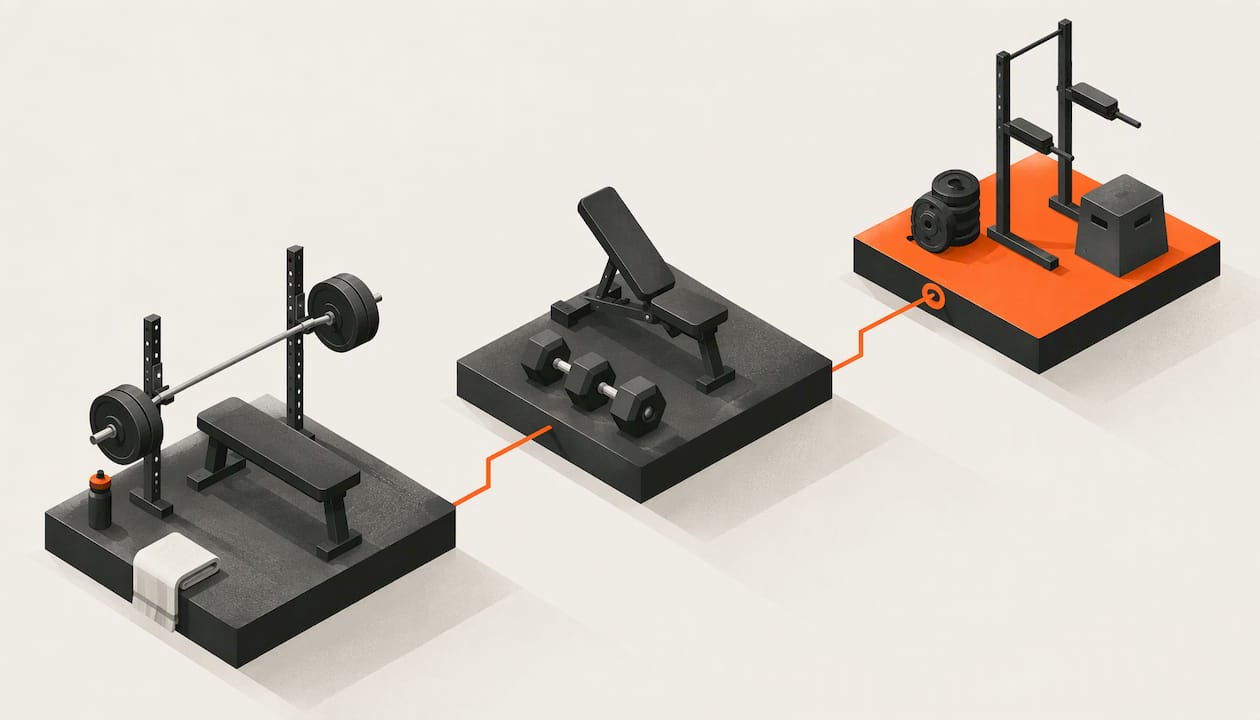
A good push day trains your chest, shoulders and triceps with two or three heavy pressing moves first, then a few isolation exercises to finish. Plan on about 5 to 7 exercises, 2 to 4 hard sets each, in roughly 45 to 60 minutes. Below you get the exercises worth doing, the order to do them in, a ready-to-run workout, and a simple way to add weight over time.
TL;DR
- Push day trains the muscles that press weight away from you: chest, front, side and rear shoulders, and triceps (Aston University).
- Start with compound presses (bench press or a variation, overhead press), then move to flys, lateral raises and triceps work.
- Train each muscle group at least twice a week, per ACSM guidance.
- Progress by adding reps or weight in small steps. Leave a rep or two in the tank on most sets.
- Most sessions fit into 45 to 60 minutes, depending on rest and exercise count.
Table of Contents
- What push day trains
- The best push day exercises
- How to order your exercises
- A complete push day workout
- Sets, reps and rest
- How often to train push
- Progressing without hurting your shoulders
- Keep track of your push day with Athlxpro
- FAQ
- Sources
What push day trains
Push day groups every movement where you press a load away from your body. That means the pectoralis major (chest), the front, side and rear deltoids (shoulders) and the triceps on the back of the upper arm. Onnit’s breakdown lists the same set of muscles, and Aston University describes push day as the session built around chest, shoulders and triceps.
The logic is practical. Your triceps and front delts already assist every chest press, so training them in the same session means they are fatigued together and then get a full break before you press again. The pull and leg days that complete a push/pull/legs split fill in the rest of the body.
The best push day exercises
A well-built push day covers four jobs: a heavy horizontal press, a vertical press, a stretch or squeeze for the chest, and direct work for the side delts and triceps. Men’s Health lists the same building blocks: bench press variations, overhead presses, fly variations, rear-delt work and triceps isolation.
Chest
- Barbell bench press. The classic. It lets you load the most weight and track progress cleanly.
- Incline dumbbell press. A 30 degree bench angle shifts more work to the upper chest and gives each arm its own range of motion.
- Push-ups. No equipment needed. ACE notes that keeping your elbows close with your hands pointing forward moves the emphasis toward the triceps.
- Cable or dumbbell fly. An isolation move that keeps tension on the chest through a long stretch. Use lighter weight than you would for a press.
- Dips. A strong chest and triceps builder once you can do sets of push-ups comfortably. Lean forward slightly to bring in more chest.
Shoulders
- Overhead press (barbell or dumbbell). Your main vertical press. A seated dumbbell version is easier to set up, and ACE points out that pressing one arm at a time adds a little core work.
- Lateral raise. The best simple way to train the side delt, which gives shoulders their width. Keep the weight light and the motion controlled.
- Rear-delt fly or face pull. Technically a pulling motion, but it keeps shoulders balanced after a lot of pressing, and Men’s Health includes rear-delt work in its push day structure.
Triceps
- Cable pushdown. Smooth, easy to load in small steps.
- Overhead triceps extension. Trains the long head of the triceps in a stretched position.
- Close-grip bench press or EZ-bar skull crusher. Heavier options when you want more load on the triceps.
One caution on the push press, a power variation of the overhead press: keep your spine upright, your trunk neutral and avoid arching your lower back, as described in this ACSM Health & Fitness Journal article. If you are new to it, stick with the strict overhead press first.
How to order your exercises
Put the hardest, most technical lifts first, while you are fresh. The standard structure puts compound pressing moves such as bench press variations and overhead presses early, then follows with isolation work for the chest, shoulders or triceps, as laid out by Men’s Health.
A simple order:
- Main chest press (barbell or dumbbell)
- Second press: incline or overhead
- Chest isolation (fly) or dips
- Side delts (lateral raise)
- Triceps
- Optional: rear delts or a finisher
If your shoulders are the weak point, swap steps 1 and 2 so the overhead press comes first.
A complete push day workout
This is a solid template for a lifter with a few months of training. Rest 2 to 3 minutes after the heavy presses and 60 to 90 seconds after the isolation moves.
| Order | Exercise | Sets | Reps |
|---|---|---|---|
| 1 | Barbell bench press | 3 to 4 | 5 to 8 |
| 2 | Seated dumbbell overhead press | 3 | 8 to 10 |
| 3 | Incline dumbbell press | 2 to 3 | 8 to 12 |
| 4 | Cable fly | 2 to 3 | 10 to 15 |
| 5 | Lateral raise | 3 | 12 to 20 |
| 6 | Cable pushdown | 3 | 10 to 15 |
| 7 | Overhead triceps extension | 2 | 10 to 15 |
That is 18 to 21 working sets. If you only have 40 minutes, drop the fly and the overhead extension and you still hit every muscle.
Sets, reps and rest
There is no single correct prescription. The ACSM’s 2026 position moves away from one-size-fits-all plans and says programs should fit your goals, enjoyment and safety so that you can stick with them. Within that, the numbers below are a good starting frame.
- For strength: heavier loads, around 80% of your one-rep max, for 2 to 3 sets per exercise, according to the ACSM’s updated guidelines. That is roughly the 3 to 6 rep range on your main press.
- For muscle size: about 10 sets per muscle group per week, per the ACSM position stand. On a push day done twice a week, that is easily met for the chest and triceps.
- For power: moderate loads of 30 to 70% of one-rep max, moved fast on the lifting phase, also from the ACSM position stand. Think of speed-focused sets of push presses or explosive push-ups.
How long should a push day last?
Most push days run 45 to 60 minutes of actual training. The main drivers are rest periods and exercise count. Six exercises with 2 to 3 minutes of rest after the heavy sets will land near an hour. Cut rest to about 90 seconds on lighter sets, or pair a triceps move with a lateral raise, and you can finish in 40 to 45 minutes. Past 75 minutes, quality usually drops, so trim the session rather than stretching it.
How often to train push
The ACSM recommends training all major muscle groups at least twice a week (ACSM). In a push/pull/legs split, that means running the cycle twice: push, pull, legs, push, pull, legs, with a rest day where you need it. That is six training days. If you can only train three days a week, a full-body plan hits every muscle twice with less time cost, and our 3-day beginner full-body routine shows how it fits together.
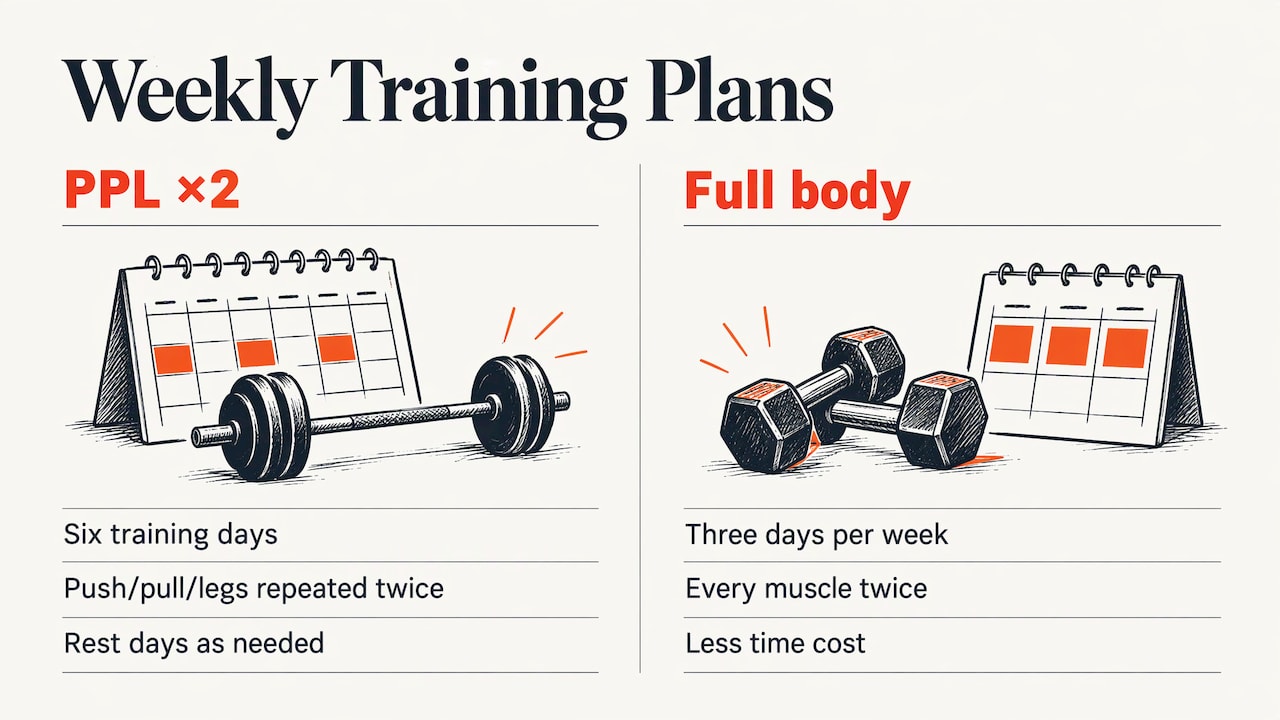
Whatever split you use, plan for 1 to 6 days a week based on what you can keep up. The best schedule is the one you repeat for months. Recovery matters as much as the lifting itself, and our piece on sleep and muscle recovery explains why.
Progressing without hurting your shoulders
The basic rule: add reps or weight regularly, but not so much that your form breaks. Onnit warns that adding weight before you are ready risks injury. A practical way to apply it:
- Pick a rep range, say 8 to 10 on dumbbell presses.
- Start at a weight where you finish all sets with a rep or two to spare.
- Each session, try to add one rep to a set.
- When you hit the top of the range on every set, raise the weight slightly and drop back to the bottom of the range.
Do you need to go to failure?
No. Research reviews by Refalo and colleagues in 2022 suggest that training to failure likely adds neuromuscular fatigue and discomfort without consistently better muscle growth, which could hurt recovery and adherence. A 2023 follow-up points the same way: closer to failure does not always mean more hypertrophy. The ACSM also says that advanced techniques like training to failure are not strictly necessary for general health and fitness, and that consistency is the main driver of results.
This is the idea behind effort-based training: you rate how hard a set felt, and that rating guides the next session. Leave a rep or two in reserve on most sets, and save the grinders for the last set of a lift if you want them at all.
If you are new
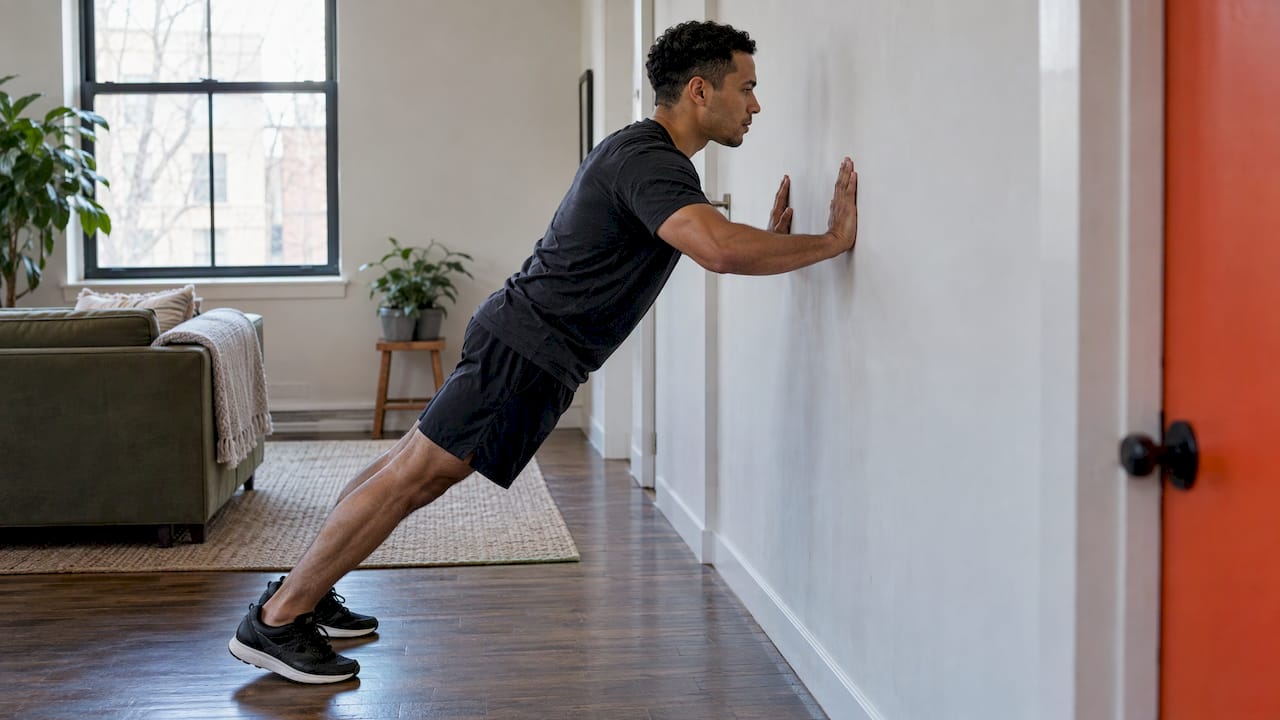
The biggest gain comes from going from no resistance training to any resistance training, and regular participation matters more than a perfect plan, as the ACSM’s guidelines update puts it. Start with push-ups (on a wall, a counter or the floor), dumbbell presses and a pushdown. The same update notes that elastic bands, bodyweight work and home routines bring marked benefits in strength, hypertrophy and physical function, so a lack of equipment is not a barrier.
If you are chasing a more extreme, low-volume, high-intensity approach, see how Dorian Yates structured his split. Treat it as an interesting study rather than a starting point.
Keep track of your push day with Athlxpro
The hard part of progressing is remembering what you lifted last week. Athlxpro is a strength training app for iPhone and Apple Watch that sets your next weight and reps from your last session and how hard it felt. It also adjusts to your morning check-in: on a bad morning it holds the weight or takes a set off.
You log a set in one tap, and a full workout can run on Apple Watch once the plan is on your watch. Programs are built on progressive overload and effort-based training, and 577 exercise videos show you how to perform each move, from the bench press to the lateral raise. Weight and volume charts show your push numbers climbing. Athlxpro is a subscription, monthly or yearly, through the App Store. See the monthly and yearly plans to get started.
FAQ
What exercises should I include on push day?
Include a bench press or variation, an overhead press, a fly or dip for the chest, a lateral raise for the side delts and one or two triceps exercises. Do the compound presses first and the isolation work after. That covers every muscle push day is meant to train.
Can I do push day at home?
Yes. Push-ups, band presses, pike push-ups and dumbbell presses cover chest, shoulders and triceps. The ACSM notes that bands, bodyweight exercises and home routines can produce marked gains in strength and muscle. Add reps or use harder variations as you get stronger.
How many exercises should a push day have?
Five to seven is enough for most people. Two to three compound presses, one or two isolation moves for chest or shoulders, and one or two for triceps. More than that usually means lower quality sets late in the session.
Should I train push day twice a week?
If your schedule allows, yes. The ACSM recommends training each major muscle group at least twice weekly. A push/pull/legs split run twice gives you that on six days. A full-body or upper/lower plan can also work with fewer days.
Sources
- Aston University: The Push/Pull/Legs Routine for Muscle Gains
- Onnit: The Best Push Day Workouts for Muscle and Strength
- Men’s Health UK: How to Structure a Push Day Workout
- ACE: Push-Ups exercise library
- ACE: Strength Training Workout for Beginners
- ACSM: Resistance Training Prescription for Muscle Function
- ACSM: Updated Resistance Training Guidelines
- ACSM Health & Fitness Journal: The Push Press Exercise
- Refalo et al. 2022: Proximity-to-failure scoping review
- Refalo et al. 2023: Resistance training proximity-to-failure and hypertrophy