
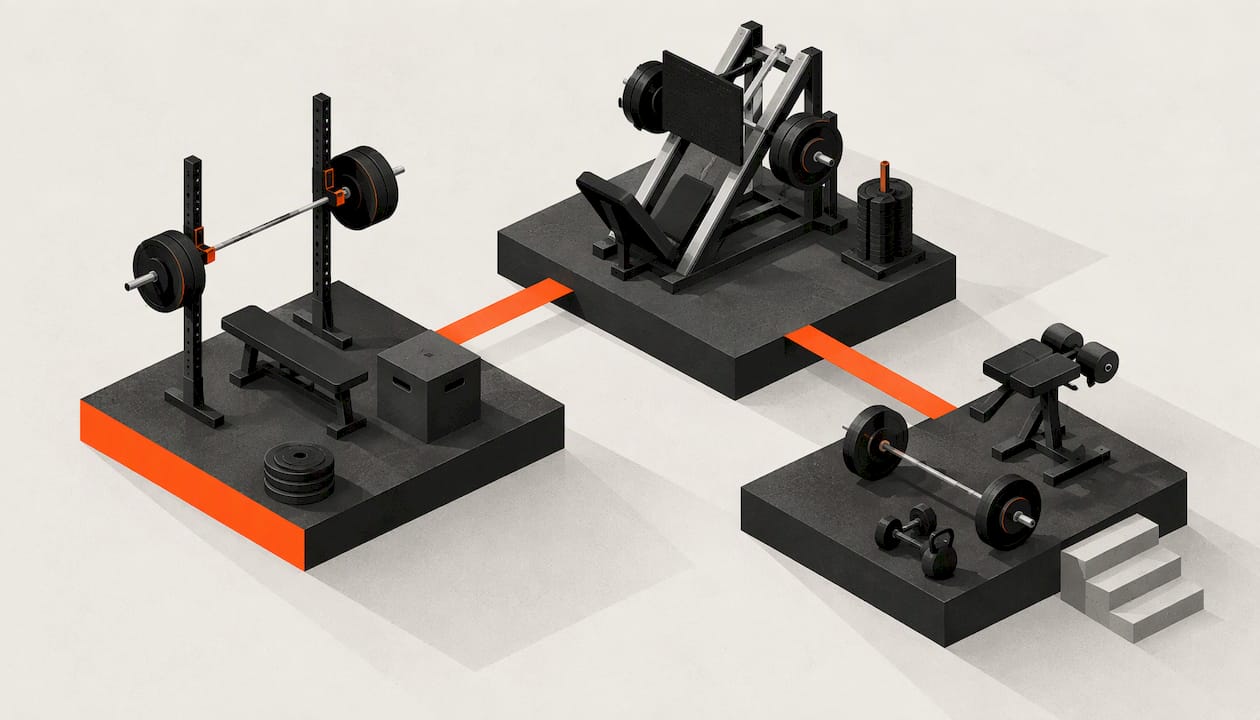
A good leg compound workout uses three to five multi-joint lifts: a squat variation, a hip hinge such as a Romanian deadlift, and a single-leg move such as a split squat or lunge. Do the heaviest lift first, rest two to three minutes between hard sets, and add a little weight or one more rep over time. This guide gives you the exercises, the order, a full sample session, beginner starting points and a way to progress.
TL;DR
- Build the session around a squat pattern, a hip hinge and a single-leg exercise. Together they cover quads, glutes, hamstrings and calves.
- Put the heaviest, most technical lift first, while you are fresh, and finish with lighter or isolation work.
- Intermediate lifters can aim for roughly 12-18 hard sets in a session, with 2-3 minutes of rest between compound sets. Beginners start with 3-5 exercises and 3 sets of 8-12.
- Progress by adding a little weight or one rep each week, and bank the gains only when form stays clean.
- Log every set so you know exactly what to lift next time.
Table of Contents
- What makes a leg exercise “compound”
- The three patterns every leg day needs
- How to order the exercises
- A sample leg compound workout
- Form cues for the big lifts
- Beginners: how to start
- How often to train legs
- How to progress week to week
- Let the app do the remembering
- Common mistakes to avoid
- FAQ
- Sources
What makes a leg exercise “compound”
A compound lift moves more than one joint and trains several muscles at once. In a squat, your hips and knees both bend and extend, so quads, glutes and hamstrings all work. In a deadlift variation, the hips hinge while the hamstrings and glutes do much of the pulling.
That is why Healthline’s leg workout guide centers effective leg training on squats for quads and glutes, hip hinges like deadlifts for hamstrings and glutes, and lunges for balance and leg strength.
There is a lot of muscle to cover. One breakdown counts 12 individual muscles in the legs: four quads, three hamstrings, three glutes and two calf muscles. You will not target all of them with one move, which is why a complete session mixes patterns instead of repeating the same one.
The three patterns every leg day needs
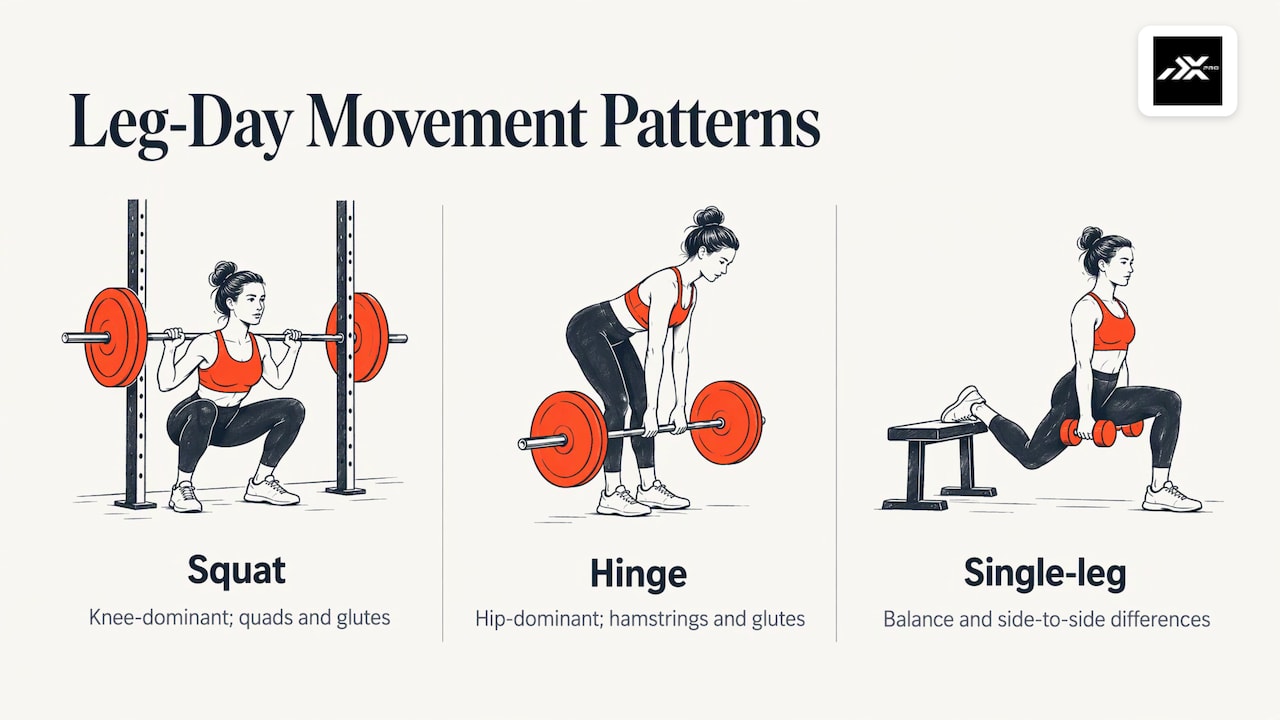
Squat pattern (knee-dominant)
This is the anchor of the session. Back squats, front squats, goblet squats and the leg press all belong here. The knees travel forward, and the quads and glutes carry most of the load.
Hip hinge (hip-dominant)
Romanian deadlifts, conventional or trap-bar deadlifts and good mornings push the hips back with the spine held neutral. The hamstrings and glutes load up. Many lifters are quad-dominant, and a hinge early in the session helps balance that out.
Single-leg work (unilateral)
Bulgarian split squats, walking lunges, step-ups and reverse lunges expose side-to-side differences and demand balance. You use less weight than on a bilateral squat, and that is normal.
Calves and accessories
Calf raises finish the job for the gastrocnemius and soleus. A leg curl or leg extension adds targeted work for the hamstrings or quads once the heavy lifting is done.
How to order the exercises
The general rule is simple: hardest first. The National Council on Strength & Fitness describes the traditional order as moving from hard to easy, complex to simple and heavy to light, for example squats before step-ups and leg press before leg extensions.
There is a practical reason. Research on exercise order, such as the Spiering et al. (2010) work summarized by The Workout Mag, shows you lift more total volume on a movement when it comes first in the session than when it comes last. So put the lift you care about most at the start.
A sensible template, following that same source:
- Heavy compound knee-dominant lift (back squat, front squat or leg press)
- Hip hinge (Romanian deadlift)
- Single-leg compound (split squat or lunge)
- Hamstring isolation (leg curl)
- Optional quad isolation (leg extension)
Don’t treat order as sacred. One review of exercise order, discussed by Outlift, notes a meta-analysis finding it does not have a big impact on muscle growth. Order matters most for the lifts you want to be strongest on. If you want to bring up your hamstrings, hinge first. One well-known bodybuilding plan, reported by Muscle & Fitness, opens with Romanian deadlifts for exactly that reason.
A sample leg compound workout
Here is a session built from the structure above. It suits an intermediate lifter who has been training consistently. The set and rep ranges follow the Workout Mag blueprint: a knee-dominant lift for 3-4 sets of 4-8 reps at 1-2 reps in reserve, a hip-dominant lift for 3 sets of 6-10, and isolation work for 2-3 sets of 10-15.
| Order | Exercise | Sets x reps | Rest |
|---|---|---|---|
| 1 | Back squat (or leg press) | 4 x 5-8 | 2-3 min |
| 2 | Romanian deadlift | 3 x 6-10 | 2-3 min |
| 3 | Bulgarian split squat | 3 x 8-10 per side | 60-90 sec |
| 4 | Seated or lying leg curl | 3 x 10-15 | 60-90 sec |
| 5 | Standing calf raise | 3 x 10-15 | 60 sec |
The working sets and warm-up sets add up. Warm-up sets do not count as hard sets, but they matter. Men’s Health advises two to three warm-up sets of three to five reps before each major movement to groove the pattern and prepare you for heavier work.
How hard should each set feel?
“1-2 reps in reserve” means you stop a set when you could have done one or two more clean reps. That is effort-based training: the load is right when the last reps are hard but your form holds. If a set feels like a grind, trim the weight. If you finish with four reps left, add some.
Rest periods
Legs are big muscles and heavy lifts tire your whole body. The strength coach quoted by Men’s Health recommends taking the full two minutes and 30 seconds between sets of major leg lifts and choosing quality over speed. Smaller or single-leg moves can run shorter. The same magazine’s 4-week legs and glutes plan uses 90 seconds between sets for the Romanian deadlift and Bulgarian split squat work, with at least 60 seconds between sides.
Form cues for the big lifts
Good technique keeps the work in the muscles and out of your joints. A few cues from established sources:
- Squat depth. The NSCA’s technique guide for the dumbbell squat says to lower until the backs of the thighs are parallel to the floor, with depth set by your lower-body flexibility. Keep your heels on the floor and your knees above to slightly in front of the ankles, not in front of the toes.
- Leg press. Keep your lower back flat on the pad and don’t let your hips lift. Trojan Fitness advises stopping just short of full knee lockout, lowering the weight under control for 3-4 seconds, and setting the seat so your knees start at 90 degrees.
- Romanian deadlift. Push your hips back, keep the bar close and your back flat. Stop where your hamstrings stretch and your back position would start to change.
- Split squat. This one demands balance and focus. Damien Patrick, quoted in Muscle & Fitness, uses a load of about 50% of his max on Bulgarian split squats, against around 80% on other lifts. Start lighter than you think.
If a movement causes sharp or joint pain rather than muscle effort, stop and see a physician or physical therapist before continuing.
Beginners: how to start
If you are new to lifting, you don’t need seven exercises. Healthline recommends 3 to 5 exercises per leg workout, 3 sets of 8 to 12 reps each, to build strength without overtraining. It also notes that research suggests training volume matters more than frequency for muscle growth.
The Institute of Personal Trainers lays out a four-week ramp: week 1 at 2 sets of 10-12 reps at an effort of 5-6 out of 10, building to 3 sets of 8-10 at 7-8 out of 10 by week 4. Its first principle is technique before load.
A beginner version of the workout looks like this:
- Goblet squat, 3 x 8-12
- Romanian deadlift with dumbbells, 3 x 8-12
- Reverse lunge or split squat, 3 x 8-12 per side
- Calf raise, 3 x 10-12
Picking a starting weight
Choose a weight that lets you finish every rep with good form but feels challenging in the last two to three reps. That is the same guidance Fitness Drum gives for beginners, and it works for any equipment. Sort out the movement first. Add weight after the pattern feels smooth.
If you are building a full routine around your legs, our beginner lifting plan shows how to fit squats and hinges into three full-body days.
How often to train legs
Two leg sessions a week works for most people. That gives each session enough weight to be worthwhile while leaving recovery days in between. Fitness Drum suggests two leg sessions per week with at least two rest days between them for beginners, and Healthline’s note on volume matters here: total hard sets across the week count for more than how many days you spread them over.
Some ways to fit it in:
- One heavy day, one lighter day. Squat heavy early in the week. Later, use a hinge and single-leg lifts for higher reps.
- Lower body inside a split. If you train three days a week, our 3-day weight training split guide compares four layouts, including ones that give legs their own day.
- Pair with pushing and pulling. After a hard leg day, an upper-body session such as the one in our push day exercises guide lets your legs recover while you keep training.
If your legs are still sore enough to change how you squat, take another day or reduce the load. Soreness is not the goal. Showing up with fresh legs for the next hard session is.
How to progress week to week
Progressive overload is the engine of a leg compound workout: do slightly more over time. Men’s Health describes it in four-week blocks: on each lift, aim to add a little weight or one more rep than the week before. When you hit the top of the rep range on every set, raise the weight and start the climb over, finishing the block with one set to failure.
A worked example with Romanian deadlifts, aiming for 3 sets of 6-10:
| Week | Weight | Reps per set |
|---|---|---|
| 1 | 135 lb | 6, 6, 6 |
| 2 | 135 lb | 7, 7, 6 |
| 3 | 135 lb | 8, 8, 7 |
| 4 | 135 lb | 9, 9, 8 |
| 5 | 145 lb | 6, 6, 6 |
Those numbers are an illustration, not a prescription. Your starting weight depends on your experience and your body.
The catch is remembering what you lifted last week, how hard it felt and what to do next. Bad nights and busy weeks make that harder, because the right weight is not the same every morning. That is where tracking earns its place.
Let the app do the remembering
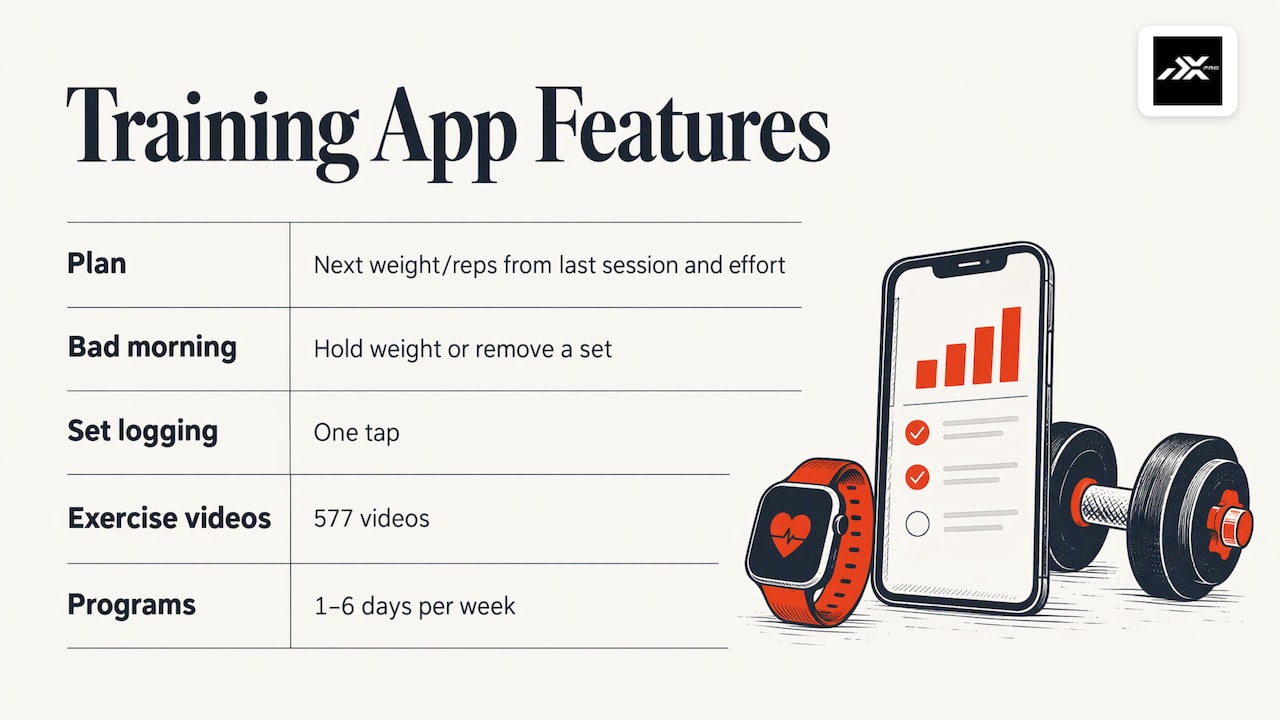
Athlxpro is a strength training app for iPhone and Apple Watch, built on progressive overload. It adds or drops weight for your next session from the sets you logged last time. You also answer a morning check-in, and on a bad morning the app holds the weight or takes a set off. Only your logged sets and that check-in change the plan.
You log a set in one tap, and once the plan is on your Apple Watch you can run a full workout from your wrist. The app includes 577 exercise videos, so you can check your squat, hinge and split squat setup, plus weight and volume charts to see your leg numbers climb. Programs run up to 6 days a week.
Athlxpro is a monthly or yearly subscription through the App Store, with a one week free trial, then $14.99 per month or $89.99 per year (US prices; other countries see theirs in the App Store). You can see the details and get started on the Athlxpro site.
Common mistakes to avoid
- Doing the lightest work first. Leg extensions before squats leaves you tired for the lift that matters. Put the heavy compound first.
- Cutting rest short. Two minutes and thirty seconds feels long. It buys you better sets.
- Chasing depth you can’t control. Depth depends on your mobility. Go as low as you can while keeping heels down and your back position steady.
- Skipping the hinge. Squat-only leg days under-train the hamstrings. Include a Romanian deadlift or similar.
- Adding weight every session. Add a little weight or a rep per week, not a jump every workout.
- Ignoring single-leg work. It shows imbalances that bilateral lifts can hide.
FAQ
What are the best compound exercises for legs?
The core set is a squat variation (back squat, front squat, goblet squat or leg press), a hip hinge such as the Romanian deadlift, and a single-leg lift such as a Bulgarian split squat or walking lunge. Together they work the quads, glutes, hamstrings and, to a lesser degree, the calves. Add calf raises to finish.
How many sets and reps should a compound leg workout have?
For intermediate lifters, a common structure is 3-4 sets of 4-8 reps on the main squat or press, 3 sets of 6-10 on a hinge, and 2-3 sets of 10-15 on isolation work. Beginners can use 3 to 5 exercises of 3 sets of 8 to 12 reps. Rest 2-3 minutes between heavy compound sets.
Should I do compound or isolation exercises first on leg day?
Start with compounds. They are heavier and more technical, and you lift more total volume on a movement when it comes first in a session. Isolation moves like leg curls and extensions come after, when you need less energy and less coordination.
How often should I train legs?
Two sessions a week suits most people, with at least two rest days between them. Total weekly hard sets matter more than frequency, so pick a schedule you can repeat. If you are very sore or your lifts drop, add a recovery day.
Sources
- Leg Workouts: The 15 Best Leg Exercises, and How to Plan a Workout (Healthline)
- The Top 10 Best Compound Exercises For Stronger Legs (BuiltWithScience)
- Understanding Exercise Order (NCSF)
- How to Structure Leg Day for Strength and Hypertrophy (The Workout Mag)
- Exercise Order: Which Exercises Should You Do First? (Outlift)
- Damien Patrick’s Workout Plan for Massive Legs (Muscle & Fitness)
- The New Rules of Leg Day (Men’s Health)
- 4-Week Legs and Glutes Workout (Men’s Health)
- Exercise Technique: Dumbbell Squat, Dumbbell Split Squat (NSCA)
- The Ultimate Leg Press Guide (Trojan Fitness)
- Beginner Training Programme: Definition & Principles (Institute of Personal Trainers)
- Dumbbell Leg Workout for Beginners (Fitness Drum)