
PHUL stands for Power Hypertrophy Upper Lower. It is a four-day program: two upper body days and two lower body days, with one day of each built around heavy, low-rep strength work and one built around higher-rep muscle building. Every major muscle group gets trained twice a week. Below you will find the weekly layout, the exercises and rep ranges, how to add weight, how to adapt the plan if four days is too much or too little, and how to tell when you need an easier week.
TL;DR
- PHUL is a 4-day split: Upper Power, Lower Power, Upper Hypertrophy, Lower Hypertrophy.
- Power days use heavy compound lifts in the 3 to 5 rep range. Hypertrophy days use moderate and higher reps.
- It is listed as an intermediate program, so beginners should start with less total volume.
- Standard PHUL has no built-in deload, so you need to watch fatigue and plan lighter weeks yourself.
- Logging weight, reps and effort every session is what makes the progression work.
Table of Contents
- What PHUL is and where it comes from
- The weekly layout
- Upper Power day
- Lower Power day
- Upper Hypertrophy day
- Lower Hypertrophy day
- How to progress on PHUL
- Keep effort in check
- Is PHUL right for you?
- Adapting PHUL to your schedule
- Monitoring recovery on PHUL
- Running PHUL with Athlxpro
- Common questions
- Sources
What PHUL is and where it comes from
PHUL was created by Brandon Campbell and, according to a reference summary, first formally published on Muscle & Strength in 2013 as a 12-week intermediate program for building strength and size. Muscle & Strength’s guide describes it as a four-day routine aimed at both strength and size, with each muscle group hit twice weekly.
The idea is simple. A pure strength program leaves size on the table, and a pure bodybuilding split rarely pushes the heavy lifts. PHUL splits the difference by giving each half of the body one heavy day and one volume day every week.
The weekly layout
The standard week, as laid out by Muscle & Strength, looks like this:
| Day | Session |
|---|---|
| Day 1 | Upper Power |
| Day 2 | Lower Power |
| Day 3 | Rest |
| Day 4 | Upper Hypertrophy |
| Day 5 | Lower Hypertrophy |
| Days 6 and 7 | Rest |
The rest day in the middle gives you a break after the two heavy days, and the weekend gives you two full days off after the volume days. Most people map Day 1 to Monday, but any pattern that keeps the same order works.
Upper Power day
This day is about moving heavy loads on the big upper body lifts. The original template uses:
- Bench press: 3 to 4 sets of 3 to 5
- Incline dumbbell bench press: 3 to 4 sets of 6 to 10
- Bent-over row: 3 to 4 sets of 3 to 5
- Lat pulldown: 3 to 4 sets of 6 to 10
- Overhead press: 2 to 3 sets of 5 to 8
- Barbell curl: 2 to 3 sets of 6 to 10
- Skullcrusher: 2 to 3 sets of 6 to 10
The pressing and rowing come first because they are the most demanding. If you want a deeper look at ordering pressing movements, our guide to push day exercises covers sets, reps and sequence.
Lower Power day
The template pairs the heavy squat and deadlift with machine and isolation work: squat, deadlift, leg press, leg curl and calf raises. The squat and deadlift are the top priority, so give them your best energy and your longest rest periods. Leg press, leg curls and calves are where you pick up extra volume without much technical risk.

Upper Hypertrophy day
This session moves to higher reps and more variety. The original template uses incline press, flye, cable row, one-arm row, lateral raise, curl and triceps extension. Loads are lighter than on the power day, and the goal is to get close to the end of each set with good control, not to grind out a max.
Lower Hypertrophy day
The lower volume day uses front squat, lunge, leg extension, leg curl and calves. These moves load the quads and hamstrings through longer ranges and with less spinal stress than a heavy deadlift. Expect more muscle burn and less nervous system fatigue than on Day 2.
How to progress on PHUL
Progression differs by day. Tiger Fitness describes the approach this way:
- Power days: add weight once all your sets reach the top of the 3 to 5 rep range.
- Hypertrophy days: add reps first, then add load once all sets reach the top of the range.
A second guide suggests aiming to add weight or reps each session at an RPE of 8 to 9, which keeps compound lifts moving without going to failure.
This is where most people slip. If you cannot recall last week’s numbers, you either go too light and stall, or too heavy and miss reps. A written record fixes that. Our guide on how to track workouts shows a simple system you can use with a notebook or an app.
A worked example
Say you bench 185 pounds for sets of 5, 5, 4 on Upper Power. You stay at 185 next week and aim for 5, 5, 5. Once every set reaches 5 with the effort feeling like an 8 or 9, you move up to the next small jump. On Upper Hypertrophy you might do incline dumbbell press for 3 sets of 8 to 12. You add a rep or two each week until all sets hit 12, then raise the dumbbells and start again near 8.
Keep effort in check
The hypertrophy-day advice from Muscle & Strength is to keep power days on compounds, use the other two days for muscle-building work, begin with lower total volume, and leave at least one rep in reserve on all sets. That last point matters. Twice-weekly training for every muscle group adds up quickly, and sets taken to failure on all four days will catch up with you.
Is PHUL right for you?
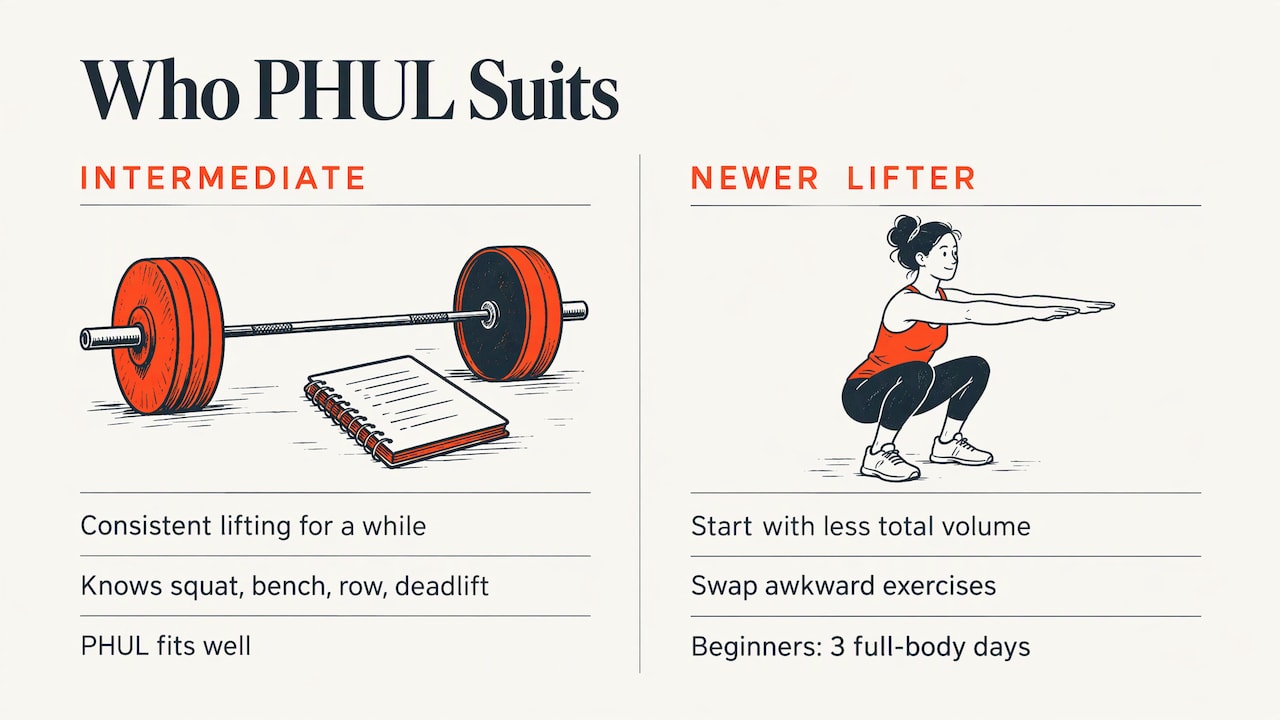
PHUL is listed as an intermediate program. If you have been lifting consistently for a while and know your technique on squat, bench, row and deadlift, it fits well. If you are newer, start with less total volume until you are used to the workload, and swap in similar exercises where a lift feels awkward while keeping the main compounds where possible.
True beginners may be better off with three full-body days first. Our beginner lifting plan is a 3-day full-body routine that builds the base PHUL assumes.
Adapting PHUL to your schedule
Three days a week
One published adaptation alternates the upper and lower hypertrophy sessions from week to week. It lowers frequency and volume, but most muscles still get hit twice weekly. If three days is your ceiling, our article on a 3 day weight training split compares four layouts and how to choose.
Six days a week
The same source describes a six-day variation that repeats the power or hypertrophy upper and lower sessions. It calls for two or three recovery days afterward and notes most trainees may struggle to recover from it. Treat it as something to earn over time, not a starting point.
Monitoring recovery on PHUL
Standard PHUL has no deload built in. One guide suggests considering a deload after four to six weeks of progress. A common approach in another summary is to cut load 5 to 10% for a week if reps drop in two sessions in a row.
What should you log? The Elevated Muscle guide suggests tracking loads, reps, rest, RIR or RPE, technique, pain, sleep, soreness and session RPE. Then look at trends: how fast your warm-up feels, technical quality, joint comfort, motivation and performance across similar workouts.
A few signs worth acting on:
- Several indicators getting worse at the same time.
- Reps falling on lifts you normally hit.
- Higher RPE than usual for the same load. Sports recovery research notes that higher-than-usual RPE for a similar bout can point to insufficient recovery.
When that happens, stop adding load or sets, drop optional failure and isolation work, reduce workload, add recovery, or take a lighter week. One bad night is not necessarily a reason to cut a session: repeated decline alongside poor sleep, rising soreness and higher session RPE tells you more. The same source material notes there is no single gold-standard measure of fatigue, so objective and subjective signals are best read together. For the sleep side, see sleep and muscle recovery.
Running PHUL with Athlxpro
PHUL works when you progress with precision, and that depends on remembering last week. Athlxpro is a strength training app for iPhone and Apple Watch. It sets your next weight and reps from your last session and how hard it felt, and it adjusts to your morning check-in: on a bad morning it holds the weight or takes a set off. You log a set in one tap, and a full workout can run on Apple Watch once the plan is on the watch.
Programs in Athlxpro are built on progressive overload and effort-based training, which matches the logic of PHUL’s power and hypertrophy days. Training, food, sleep, steps and heart rate are on one screen, and 577 exercise videos help with technique on lifts like the front squat or one-arm row. Athlxpro is a subscription, monthly or yearly, through the App Store. See Athlxpro on iPhone and Apple Watch for the plans.
Common questions
How many days a week is PHUL?
PHUL is a four-day program. You train upper power, lower power, upper hypertrophy and lower hypertrophy, with rest days between the two halves of the week. Each muscle group is trained twice weekly.
Is PHUL good for beginners?
It is listed as an intermediate program. If you are newer, start with less volume, keep the main compounds and swap in similar exercises where needed. A 3-day full-body plan is a gentler first step.
Does PHUL include a deload?
Not in its standard form. Plan a lighter week after four to six weeks of progress, or sooner if performance stalls and several fatigue signs worsen together.
Can I run PHUL on three days?
Yes. One adaptation alternates the upper and lower hypertrophy sessions weekly. You lose some frequency and volume, but most muscles still train about twice per week.
Sources
- Power Hypertrophy Upper Lower (P.H.U.L.) Workout, Muscle & Strength
- PHUL, Grokipedia
- PHUL Workout: 4 Day Power Hypertrophy Split, Tiger Fitness
- PHUL (Power Hypertrophy Upper/Lower) Workout Program, Inspire US
- PHUL Workout Plan: 4-Day Strength & Hypertrophy, Elevated Muscle
- Monitoring to Support Recovery, Gatorade Sports Science Institute