
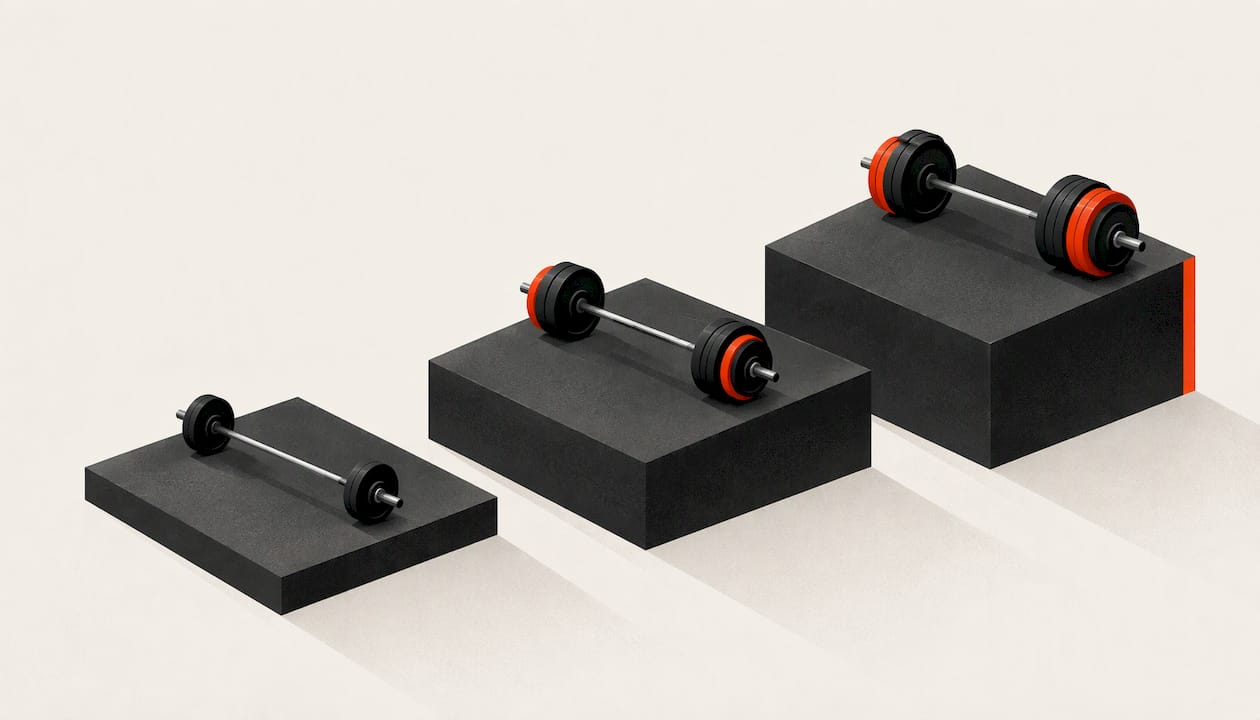
Strength training progression means asking your muscles for slightly more than last time, then repeating that request for months. You do it by adding weight, reps, sets or training frequency in small steps, and by judging each step against how hard the last session felt. The hard part is not the idea. It is remembering last week’s numbers and deciding the next step honestly. That is the job Athlxpro takes on: it sets your next weight and reps from the sets you logged last time.
TL;DR
- Progression is a small, steady increase in the demand you place on a muscle. ACSM’s 2026 Position Stand says the increase can be slight, as long as it keeps coming.
- Change one thing at a time: weight, reps, sets or rest. A common guideline is a 2 to 10% load increase once you beat your target reps on two sessions in a row.
- Rate every set by effort, not only by numbers. Leaving 1 to 3 reps in reserve keeps progress steady.
- Train each major muscle group at least twice a week. Consistency matters more than a complicated plan.
- When progress stalls, add a planned lighter week before you add more work.
Table of Contents
- What progression actually means
- Five ways to progress a lift
- When to add weight, and how much
- Use effort as well as numbers
- How much training you need
- What to track from session to session
- How fast to expect progress
- When progress stalls
- Let the app do the arithmetic
- FAQ
- Sources
What progression actually means
Your body adapts only to demands it has not met before. Lift the same weight for the same reps every week and, after the first few sessions, nothing new is asked of your muscles. That is why ACSM’s 2026 Position Stand describes progressive overload as the need to increase the stimulus over a program, whether through load, volume, frequency, exercise selection or duration, even if only slightly.
Progression also has limits. An earlier ACSM position stand on progression models notes that no one can keep improving at the same rate over the long term. Smart adjustments of your program variables can limit plateaus, but they cannot abolish them. Expect fast early gains and slower ones later. That is normal, not a sign you are doing something wrong.
Five ways to progress a lift
You have more levers than the barbell. Cleveland Clinic lists more weight, more repetitions, more sets and shorter rests between sets, and advises changing one factor at a time so you know what worked.
| Lever | What you do | Best for |
|---|---|---|
| Add weight | Increase the load while keeping reps the same | Main lifts when reps are hitting the top of your range |
| Add reps | Do more reps at the same weight | Isolation work, or when the next weight jump is too big |
| Add sets | Do one more set of an exercise | When weight and reps are both stuck |
| Shorten rest | Cut the pause between sets | Short sessions and lighter exercises |
| Lower the effort | Do the same work, but it feels easier | A sign you are ready to push the next step |
The last row surprises people. If you lift the same weight for the same reps and it felt like a 9 out of 10 last time but a 7 this time, you have progressed. Your capacity went up even though the numbers did not move.
Also keep technique in the picture. Progress that comes from bouncing the bar, rushing reps or cutting range of motion is not progress, because next month you cannot repeat it. Keep the movement the same and raise the demand around it.
When to add weight, and how much
The most useful rule comes from ACSM’s progression models: increase the load by 2 to 10% when you can complete your current weight for one to two reps over your target on two consecutive sessions. The same paper recommends only small increases in training volume, 2.5 to 5%, to avoid overtraining.
Here is a worked example with a squat.
- Your target is 3 sets of 8 reps at 100 lb.
- Monday you manage 9 reps on your sets. Thursday you manage 9 again.
- That is one rep over target on two sessions in a row, so you add weight.
- A 2 to 10% jump on 100 lb is 102 to 110 lb. Most people round to the nearest plate they own and pick 105 lb.
- Next session you will probably drop back toward 8 reps. Stay there until you hit 9 twice again.
Smaller lifts and upper body moves usually need the smaller end of that range, because a 10 lb jump on a lateral raise is enormous. Big leg lifts tolerate more. If you only have large plates, add reps first and wait for the weight jump.
Use effort as well as numbers
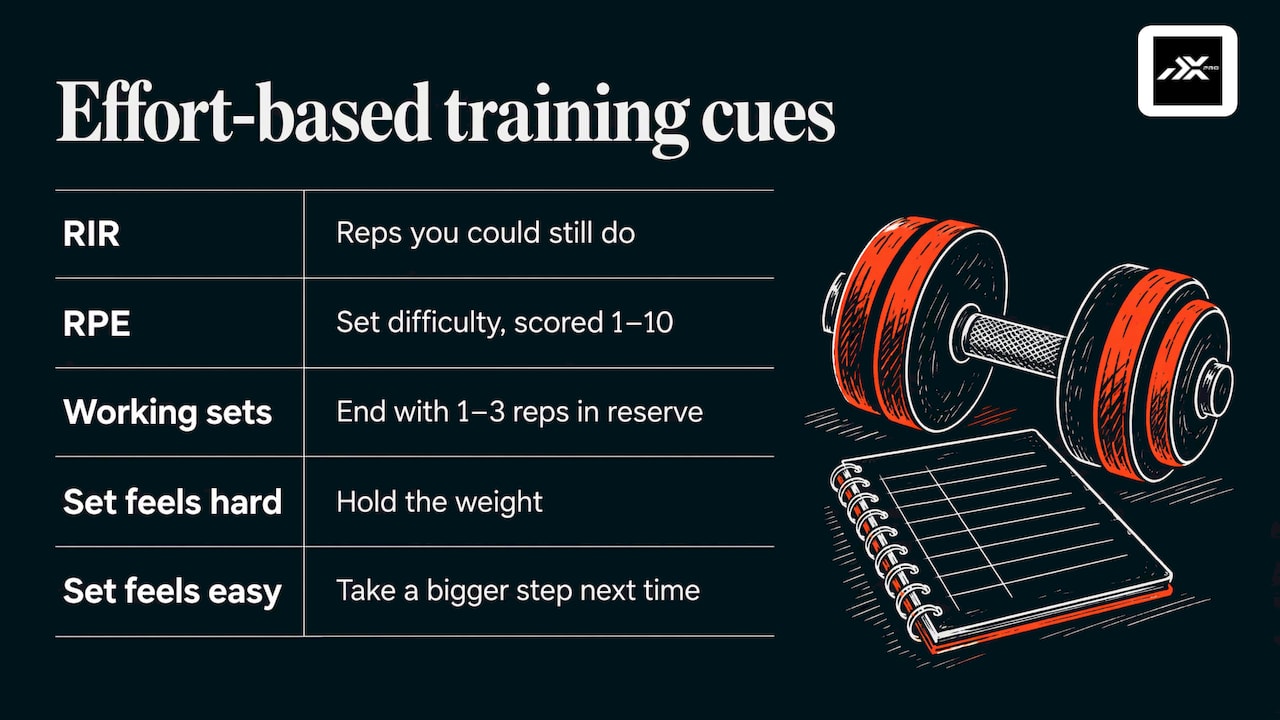
Numbers alone miss how you slept, how stressed you are and how the last set really felt. Two common effort scales fix that. Reps in reserve (RIR) is how many more reps you could have done when you stopped. The rating of perceived exertion (RPE) is a 1 to 10 score of how hard a set felt.
A 2020 review of methods for regulating and monitoring resistance training found that session ratings, RIR-based ratings and post-set effort scores were strongly associated with training performance. It also described practical autoregulation: assign a rep target at a given RIR-based effort score, and adjust load based on how the sets actually go.
In plain terms: if a set that should leave 2 reps in reserve felt like a grind, hold the weight. If it felt easy, take a bigger step next time. NASM’s hypertrophy programming guide suggests ending most working sets with 1 to 3 reps in reserve.
This is the logic behind effort-based training. The programs in Athlxpro are built on progressive overload, so the sets you log decide your next prescription.
How much training you need
Progression only works if there is enough training to progress. The 2026 ACSM guidelines, as summarized by ACSM, recommend training all major muscle groups at least twice a week. One of the position stand’s authors, Stuart Phillips, says that matters far more than chasing a perfect or complex plan.
The Position Stand itself, which synthesized 137 systematic reviews, adds specifics:
- For strength: loads of at least 80% of your one-rep max (the heaviest weight you can lift once), 2 to 3 sets, at least two sessions per week.
- For muscle size: at least 10 sets per muscle group per week.
The same document found that training to momentary failure, the type of equipment, set structure and complex periodization did not consistently change outcomes for healthy adults. You do not need to hunt for the perfect method. You need a reasonable plan that you repeat and slowly make harder.
If you are unsure how to fit that into your week, a plan of 1 to 6 training days is enough to cover every muscle twice. Our guides to a beginner full-body routine and a strength training planner show how the sets add up.
What to track from session to session
To progress on purpose, you need to know what you did last time. Track four things for every working set:
- The exercise and the weight.
- The reps you completed.
- How hard it felt, as RIR or RPE.
- Anything unusual: poor sleep, a missed meal, a sore joint.
Beyond the logbook, NASM recommends tracking loads, reps and quality, plus measurements and photos, and notes that scale weight alone tells an incomplete story.
The weak point of any paper log is the moment you need it. Mid-workout, with chalk on your hands, nobody wants to flip pages or work out a percentage. In Athlxpro you log a set in one tap, and a full workout can run on Apple Watch once the plan is on the watch. Weight and volume charts, records, awards, XP and levels show the trend over weeks. If you train with Apple Watch, our guide to tracking lifts properly on Apple Watch goes through the setup.
How fast to expect progress
Early gains are real but mostly neurological. Cleveland Clinic says strength improvements can show up in three to four weeks, while visible muscle changes can take up to six months or more. Its experts describe the first three weeks as neuromuscular reeducation, when your muscles learn the movement. An ACSM review of progression adds that muscle growth becomes evident within roughly 4 to 8 weeks, and the nervous system drives much of the early strength increase.
So in your first month, expect your numbers to climb quickly. After that, expect a slower pattern: a bit more weight every week or two on some lifts, a bit more reps on others, and the occasional week with no change. Do not judge a plan on one session. Judge it on a month of logs.
When progress stalls
A stall is data. Before you add more work, ask three questions:
- Did I hit the same rep target at a lower effort? That is progress too.
- Is my recovery behind my training? Poor sleep alone can flatten your numbers, and our piece on sleep and muscle recovery covers the research.
- Have I gone several weeks without a lighter week?
The last one is common. A 2024 survey of strength and physique athletes found a typical deload lasted about 6.4 days and came around every 5.6 weeks. Lifters mostly kept their training frequency but cut reps per set and sets per week, lowered the load and left more reps in reserve. The leading reasons for deloading were that the program said so, feeling beat up, and stalled or falling performance.
Try this sequence when you stall:
- Hold the weight for one more session and aim for one more rep.
- If that fails, add one set to that exercise.
- If you are tired across several lifts, take a lighter week: fewer sets, more reps in reserve, same days.
- Return to your normal plan and restart the weight rule from the top.
Bad mornings follow the same logic on a smaller scale. Pushing the planned weight on a day you slept badly is how one off day becomes a lost week. Athlxpro handles this with a morning check-in: on a bad morning it holds the weight or takes a set off, and only your logged sets and that check-in change the plan.
Let the app do the arithmetic
Everything above comes down to remembering numbers, applying a rule and judging effort. That is arithmetic and memory work, and it is where most lifters lose a few percent a month without noticing.
Athlxpro is a strength training app for iPhone and Apple Watch that adds or drops weight for your next session from the sets you logged last time, so you never have to remember last week’s weights. A morning check-in adjusts the plan to how you feel. Your training, food, sleep, steps and heart rate appear on one screen, and Alex, the AI coach, sees them. Apple Health data needs your consent. 577 exercise videos show the movement you are loading. It is a monthly or yearly subscription through the App Store, with a one week free trial, then $14.99 per month or $89.99 per year (US prices; other countries see theirs in the App Store).
If you want your progression decided for you, one set at a time, try Athlxpro on iPhone and Apple Watch. If you are still choosing a program structure, our guide to a personalized workout plan that adapts is a good next read.
FAQ
How often should I increase the weight?
When you complete one to two reps over your target on two sessions in a row, the ACSM progression guideline suggests adding 2 to 10% to the load. Beginners often get there every week or two. Experienced lifters take longer and may progress through reps or sets in between.
Is it better to add weight or reps?
Both count. Adding weight is the usual choice for main lifts, and adding reps suits smaller lifts or moments when the next weight jump is too large. Change one at a time, as Cleveland Clinic advises, so you can see which change moved your numbers.
How many sets per muscle should I do each week?
The 2026 ACSM Position Stand says muscle growth is enhanced by at least 10 sets per muscle group per week. Strength is enhanced by loads of at least 80% of your one-rep max, for 2 to 3 sets, in two or more sessions a week. Start near the lower end and add sets only when weight and reps stop moving.
Do I need to train to failure to progress?
No. The 2026 ACSM Position Stand found that training to momentary failure did not consistently change outcomes for healthy adults. Ending sets with 1 to 3 reps in reserve keeps quality high and recovery manageable.
What should I do if I am new to lifting?
Start with a simple full-body plan, learn the movements with light loads and log every session. Early strength gains come quickly, as the first weeks are mostly your nervous system learning the lift. If you have a medical condition or an injury, check with your doctor before you begin a new training program.
Sources
- American College of Sports Medicine Position Stand, 2026
- ACSM Publishes Updated Resistance Training Guidelines
- Progression Models in Resistance Training for Healthy Adults, ACSM 2002
- Fundamentals of Resistance Training: Progression, 2004
- Cleveland Clinic: Should You Try Progressive Overload Training?
- Cleveland Clinic: How Long Does It Take To Build Muscle Mass?
- Methods for Regulating and Monitoring Resistance Training, 2020
- NASM: Muscular Hypertrophy Programming
- Deloading Practices in Strength and Physique Sports, 2024