
The Mike Mentzer workout routine is called Heavy Duty. It trains each muscle with one all-out working set per exercise, takes that set to failure, and then rests for days before the next session. A classic version rotates four workouts (chest and back, legs, shoulders and arms, legs again) and starts with one session every four days. This guide covers the exercises, the rep ranges, the recovery gaps, how to progress, and how the approach compares with what training research has found.
TL;DR
- Heavy Duty is built on three principles: training must be intense, brief and infrequent.
- The routine prescribes one working set per exercise, usually for 6 to 10 strict reps, taken to failure.
- You begin with one workout every four days and add rest days when progress stalls.
- Progress by adding weight once you pass 10 reps, and keep a chart so you can see every change.
- Research shows low-volume training can build strength, but higher weekly volume tends to do better for muscle size. Treat the routine as a starting framework and adjust it to your own results.
Table of Contents
- What Heavy Duty actually is
- The four-workout rotation
- Sets, reps and how close to failure
- How often to train: the recovery rule
- How to progress the weights
- A two-workout version: the Consolidated Program
- Is it right for beginners?
- What research says about low-volume training
- Tracking Heavy Duty without losing the thread
- Where Athlxpro fits
- FAQ
- Sources
What Heavy Duty actually is
Mike Mentzer’s method rests on a simple chain of logic. Training has to be intense enough to stimulate strength and size. It has to be brief so it uses little of your recovery resources. It has to be infrequent so you do not end up overtrained. Those are the three principles as laid out in a 2003 Iron Man Magazine Q&A.
Intensity has a specific meaning here. Mentzer defined it as the percentage of possible momentary muscular effort being exerted. Because you can only verify that you gave close to 100% by lifting until you cannot complete another rep, the working set goes to failure. That is why the routine looks so small on paper: one set, but a set where nothing is held back.
It also explains why heavier weights and fewer reps are preferred. The same guide notes that it is easier to reach the intensity needed for mechanical tension with heavier loads and fewer reps.
The four-workout rotation
The classic Heavy Duty rotation, as described in Iron Man Magazine, alternates four workouts:
| Workout | Focus |
|---|---|
| 1 | Chest and back |
| 2 | Legs |
| 3 | Shoulders and arms |
| 4 | Legs |
Legs appear twice because the large muscles of the lower body are a major part of the program. You work through the four workouts in order and then start again at workout 1.
Exercise order matters in the original version. Mentzer’s 1979 back workout used pullovers right before pulldowns as a pre-exhaust superset. The pullover isolates the lats, and the pulldown then works the lats along with the biceps and rear delts, so the larger muscle is already fatigued when you reach the compound move. The last warmup set used roughly 75% of the working weight and stopped short of failure, so you arrived at the working set prepared but not tired.
Sets, reps and how close to failure
The rules are short:
- One working set per exercise. Warmups come before it and do not count.
- 6 to 10 reps for most exercises. Mentzer’s experience with clients convinced him this range was ideal for most movements.
- 12 to 20 reps for calves, which he found responded better to higher reps.
- Lower reps on the compound half of a pre-exhaust set: 1 to 3 for incline presses, 3 to 5 for dips.
- Strict form. Reps are performed under control, taken to failure, with no bouncing, jerking or thrusting of the bar.
The form rule is the safety rule. Heavy Duty is described as a high-intensity, moderate-force program, which the same article presents as safer than ballistic low-rep training, where high force creates a far greater potential for injury. Lift, hold and lower the weight deliberately. If a rep needs momentum to finish, the set is over.
Forced reps, negatives and rest-pause
Beyond failure, the techniques Heavy Duty prescribed most were forced reps, negative reps and rest-pause. Mentzer trained with at least one partner who spotted him and helped him past the point of failure. If you train alone, these techniques are not available in the same way, and a set to failure on a heavy barbell lift should be done in a rack or with safety arms set at the right height.
Rest-pause also comes with an experience requirement. Mentzer said it is not recommended for beginners. In his view it suits only bodybuilders with at least two years of hard training and fairly advanced development, and then for short periods of no more than six weeks.
How often to train: the recovery rule
This is the part most people get wrong. Heavy Duty is not “train hard every day with one set.” Initially you train only once every four days, rotating through the four workouts. When your strength plateaus, you work out even less often and add one or two extra rest days between sessions.
Mentzer’s reasoning was that every strength gain cuts a deeper inroad into your recovery ability, and recovery ability does not keep pace with size and strength. So as you grow stronger, the gap between sessions grows too: six days, seven days or more. He also argued that recovery can take upward of five days, and that growth happens after recovery, so more time has to pass before you return.
The practical version looks like this:
- Start with one workout every four days, following the rotation.
- Track the weight and reps of every working set.
- When the numbers stop climbing, add a day or two of rest between workouts.
- If you stall again, take a full week off, then resume the same routine at one session every seven days. That is Mentzer’s own advice for overtraining.
Sleep sits at the center of recovery, whatever training style you follow. If you are stretching out your rest days, our piece on sleep and muscle recovery covers what the research says.
How to progress the weights
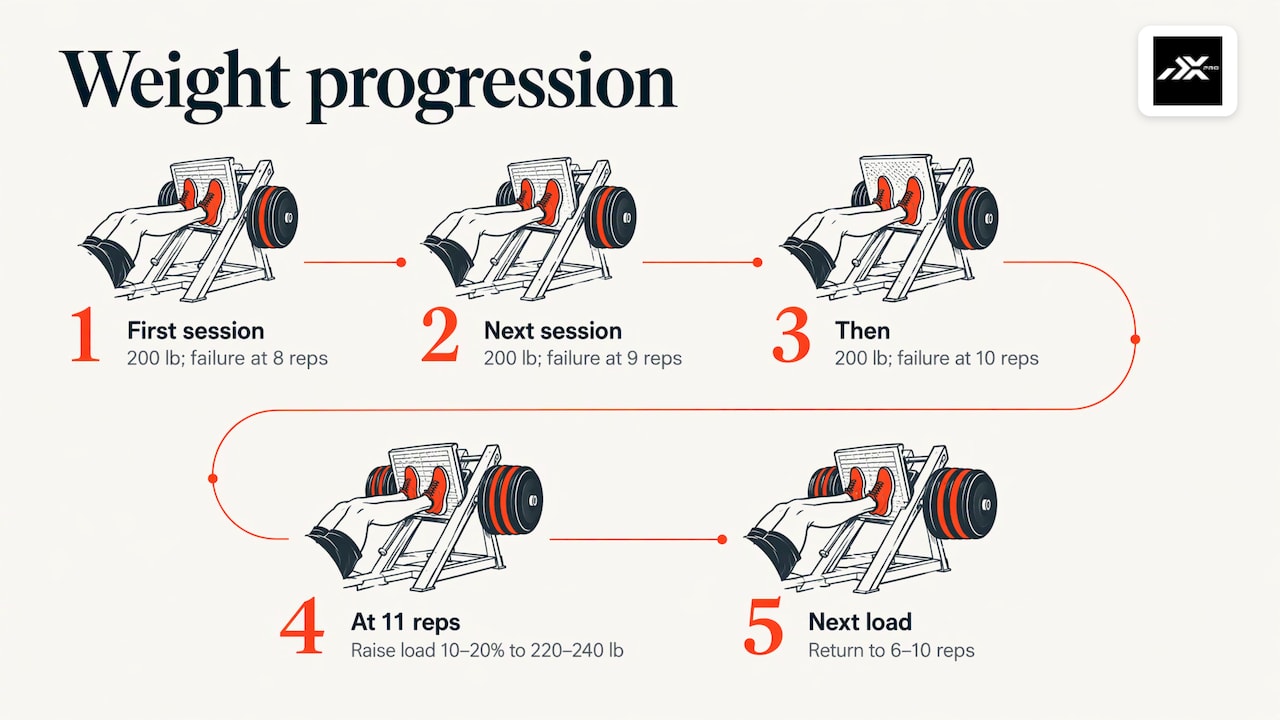
Progression is a double-progression scheme. Pick a weight you can lift for about 6 to 10 strict reps and take the set to failure. When you manage more than 10 reps, raise the weight by about 10 to 20 percent, or whatever amount puts you back in the 6 to 10 range. Keep a progress chart.
A worked example: you leg press 200 lb and reach failure at 8 reps. Next session you get 9, then 10. When you hit 11, you raise the weight to roughly 220 to 240 lb, or the nearest amount that drops you back to 6 to 10. The chart makes this obvious. Without it, you have to remember what you lifted nine days ago.
A two-workout version: the Consolidated Program
Later in his career Mentzer cut volume even further. The Consolidated Program, as published on mikementzer.org, uses two alternating workouts:
- Workout A: squat or leg press for one working set of 8 to 15 reps, then a close-grip palms-up pulldown for one working set of 6 to 10 reps.
- Workout B: conventional or trap-bar deadlift for one working set of 5 to 8 reps, then a parallel-bar dip for one working set of 6 to 10 reps.
Sessions are separated by seven days of recovery, so each workout comes around once every fourteen days. It is the extreme end of the method, and it only makes sense if you are truly reaching failure on those sets.
Is it right for beginners?
Mentzer himself pointed beginners toward something more conventional. In the rest-pause article, he said beginners develop best on routines that emphasize basic exercises, few sets and moderate reps. That is useful guidance if you are new: learn the lifts, build a base, and keep the failure work limited while your technique is still forming.
If that is where you are, a structured full-body plan is a good place to start. We lay one out in our beginner lifting plan, and the 3 day weight training split guide shows how to choose among several layouts.
What research says about low-volume training
Heavy Duty makes strong claims, so it helps to see what controlled studies have found. The answer is mixed, and it depends on whether your goal is strength or muscle size.
In favor of low volume: a 2016 study compared low-volume high-intensity training (16 people) with higher-volume bodybuilding training (14 people), twice weekly for 10 weeks. Both groups improved significantly, and the high-intensity group had significantly greater gains in 3 of 9 exercises. The authors noted that the reasons for the differences were unclear, since several training variables differed between the groups.
Pointing toward more volume: a 2017 meta-analysis found a graded dose-response relationship, where more weekly sets produced greater muscle growth. A 2022 systematic review concluded that 12 to 20 weekly sets per muscle group may be an optimum recommendation for young, trained men. A 2023 network meta-analysis ranked higher-load, multiset, twice-weekly training highest for hypertrophy.
On frequency: a 2018 meta-analysis found that more frequent training improved strength gains, but when volume was equated the effect of frequency was not significant. So what matters most is the total amount of hard work. How it is split across the week matters less. One strength coach argues that muscles are ready again after two to three days, and that hitting a muscle 2 to 3 times a week beats a couple of all-out sets every one to two weeks.
What this means for you: Heavy Duty gives you a clear rule, take the set to failure, and a clear reason to respect recovery. If you follow it, treat the rest gaps as something your own numbers should set. If your weights climb each session, your recovery is keeping up. If they stall, add rest as Mentzer advised. If you want more weekly volume or frequency, other splits do that. Our Dorian Yates training program guide covers another low-volume, high-effort split, and PHUL workouts show a four-day alternative with more sets.
Tracking Heavy Duty without losing the thread
The routine depends on your records. With one working set per exercise and rest gaps of four, seven or fourteen days, you cannot rely on memory to know whether last time was 8 reps at 200 lb or 9 at 190. Heavy Duty tells you to keep a chart for exactly this reason. Our guide on how to track workouts shows a simple system, and the strength training planner article explains how to build a plan around it.
A few habits make the log useful:
- Write down weight, reps and how the set felt, including whether you truly reached failure.
- Note the gap since the previous session, because that gap is a variable in this routine.
- Record warmup weights once, so you can repeat the same ramp each time.
- Review the trend before each session and decide whether to add weight or rest.
Where Athlxpro fits
Athlxpro is a strength training app for iPhone and Apple Watch. It adds or drops weight for your next session from the sets you logged last time, so you never have to remember last week’s weights. Its programs are built on progressive overload, with plans of up to 6 days a week.
The morning check-in adds a second layer. On a bad morning, the app holds the weight or takes a set off. That echoes the spirit of Heavy Duty, where effort and recovery decide what you do next. You log a set in one tap, and a full workout can run on Apple Watch once the plan is on the watch. Weight and volume charts and records show your trend over time, and PDF and CSV reports are made on your iPhone. If you track a low-frequency routine, you can see every session in one place.
Athlxpro is a subscription, monthly or yearly, through the App Store, with a one week free trial, then $14.99 per month or $89.99 per year (US prices; other countries see theirs in the App Store). You can see the plans at athlxpro.com.
FAQ
How many days a week is the Mike Mentzer workout?
Not many. The classic version starts with one workout every four days, rotating four workouts. As strength plateaus, you add one or two rest days, and later versions space sessions six to seven days or more. The two-workout Consolidated Program has each workout come around once every fourteen days.
How many sets does Heavy Duty use per exercise?
One working set per exercise, after warmups, taken to failure. Most exercises use 6 to 10 reps, calves use 12 to 20, and the compound half of a pre-exhaust set uses fewer reps. Every rep is performed strictly and under control.
What do I do when my progress stalls?
Mentzer’s first answer was more rest, not more work. He advised taking a full week off, then resuming the same routine but training once every seven days instead of once every four. Your logged numbers tell you when this is needed.
Can a beginner use the Mike Mentzer routine?
Beginners are better served by conventional routines built on basic exercises, few sets and moderate reps, according to Mentzer’s own comments on rest-pause training. Build technique first, then bring in failure training gradually.
Is one set really enough to build muscle?
Studies show low-volume training can produce solid gains, including a 10-week trial where it matched or beat higher-volume work in several lifts. Meta-analyses of muscle size, though, tend to favor more weekly sets, so track your results and adjust.
Sources
- Heavy Duty: High Intensity Q&A, Iron Man Magazine
- Mike Mentzer’s Heavy Duty Workout: The Ultimate Guide, The Art of Manliness
- An Introduction to Heavy Duty Training, Part 3, Iron Man Magazine
- Build Muscle Fast With Mike Mentzer’s High-Intensity Workout, Muscle & Fitness
- Heavy Duty: Questions & Answers, Iron Man Magazine
- Heavy Duty: Rest/Pause Training Pt. 2, Iron Man Magazine
- Mike Mentzer’s Consolidated Program, mikementzer.org
- A comparison of low volume high-intensity-training and high volume traditional resistance training, PMC
- Dose-response relationship between weekly resistance training volume and muscle mass, PubMed
- A Systematic Review of The Effects of Different Resistance Training Volumes on Muscle Hypertrophy, PMC
- Resistance training prescription for muscle strength and hypertrophy, PMC
- Effect of Resistance Training Frequency on Gains in Muscular Strength, PubMed
- Is the Heavy Duty training method best for maximum muscle growth, T3