
RPE strength training means choosing your weights by how hard a set felt, not by a fixed percentage. You rate each set on a 1 to 10 scale, then raise, hold or lower the load next time based on that rating. Done consistently, it keeps heavy days heavy and bad days productive. The weak point is memory: you have to know what you lifted last week and how it felt. That is the job Athlxpro takes off your hands, because it sets your next weight and reps from the sets you logged last time.
TL;DR
- RPE is a rating of perceived exertion. In lifting, it is tied to reps in reserve (RIR): RPE 8 means about two clean reps were left.
- For most strength and muscle work, aim for the RPE 6 to 9 zone and keep sets short of a true grind, using a range instead of an exact number.
- Accuracy improves with practice, and it is best when a set is close to failure. Novices tend to misjudge effort.
- Same weight at a lower RPE over time is progress, even without a max test.
- Athlxpro adjusts your next weight and reps from the sets you logged and your morning check-in, and you log a set in one tap.
Table of Contents
- What RPE means in weight training
- Why lifters use RPE instead of fixed percentages
- How to rate a set
- How to use RPE to choose your weight
- What RPE should you train at?
- Where RPE goes wrong
- Track RPE to see progress without max tests
- Readiness: when the morning changes the plan
- Where Athlxpro fits
- Try Athlxpro
- A simple RPE plan to start this week
- FAQ
- Sources
What RPE means in weight training
RPE stands for rating of perceived exertion. The original Borg scale ran from 6 to 20 and was designed mainly for aerobic exercise, while lifters use a 1 to 10 version tied to reps in reserve, as the 2016 review by Helms and colleagues explains.
Reps in reserve, or RIR, is the number of clean repetitions you could still have done when you stopped the set. The two scales translate into each other:
| RPE | Reps left in the tank | What it feels like |
|---|---|---|
| 10 | None | Maximal effort, no more reps possible |
| 9 | About 1 | One more rep, barely |
| 8 | About 2 | Hard, but the bar speed still holds |
| 7 | About 3 | Challenging, controlled |
| 6 | About 4 | Moderate, fast reps |
The link between RPE 8 and about two remaining reps comes from the same Helms review. The review also notes that exact RIR estimates get less precise when more than three reps remain, so the lower rows of the table are rougher estimates than the top ones.
The useful point: RPE is not a measure of how tired you are in general. It is a judgment about one set, made right after you finish it.
Why lifters use RPE instead of fixed percentages
A percentage of your one-rep max assumes you are the same lifter every day. You are not. Sleep, stress and the week before all change what 225 pounds feels like on Tuesday.
This is the idea behind autoregulation. A 2020 review of methods for regulating and monitoring resistance training describes it as adjusting training based on performance, readiness or recovery, with load progression and intensity or volume changes as practical tools. The NSCA Strength & Conditioning Journal defines autoregulated training in much the same way: day-by-day intensity set by current readiness and performance, including neuromuscular fatigue.
The same 2020 review points out that RIR-based RPE is one of the practical methods, while some other measures, such as blood markers or lab-based tests, are logistically restrictive. You need no equipment to use RPE. You need a rating after each set.
Does it work? A 2021 systematic review of 14 studies, 30 training groups and 356 participants found that all the autoregulation protocols increased 1RM, and the authors concluded that subjective and objective methods can help improve maximal strength.
How to rate a set
The method is simple. The skill is in being honest.
- Finish the set with good form. Count only clean reps, the kind you would be happy to film.
- Ask how many more clean reps you could have done. Not heroic reps. Clean ones.
- Convert that number to RPE. Two left is RPE 8. One left is RPE 9. None left is RPE 10.
- Write it down immediately. Ratings made an hour later drift toward how the whole session felt.
The Helms review recommends familiarizing yourself with the scale before using it to prescribe loads, and notes that experienced lifters generally rate effort more accurately than novices. If you are new, that is not a reason to avoid RPE. It is a reason to start logging it now, so your ratings get sharper.
A calibration trick for beginners
Take one safe exercise, such as a machine press or a goblet squat. Do a set at a weight you expect to be moderate and stop when you think you have two reps left. Then, with good form, see how many reps you actually get. The gap between your estimate and reality is your calibration error. Repeat across a few weeks and the gap shrinks. Skip this on lifts where failure is unsafe, such as a heavy barbell bench press without a spotter or safeties.
How to use RPE to choose your weight
There are two common ways to prescribe effort, and the 2022 randomized trial by Boxman-Zeevi and colleagues describes both.
Fixed reps, variable load. The plan says 3 sets of 8 at RPE 8. You pick a weight you expect to leave about two reps in reserve after eight, then adjust the next set if the effort was off. The catch, noted by the same trial, is that you must predict before the set how it will feel at the end, which can be hard to do accurately.
Open reps, fixed load. You choose a weight and keep lifting until you reach the target RPE. Your rep count becomes the result. This gives the trainee a simpler task but a less clear endpoint.
A 2020 review of autoregulation gives a clean example of the first approach. For 3 sets of 10 at 2 RIR, you choose a load you estimate would allow about 12 reps, then stop at 10. The same review says the next-set load can be adjusted using how earlier sets went.
How much to change the weight
When the rating misses the target, nudge the load, don’t rebuild it. The MASS Research Review guide recommends working to an RPE range rather than demanding an exact rating, and cites an adjustment guide of roughly 2% of load for each 0.5 RPE point outside the target range.
A worked example: your target for squats is RPE 8 and your first set of 5 at 200 pounds felt like a 9.5. That is 1.5 points above target, so three half-point steps, or about 6%. Drop to roughly 188 pounds for the next set. If you land at 7.5 instead, add about 2%, near 204 pounds.
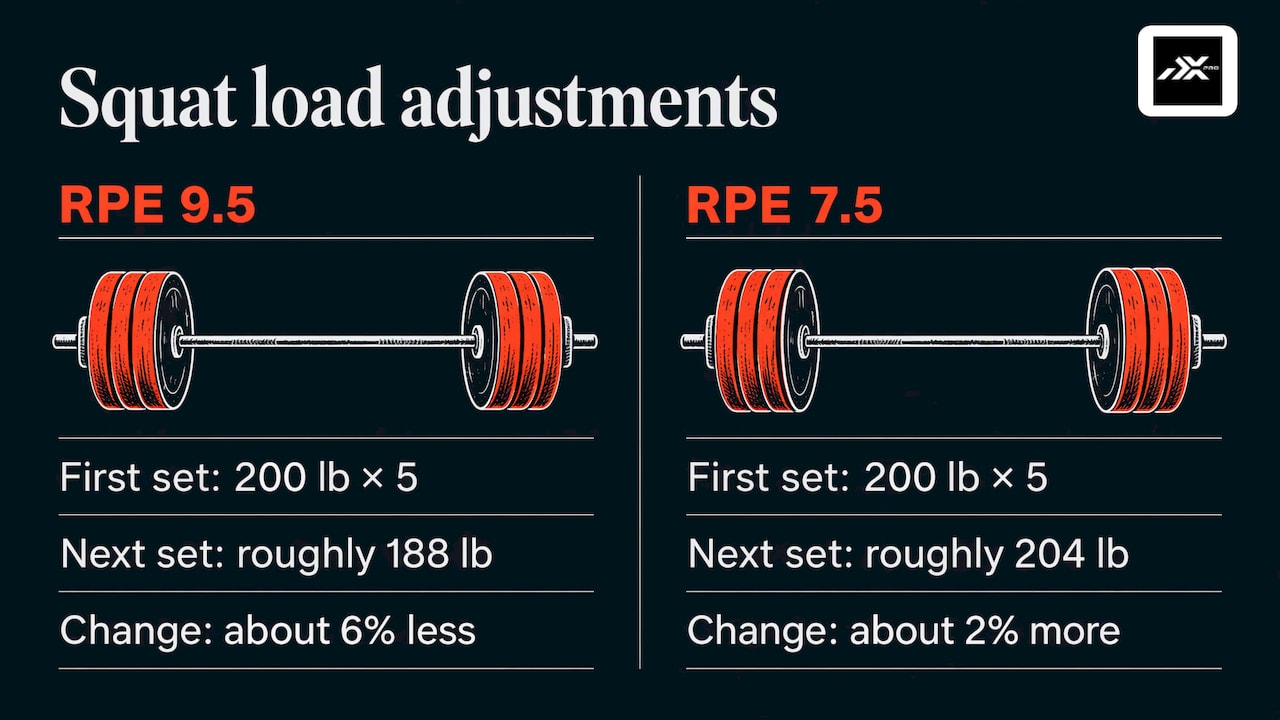
The point is that you use the next set to correct, and the rating makes the correction small and fast.
What RPE should you train at?
The answer depends on the goal, the exercise and where you are in the program.
- Muscle size: the Helms review advises mainly 6 to 12 reps at RPE 8 to 10, with main movements often at RPE 6 to 8.
- Muscular endurance: usually RPE 9 to 10.
- Accumulating volume: the MASS guide describes stopping sets around RPE 7 to 8, and says low-volume, high-intensity work may stop around RPE 9.
In practice, most of your sets belong around RPE 7 to 9. That gives you enough stimulus to progress without taking every set to the edge, which costs recovery. Save RPE 9.5 and 10 for the last set of an exercise or for a planned test day.
Set your range by exercise, too. Compound lifts with a heavy bar, such as squats and deadlifts, are best kept a notch below failure, because form breaks down when you are tired. Isolation work on a machine or cable is safer to push closer to the limit.
Where RPE goes wrong
The research is clear about the limits, and knowing them makes you a better user of the scale.
- Far from failure, estimates blur. Accuracy falls when more than three reps remain, and RIR-based RPE is most appropriate for sets that end relatively near failure. It is not a precise gauge for fast, light power work done far from failure, according to the Helms review.
- Novices misjudge. Expect a few weeks of rough ratings.
- Predicting is harder than recalling. The Boxman-Zeevi trial flags that anticipating the end-of-set effort in advance can be difficult.
- Inflation and deflation. Rating a set 8 because the plan says 8 defeats the purpose. Rate what happened.
- Mixing scales. A 6 to 20 Borg rating is not the same as a 1 to 10 lifting RPE.
The fix for nearly all of these is the same: record every set, every session, in the same way, so the pattern is visible.
Track RPE to see progress without max tests
Max tests are tiring and not something you want to repeat every few weeks. RPE gives you a gentler signal. According to the MASS Research Review, doing the same load at a lower RPE over time indicates improved performance, and tracking RPE has value even when you do not use it to change loads.
Example: three weeks ago, 135 pounds for 8 reps on the bench press was an RPE 9. Today it is an RPE 8. You did not set a record, but you got stronger, and you can raise the weight with confidence. That is how progression works day to day, and it is the logic behind a good strength training progression.
The 2020 review of monitoring methods covered 90 studies and found that perceptual ratings, including RIR-based RPE, are among the practical measures linked to resistance-training performance. The same paper reports strong associations (r of 0.68 or higher) between performance and some measures, including session RPE and RIR-based ratings.
There is a catch for anyone who keeps notes by hand: the data is only useful if you can see last week’s numbers when you are standing at the rack. A good workout set tracker removes that friction.
Readiness: when the morning changes the plan
RPE tells you how a set went. Readiness tells you how the day is likely to go. Lifters often combine the two: a rough night does not cancel training, it changes the dose.
The usual autoregulation moves are small: hold the weight instead of adding, drop a set, or stop a notch earlier. A daily recovery routine for athletes shows how recovery habits sit around training, and your own rating of how you feel that morning is a simple input to the plan.
Be wary of overreading numbers. In a 2020 study of smartphone-derived heart rate variability in 12 powerlifters, morning readings tracked overload and taper phases, while readings taken right before testing did not show significant differences, and agreement between the two timings was wide. Timing matters, and a consistent routine matters more than a single reading.
Where Athlxpro fits
RPE is simple in theory and tedious in practice. You need last week’s weight, last week’s effort, a target and some quick math, all between sets. Athlxpro takes the math off your hands. It adds or drops weight for your next session from the sets you logged last time, so you never have to remember last week’s weights.
Here is how that maps to the routine above:
- Logging: you log the weight and reps of a set in one tap, on iPhone or on Apple Watch.
- Adjusting: the next weight and reps come from your last session and that effort. Only your logged sets and the morning check-in change the plan.
- Bad mornings: the morning check-in lets the plan hold the weight or take a set off when you are not at your best.
- Progress: weight and volume charts, records, awards, XP and levels show what your training adds up to.
- Technique: 577 exercise videos are there when you are unsure of a movement.
Programs are built on progressive overload, and they run 1 to 6 days a week. A full workout can run on Apple Watch once the plan is on the watch, which suits anyone who wants to keep the phone in the locker. Our guides on tracking lifts on Apple Watch and building a personalized workout plan go deeper on both.
Try Athlxpro
If you want the next weight worked out for you, Athlxpro does it from the sets you log, and your next session is planned for you. Alex, our AI coach, sees your training, food, sleep, steps and heart rate on one screen, and the Apple Health data needs your consent. Athlxpro is a monthly or yearly subscription through the App Store, with no ads and no analytics SDKs.
If you train on iPhone or Apple Watch, start with Athlxpro and let the sets you log set the next one.
A simple RPE plan to start this week
- Pick a main lift for each session and an RPE range, such as 7 to 9, for your working sets.
- Choose a weight you expect to leave about two reps in reserve, and do your planned reps.
- Rate each set right away, honestly.
- If you miss the range, change the next set by about 2% per half-point.
- Next session, start from last session’s weight and effort. Add weight only if the same load felt easier.
- Every few weeks, look back at your charts: same weight, lower RPE means you are improving.
If you also want to set up your week, an upper/lower split works well with effort-based sets because each lift returns often enough to see a trend.
FAQ
What should RPE be for strength training?
For most work, an RPE of 7 to 9 is a good zone, with main compound lifts often at 6 to 8 and finishing sets closer to 9. A range works better than a fixed number, as the MASS Research Review recommends. Save RPE 10 for rare, planned efforts.
What is the difference between RPE and RIR?
RIR counts the clean reps you had left, while RPE is the 1 to 10 rating of effort. On the lifting scale, RPE 8 means about two reps in reserve. They describe the same thing in two ways.
Can beginners use RPE?
Yes, with practice. Novices tend to rate effort less accurately than experienced lifters, so start by logging ratings on safe exercises and expect them to sharpen over a few weeks. Even rough ratings show a trend when you record them every session.
How is RPE different from autoregulation?
Autoregulation is the broader idea of adjusting training to your performance, readiness or recovery. RPE is one of the most practical tools for doing it, alongside choices like holding the weight or dropping a set.
Sources
- Application of the Repetitions in Reserve-Based Rating of Perceived Exertion Scale for Resistance Training (Helms et al., 2016)
- Methods for Regulating and Monitoring Resistance Training (2020)
- Autoregulated Resistance Training, NSCA Strength & Conditioning Journal (2019)
- Effects of subjective and objective autoregulation methods on maximal strength (2021 systematic review)
- Autoregulation in Resistance Training: Addressing the Inconsistencies (2020)
- Prescribing Intensity in Resistance Training Using Rating of Perceived Exertion (Boxman-Zeevi et al.)
- RPE and RIR: The Complete Guide, MASS Research Review (2023)
- Inter- and Intra-Day Comparisons of Smartphone-Derived Heart Rate Variability (2020)
- Daily Recovery Routine for Athletes: A Practical Plan