
A strength plateau is a stretch where the bar weight, your reps or your estimated one-rep max stop going up even though you keep training hard. The way out is rarely a brand-new program. It is a clear record of what you lifted, an honest read on how hard it felt, and one change at a time. That is exactly the job Athlxpro is built for: it adds or drops weight for your next session from the sets you logged last time, so you know the next weight before you walk in.
TL;DR
- A real plateau means roughly three to eight weeks of flat numbers on comparable sessions, not one bad day.
- Check the usual suspects first: too little challenge, too little recovery, poor form at heavier loads, or no clear progression scheme.
- Change one variable at a time (reps, load, sets, rest or exercise) and give it several weeks before judging it.
- On a bad morning, holding the weight or cutting a set is smart training, not a step back.
- Athlxpro plans your next session from your last one and your morning check-in, so progression stays on track.
Table of Contents
- What a strength plateau actually is
- Why strength stalls
- Step by step: how to break a strength plateau
- How to track so you can see a plateau coming
- Bad mornings are part of the plan
- How Athlxpro fits a plateau
- Beginner, intermediate or advanced: what to expect
- When to get help
- FAQ
- Sources
What a strength plateau actually is
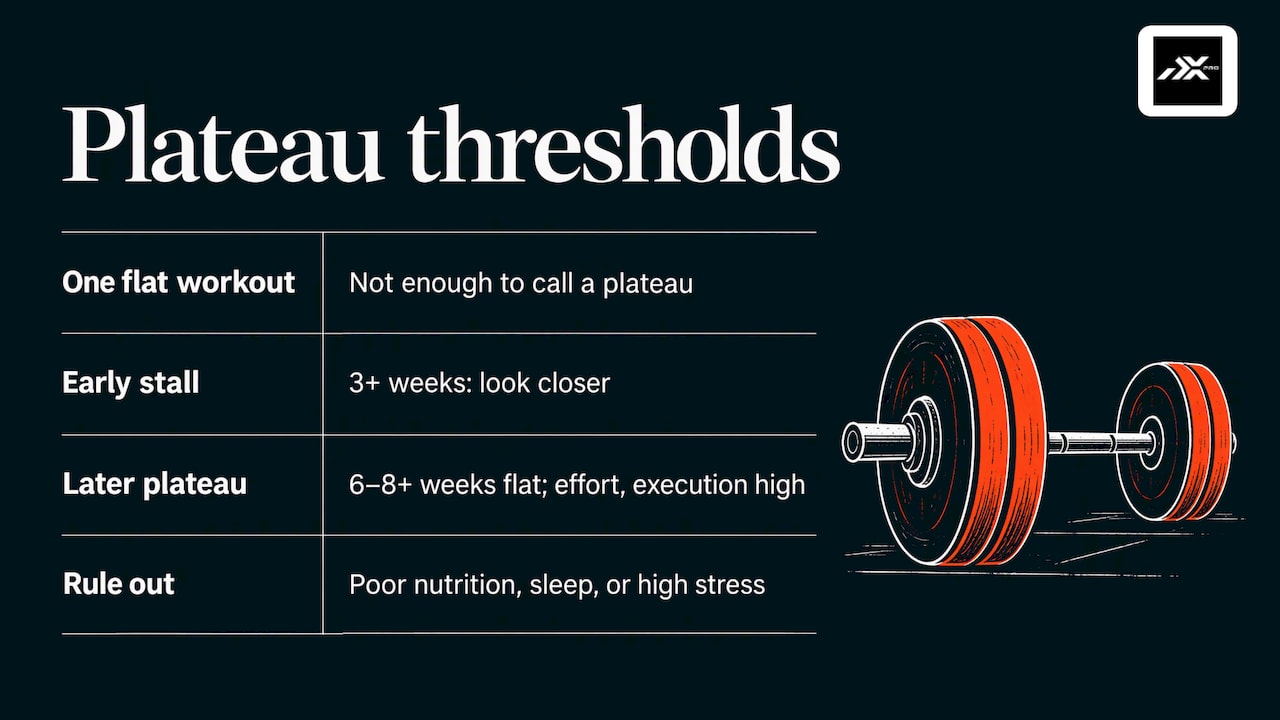
One flat workout is not a plateau. Sleep, stress and a long day at work all move your numbers around. Barbell Medicine’s guidance on stalls describes a stall as a measure such as working-set weight or rep maximum not progressing as expected, and says that in strength training this typically takes at least three weeks to call.
Other coaches draw the line later. A March 2026 Powerlifting.com article defines a plateau as six to eight or more weeks without improvement in bar weight, reps or estimated one-rep max while effort and execution stay high. The two views fit together: three weeks tells you to look closer, six to eight weeks of flat results with good effort tells you something has to change.
A coach quoted by Men’s Health adds a useful condition. A true plateau is one that you cannot explain by poor nutrition, lack of sleep or unusually high stress. If one of those is the obvious culprit, fix it first.
Slow progress is not a plateau
Progress naturally slows with experience. A beginner can often add weight or reps nearly every session. An intermediate lifter may add weight monthly instead of weekly. Barbell Medicine notes that adding 5 lbs or 2.5 kg to a working weight over three weeks can be outstanding progress in some contexts, and that forcing progress that is not realistic risks frustration, burnout and injury. If you are slowly climbing, you are not stuck. You are just past the easy phase.
Why strength stalls
There are two layers: the habits you can fix this month, and the biology you cannot.
The fixable causes
Verywell Fit says plateaus come from the body adapting to exercise, and that they can result from insufficient challenge, incorrect form or inadequate recovery. The Powerlifting.com article lists six common causes:
- Inconsistent programming
- Too little volume (total hard sets)
- Technique that needs refinement
- Under-recovery: chronic poor sleep, too few calories (especially carbohydrates), high life stress or too much conditioning
- Emotional overtraining: testing maxes instead of training
- Constant program hopping
Notice how many of these come down to the same thing: you do not have a clear, repeatable way to add a little more work over time. Strength rewards the boring approach of doing slightly more than last time, then recording it.
The biological ceiling
A 2023 review in PubMed by Ryo Kataoka examines why muscle growth slows after long-term training. It points to muscle’s anabolic signaling becoming less responsive to loading, to energy balance limiting growth, and to cellular brakes that hinder growth over time. Outside Online reports that even powerlifters on rigorous programs hit similar effects.
What that means for you: if you have trained for years, slower gains are normal. But most lifters stalling at a few months or a couple of years in are nowhere near that ceiling. They are dealing with the fixable list above.
Step by step: how to break a strength plateau
The order matters. Start with the cheapest, least disruptive fix and move down the list only if the numbers stay flat.
Step 1: Confirm it with your own logs
Look at the same lift across at least three comparable weeks. Compare the weight, the reps and how hard each set felt. If the top set was the same load for the same reps but felt harder each time, that is a warning sign. If it felt easier, you are probably about to progress.
This is where memory fails most people. “I think I benched 185 last week” is not data. In Athlxpro, you log a set in one tap, and the app keeps your weight and volume charts, records and history in one place, so spotting a flat line takes seconds. On iPhone or Apple Watch, the number is there when you need it.
Step 2: Audit effort and recovery
Ask three plain questions:
- Are my hard sets actually hard? Many lifters stop sets well short of where they think they are.
- Am I sleeping enough, eating enough and coping with life stress?
- Has my warm-up gotten longer, or have loads that used to feel clean started to break down?
Coach360 suggests that a recovery week is warranted when two or more signals show up in consecutive sessions: warm-ups taking 30% or more longer, form breakdown on loads that were clean two weeks ago, perceived exertion of 7 or higher on sessions that used to feel like 5 to 6, noticeably lower motivation, or poor sleep for three or more days in a row.
Our guide on sleep and muscle recovery goes deeper on the recovery side.
Step 3: Fix the progression scheme
If you add weight whenever you feel like it, you will stall. A simple, repeatable rule works better. One popular option is double progression: pick a rep range, say three sets of five to seven reps. Keep the weight the same until you can complete all three sets at seven clean reps, then increase the load slightly and work back up from five.
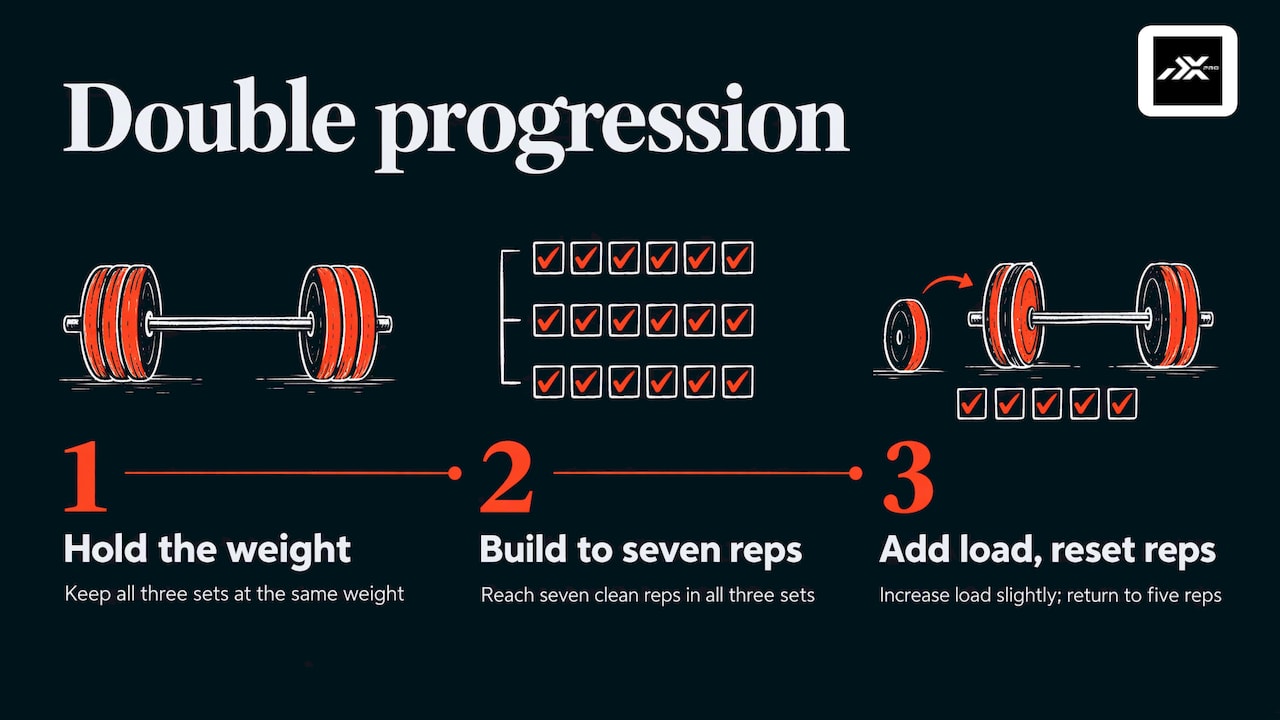
This is the kind of rule Athlxpro applies for you. Its programs are built on progressive overload, and it sets your next weight and reps from the sets you logged last time. You do not have to do arithmetic between sets or remember last week’s weights.
Step 4: Adjust volume, in either direction
Volume is the total hard work you do per muscle per week. Plateaus come from too little or too much, and the fix is opposite.
- Too little: if you feel recovered and your technique is sound, add a set or two to the stalled lift or muscle group.
- Too much: if you are tired all the time and a deload does not help, you may simply be doing too much, and the answer is to do less.
The Men’s Health coach recommends adding some change to a program every four to 16 weeks, and says that changing your stance, grip, tempo or moving to a close exercise variation is often enough. You rarely need to throw the whole plan away.
Step 5: Use a deload when fatigue is the problem
A deload is a planned lighter week. NASM recommends scheduled deload weeks, reducing volume or intensity by roughly a third, when performance flattens, plus using effort tools such as reps in reserve (how many reps you had left before failure) and matching training load to real recovery capacity including sleep, nutrition and life stress.
In the same article, NASM points out that the body does not distinguish training stress from life stress. A brutal stretch at work may be exactly when volume should come down, not up. Pushing through is the trap.
Step 6: Change one thing, then wait
Changing five things at once tells you nothing. Pick one variable (rep range, weekly sets, rest time, exercise variation), run it for four to eight weeks, and compare. If you want a plan that makes this easier, our strength training planner guide walks through how to structure the weeks, and the personalized workout plan article explains how a plan can adapt to you.
How to track so you can see a plateau coming
Tracking is what separates a true plateau from a bad month. A useful log has five fields for every working set: exercise, weight, reps, how hard it felt, and the date. That is enough to see three things:
- Trend in load: is the same effort moving more weight over time?
- Trend in effort: is the same weight feeling harder?
- Trend in volume: are weekly total sets and reps holding steady, rising or sliding?
A flat line in load with rising effort usually points to recovery. A flat line in both with easy effort usually points to too little challenge. That distinction guides which step above to take.
Athlxpro covers each of these. Weight and volume charts show your trends, records and awards mark real progress, and a full workout can run on Apple Watch once the plan is on the watch, so logging does not depend on carrying your phone around the gym. If you want to see how that works on the wrist, read our piece on Apple Watch strength training.
When you work with a coach, PDF and CSV reports and a full JSON export are made on your iPhone, so your history travels with you.
Bad mornings are part of the plan
Not every session should be a personal best. The Men’s Health coach says everyone has off days and not every workout can be filled with personal bests. Treating a rough day as a failure leads people to grind through junk sessions, which is exactly how stalls turn into burnout.
Athlxpro adjusts to your morning check-in. On a bad morning, it holds the weight or takes a set off. That keeps the plan moving without forcing a load your body is not ready for. Over weeks, those small adjustments keep you training consistently, and consistency is what produces the next personal record.
How Athlxpro fits a plateau
If you have been stuck, the usual pattern is that nobody can say which variable changed, because nothing was recorded. Athlxpro handles the parts that are easy to get wrong by hand. It sets your next weight and reps from the sets you logged last time. It adapts to your morning check-in. It logs each set in one tap. Alex, the AI coach, sees your training, food, sleep, steps and heart rate on one screen (the Apple Health data needs your consent), so you can look at the whole picture when you are working out why progress slowed. Only your logged sets and the morning check-in change the plan.
Athlxpro is a subscription, monthly or yearly, through the App Store, with a one week free trial, then $14.99 per month or $89.99 per year (US prices; other countries see theirs in the App Store). It runs on iPhone and Apple Watch, has 577 exercise videos for checking your form, and has no ads and no ad tracking.
Ready to know your next weight? Start with Athlxpro and let your last session set the next one.
Beginner, intermediate or advanced: what to expect
Your training age changes what a normal rate of progress looks like.
| Stage | Typical progress | What to do when stuck |
|---|---|---|
| Beginner | Add weight or reps almost every session | Check consistency, sleep and form before changing the program |
| Intermediate | Add reps weekly or weight monthly | Use double progression, adjust weekly sets, schedule deloads |
| Advanced | Gains are slow and small | Change one variable at a time over longer blocks, and track closely |
Beginners often stall because of inconsistent attendance or poor recovery, not because the program stopped working. If that is you, a simple structure helps more than novelty. Our beginner lifting plan gives a three-day full-body routine to build on.
When to get help
If you have worked through effort, recovery, progression and volume and still see nothing, a qualified coach can often spot a technique error or programming gap faster than months of trial and error. If you are an athlete working toward a specific competition, that is a good time to bring a coach your exported training history.
Pain is different. Ohio State Health & Discovery advises seeing a physician if pain persists and interferes with workouts and daily life after a week or two, even after resting the affected joint or muscle. Do not train through sharp or lingering pain to break a plateau.
FAQ
How long does a strength plateau last?
It lasts as long as the cause goes unaddressed. A stall of about three weeks is the point to investigate, and six to eight weeks of flat results with strong effort is a plateau. Once you change one variable and run it for four to eight weeks, most lifters see a clear answer.
Should I change my whole program to break a plateau?
Usually not. Small changes such as a different grip, stance, tempo or exercise variation are often enough, and changing one thing at a time shows you what worked. Constantly switching programs is itself listed as a common cause of stalls.
Can too much training cause a plateau?
Yes. If training stress plus life stress outpaces recovery, performance flattens. Lowering volume, taking a deload week and prioritizing sleep and food often restarts progress. A planned lighter session is part of training, not a loss.
How do I know if I am stuck or just progressing slowly?
Compare the same lift over several comparable weeks, including weight, reps and how hard it felt. Rising reps or easier effort at the same weight means progress. Flat numbers with high effort across six to eight weeks means a plateau. A written log makes this obvious.
Sources
- Training Expectations: Understanding Stalls, Barbell Medicine
- Plateau or Impatience? Powerlifting.com
- How Often Should I Change My Workout Plan, Men’s Health
- 6 Tips to Overcome a Weightlifting Plateau, Verywell Fit
- The Plateau in Muscle Growth with Resistance Training, PubMed
- The Physiology of Training Plateaus, Outside Online
- Recovery Programming: When to Pull Back, Coach360
- Overtraining: How Trainers Spot It, NASM
- Warning signs of overexertion, Ohio State Health & Discovery