
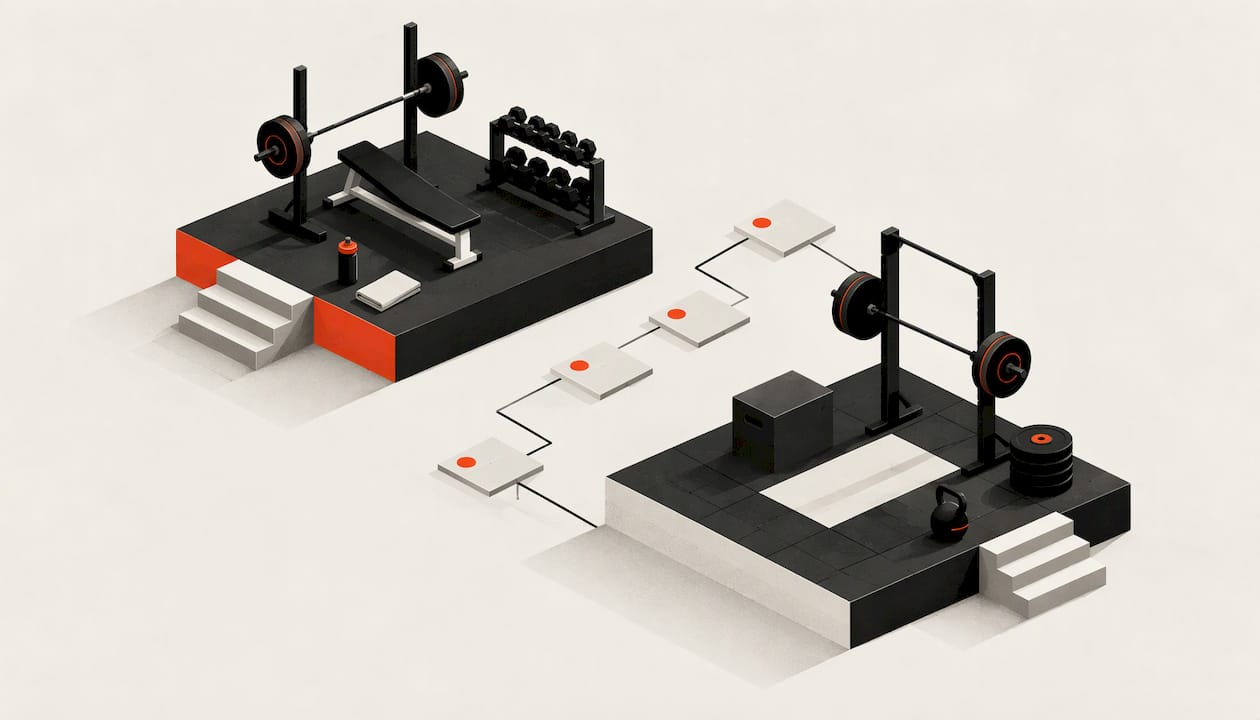
An upper/lower split divides your training week into upper-body sessions and lower-body sessions. In its classic form you train four days, two upper and two lower, so each muscle group gets hit about twice a week with recovery in between. It works well for lifters who have outgrown full-body training and want more volume per session without living in the weight room. Below: the schedules, a sample week, sets and reps, progression, and who should pick it over push/pull/legs.
TL;DR
- An upper/lower split alternates upper-body and lower-body days. The standard version is four sessions a week, with each muscle trained about twice.
- When weekly sets are equal, research finds split and full-body training build similar strength and muscle, so choose the one you can keep doing.
- Beginners usually do fine with full-body training two or three days a week and can move to upper/lower when they add a fourth session.
- Make the two upper days and two lower days different: one press-led, one pull-led, one squat-led, one hinge-led.
- Progress by adding reps within a range, then adding weight. Track every set so last week’s numbers are always in front of you.
Table of Contents
- What an upper/lower split is
- Does an upper/lower split work for muscle and strength?
- How to schedule it: 2, 3 and 4 days
- What to put in each session
- Sets, reps and rest
- How to progress week to week
- Upper/lower vs. push/pull/legs vs. full body
- Is upper/lower right for beginners?
- Running your split in Athlxpro
- Common mistakes to avoid
- FAQ
- Sources
What an upper/lower split is
The idea is simple. Upper days cover chest, back, shoulders and arms. Lower days cover quads, hamstrings, glutes and calves, with some core work added on whichever days you like. ACE describes a four-day routine as an upper-body portion and a lower-body portion, each performed twice a week, with torso or core work added on some days.
Why do people like it? Two reasons. First, frequency: hitting each muscle twice a week gives you more chances to practice the lifts and spread your volume. Second, recovery: while your legs rest, your upper body works, and the reverse. NASM calls it a middle ground: more focused and recoverable than frequent full-body training, and more balanced and frequency-friendly than body-part splits.
It helps to be clear about what the split is not. It is not a magic format. ACE frames split training mainly as a way to fit in more weekly sessions, build practical training volume and keep recovery between sessions for the same muscles, not as something the body physiologically requires. That is good news: you can pick it because it fits your life.
Does an upper/lower split work for muscle and strength?
Yes, when the total work is enough and you progress over time. The format itself is not the lever. Here is what the evidence shows:
- A 2024 systematic review and meta-analysis of 14 studies with 392 healthy adults found no significant difference between split and full-body routines for bench-press strength, lower-limb strength, muscle area or lean body mass when volume was equated. The authors conclude that trainees can choose by personal preference.
- A 2022 randomized trial in 50 untrained women compared two full-body sessions a week with four upper/lower sessions using the same exercises, weekly sets and reps. After 12 weeks there were no between-group differences, and both groups improved bench press, lat pulldown and leg press 1-RM, jump height, upper-body power and muscle mass.
- A 2021 study of 67 untrained subjects compared an A/B split with full-body training, both using sets of 8 to 12 reps, and found similar strength and muscle-thickness changes.
The 2026 ACSM position stand points the same way. It reports that hypertrophy is enhanced by higher weekly volumes, at least 10 sets per week, and that things like equipment type, exercise complexity and periodization did not consistently change outcomes. For strength-focused lifters it recommends putting heavy key lifts early in the session, while hypertrophy programming should emphasize enough weekly volume rather than a particular split label.
Translated: the upper/lower split is a good container. What fills it, enough hard sets, done consistently, and progressed, is what builds results.
How to schedule it: 2, 3 and 4 days
You can run an upper/lower split on fewer or more days than the classic four. Here is how each version lays out.
| Days per week | Layout | Best for |
|---|---|---|
| 2 | One upper day, one lower day | Very busy weeks, or a maintenance block |
| 3 | Alternate upper/lower/upper one week, lower/upper/lower the next | Steady progress on a tighter schedule |
| 4 | Two upper days, two lower days | The standard setup for most lifters |
The four-day version is the one most people mean. NASM describes the classic setup as two upper and two lower sessions, with three recovery days and each muscle group trained about twice a week.
A typical four-day week
The simplest pattern keeps hard days apart:
- Day 1: Upper
- Day 2: Lower
- Day 3: Rest
- Day 4: Upper
- Day 5: Lower
- Days 6 and 7: Rest
If your schedule shifts, the rule is just to avoid stacking two lower days back to back. Monday, Tuesday, Thursday, Friday is the common layout. Tuesday, Wednesday, Friday, Saturday works as well, so long as you rest between the second lower day and the next week’s first.
The three-day rotation
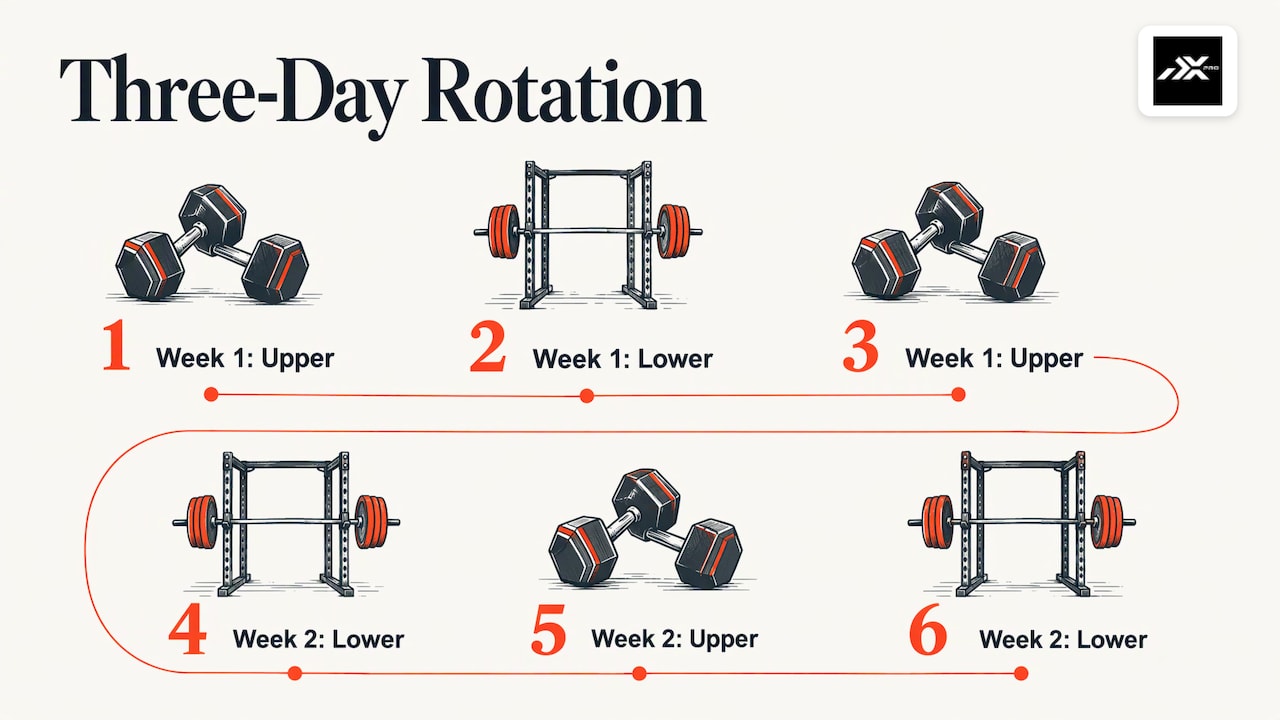
With three days you cannot split evenly, so you rotate. Week one runs upper, lower, upper. Week two runs lower, upper, lower. Over two weeks each half of the body is trained five times and the twice-weekly average holds roughly. If you want a closer look at three-day options, our guide to a 3 day weight training split compares four plans and how to choose.
Going beyond four
Some lifters add a fifth day or fold in a third type of session. If you like a heavy day and a volume day in the same week, the PHUL power hypertrophy split is a four-day variation built on the same logic.
What to put in each session
Make every session earn its place. Repeating the same upper workout twice a week is fine, but giving each day a different emphasis gives you more exercise variety and keeps joints happier.
Pick movement patterns first
For the upper body, cover pushing and pulling: a horizontal press, a vertical press, a row and a pulldown or pull-up. For the lower body, cover a squat pattern, a hip hinge and a single-leg movement, then add calves. Examples: squats or leg presses, deadlifts or hip thrusts, lunges or step-ups, calf raises, and optional planks, farmer’s walks or dead bugs for the core. Our breakdown of push day exercises goes deeper on pressing order, sets and reps.
Order matters
AUSactive’s resistance exercise guidelines recommend large multi-joint exercises before small single-joint ones, and generally large muscle groups before smaller ones, to preserve training intensity. So squat before leg extensions, bench before triceps pushdowns.
A sample four-day plan
This layout gives each day a lead lift. Adjust exercises to your equipment and preferences.
| Day | Lead lift | Supporting work |
|---|---|---|
| Upper A (press-led) | Barbell or dumbbell bench press | Row, overhead press, lateral raise, triceps, biceps |
| Lower A (squat-led) | Back or front squat, or leg press | Romanian deadlift, lunge, calf raise |
| Upper B (pull-led) | Pull-up or lat pulldown | Incline press, seated row, rear delt, curls |
| Lower B (hinge-led) | Deadlift or hip thrust | Split squat, leg curl, calf raise, core |
Plan on roughly five to seven exercises per session. Keep the first one or two heavy and the rest moderate.
Sets, reps and rest
For strength, the 2026 ACSM position stand reports that loads of at least 80% of 1-RM, full range of motion, two to three sets, key work placed early and training at least twice a week all support gains. Your heavy lead lifts on each day fit that template well.
For general training and size, AUSactive recommends loads that allow no more than 8 to 12 good-form reps before fatigue. Trained lifters chasing strength may need heavier loads and fewer reps, while those chasing hypertrophy should do most work in the 8 to 12 range. A practical way to use this: lead lifts at 4 to 8 reps for 3 sets, accessories at 8 to 12 reps for 2 to 3 sets.
To reach the weekly volume that hypertrophy responds to, count hard sets per muscle across both days. With two sessions a week, 5 or more sets per muscle each time gets you to the 10-set mark the ACSM stand points to.
Rest times matter too. AUSactive suggests at least 2 to 3 minutes for heavy multi-joint strength work, while 1 to 2 minutes can be enough for smaller single-joint exercises. Use a timer so rest does not drift.
How to progress week to week
Progressive overload is the engine. You can only get stronger if next week asks a little more than this week. Two common methods:
- Double progression. Pick a rep range, say 8 to 12. Start at the bottom, add reps until every set hits the top, then raise the weight and drop back to the bottom of the range. ACE describes a version of this, building to 15 good-form reps then raising resistance by 5%.
- Load jumps when you exceed the range. AUSactive recommends increasing resistance by 2 to 10% once you can do more than 12 good-form reps, which returns the exercise to the intended range.
Effort matters as much as numbers. Finishing a set with a rep or two in reserve is a different day from grinding the last rep. If you log how hard each set felt, you can see when to push and when to hold. We cover the logging side in how to track workouts.
Recovery sets the ceiling. Hard days stack up, and short sleep makes weights feel heavier. Our page on sleep and muscle recovery explains what the research says. On a rough morning, holding the weight or trimming a set is a smart call, not a failure.
Upper/lower vs. push/pull/legs vs. full body
Upper/lower sits between two other popular formats.
- Full body trains everything each session. It suits beginners and anyone with two or three days. The trade-off is that sessions get long if you want lots of volume.
- Push/pull/legs splits into three types of session. Run it three days and you hit each muscle once; run it six and you hit each twice. It gives room for more exercises per muscle but needs more days to reach the same frequency.
- Upper/lower reaches twice-a-week frequency in just four days, with sessions of manageable length.
So if you can train four days and want each muscle twice, upper/lower is the efficient pick. If you have six days and like shorter, more focused sessions, push/pull/legs fits. The research above says neither beats the other when volume is matched, so go with what you will show up for.
Is upper/lower right for beginners?
It can be, with an adjustment. ACE recommends full-body training two or three times a week for beginners and general health, and says split routines can come in when a trainee adds a fourth weekly session. AUSactive’s progression guidance starts beginners at two sessions and one set per exercise, then builds toward three sessions and three sets as fitness improves.
Adherence deserves attention. In the Norwegian trial on untrained women, four shorter split sessions were no more effective than two longer full-body sessions, and the split group had more withdrawals attributed to time or motivation. If four days a week feels like too much right now, start with our beginner 3-day full-body routine and move to upper/lower later.
Running your split in Athlxpro
Athlxpro is a strength training app for iPhone and Apple Watch, with programs built on progressive overload. You can train up to 6 days a week, so an upper/lower layout of two, three or four days fits right in.
Here is how it helps with the exact problem an upper/lower split creates: remembering four different sessions’ worth of weights. Athlxpro sets your next weight and reps from the sets you logged last time. It also adjusts to your morning check-in: on a bad morning it holds the weight or takes a set off. You log a set in one tap, and a full workout can run on Apple Watch once the plan is on the watch. For more on that, see Apple Watch strength training.
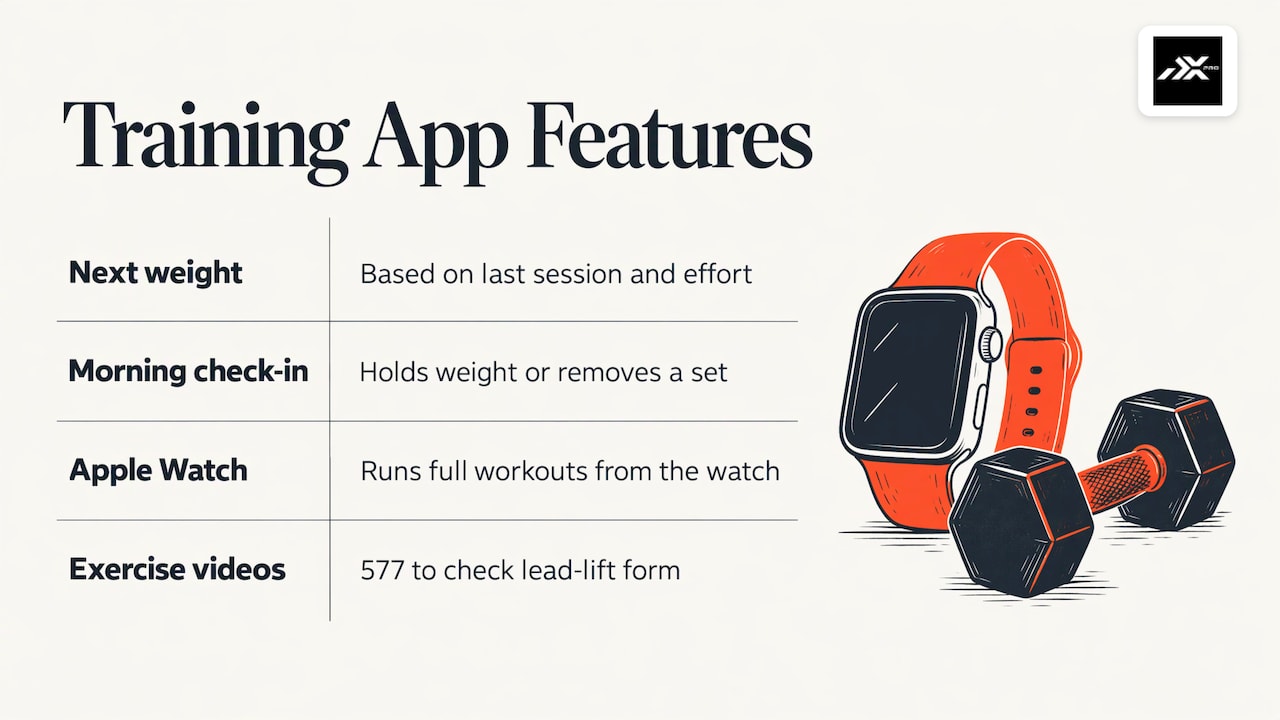
There are 577 exercise videos to check form on each lead lift, weight and volume charts to watch your progress, and records, awards, XP and levels to keep the weeks interesting. Alex, the AI coach, sees your training, food, sleep, steps and heart rate, with Apple Health data shared only with your consent. If you want to build the plan itself, see our guide to a personalized workout plan and the strength training planner.
Athlxpro is a monthly or yearly subscription through the App Store, and it starts with a one week free trial, then $14.99 per month or $89.99 per year (US prices; other countries see theirs in the App Store). There are no ads and no ad tracking, and health data is never used for ads.
Ready to run your split without notebooks or uncertainty? Get started with Athlxpro and let the app set your next weights.
Common mistakes to avoid
- Two identical upper days. Vary the lead lift and rep ranges so Thursday is a different session from Monday.
- Stacking lower days. Keep at least one rest day between lower sessions so your legs can recover.
- Too little volume. One or two token sets per muscle will not get you to the weekly totals the ACSM stand describes.
- Skipping the progression plan. Without a rule for when to add weight, sessions drift. Pick double progression or a load-jump rule and stick to it.
- Ignoring how you feel. Adjusting a day is better than forcing a bad one and missing the next three.
FAQ
Is an upper/lower split effective?
Yes. When weekly sets and effort are matched, research finds split and full-body programs produce similar gains in strength and muscle. The split’s advantage is practical: it lets you train each muscle twice a week with sessions of reasonable length.
How many days a week is upper/lower?
Four is the classic answer: two upper and two lower days, with three days of rest. You can also run it on two days or three days, rotating upper/lower/upper one week and lower/upper/lower the next.
Is push/pull/legs or upper/lower better?
Neither wins on results when volume is equal. Upper/lower reaches twice-weekly frequency in four days, while push/pull/legs needs six days to do the same. Pick based on how many days you can train consistently.
What is a good upper/lower split for beginners?
Beginners are usually better served by two or three full-body sessions a week first, then moving to upper/lower once they add a fourth session. Start with one lead lift per day and two or three sets, and add volume gradually.
Sources
- ACE: Mastering the Art of the Split Routine (May 2024)
- NASM: Upper/Lower Splits Explained
- Efficacy of Split Versus Full-Body Resistance Training: systematic review and meta-analysis (2024)
- A randomized trial on the efficacy of split-body versus full-body training in untrained women (2022)
- Split or full-body workout routine: which is best (2021)
- American College of Sports Medicine Position Stand (2026)
- AUSactive: Resistance Exercise Prescriptions for Healthy Adults
- Split-body versus full-body trial, adherence and withdrawals (2022)