
Evidence-based lifting means building your training around what large reviews of the research agree on, then tracking your own numbers so you can see it working. In practice that comes down to a few things: lift hard enough, do enough weekly sets, add load or reps over time, and recover well. The rest is detail. The hard part is not knowing the principles. It is remembering last week’s weights and deciding what to lift next. That is the job Athlxpro does: it plans your next session from the weights and reps you logged last time, and you log a set in one tap on iPhone or Apple Watch.
TL;DR
- Evidence-based lifting is a method, not a brand: use the variables that reviews show matter (load, weekly volume, frequency, progression) and stop agonizing over the rest.
- For strength, the 2026 ACSM overview points to heavier loads (at least 80% of your one-rep max), 2 to 3 sets, early in the session, at least twice a week. For muscle size, it points to at least 10 sets per muscle per week.
- Progress by adding weight or reps over time. Both work, so pick one rule and stick to it.
- Short on time? Enough weekly volume matters more than a perfect split.
- Sleep, rest days and honest effort ratings decide whether the plan works. Tracking is what makes it a method.
Table of Contents
- What “evidence-based lifting” actually means
- The variables that matter most
- Progressive overload: the principle everything else rests on
- How to structure your week
- Lifting efficiently when time is short
- Recovery decides whether the plan works
- A evidence-based week you can start now
- Where Athlxpro fits
- FAQ
- Sources
What “evidence-based lifting” actually means
The phrase has become a label online, and some lifters use it to mean complicated. It does not have to be. At its simplest, it means your program follows findings that hold up across many studies, and you change it when your own results say so.
The strongest single reference is a 2026 position stand from the American College of Sports Medicine. It is an overview of 137 systematic reviews, and it confirms that resistance training improves muscle strength, size, power and physical function in healthy adults compared with no exercise. It also notes that heavier loads, training frequency and volume affect particular outcomes, while several other variables did not consistently change results.
That last point is the useful one. A lot of the arguments you see about exercise order, tempo or the perfect rep range are about variables that did not show consistent effects. The ones that did are the ones to organize your week around.
The ACSM also stresses that programs should fit your goals, enjoyment and safety, because the plan you keep doing beats the plan that looks best on paper. A evidence-based approach is therefore personal by design.
The variables that matter most
Here is what the ACSM overview and a time-efficiency review point to, in plain terms.
| Goal | Load | Sets | Frequency and volume | Rest between sets |
|---|---|---|---|---|
| Strength | At least 80% of 1RM (the heaviest weight you can lift once) | 2 to 3 per exercise | At least 2 sessions a week, with the key lifts early in the session | Commonly 3 to 5 minutes |
| Muscle size | A range of loads can work | Enough to reach the weekly total | At least 10 sets per muscle per week, with eccentric (lowering) overload | Commonly 1 to 2 minutes |
Sources: the ACSM position stand for loads, sets, frequency and weekly volume, and a review of time-efficient training for rest intervals.
A few notes on reading this table:
- Heavy is relative. At least 80% of your one-rep max usually means sets of about 8 reps or fewer, stopped before form breaks down. You do not need to test a true max. A set that felt hard at a given weight tells you where you stand.
- Weekly volume is the number to watch. Ten sets per muscle per week can be spread over two or three sessions. Count hard sets, not warm-ups.
- Rest is a tool. The same review says untrained lifters can rest 1 to 2 minutes, while trained lifters should rest at least 2 minutes. Resting longer on heavy compound lifts is normal.
Progressive overload: the principle everything else rests on
Progressive overload means asking your muscles for slightly more over time, so they have a reason to adapt. The ACSM describes progressive resistance training as gradually increasing force output to improve muscle function, size and performance.
You can add more in two simple ways: more weight, or more reps at the same weight. A guide to progressive overload for youth pitchers shows how the same idea applies in another sport, and it is a reminder that the rule is about small, steady increases, not big jumps.
A simple progression rule
Pick a rep range, for example 6 to 10 on a bench press. Start with a weight where you can do 6 reps with a couple left in the tank. Each session, try for one more rep. When you hit 10 reps on all sets, add the smallest jump available and drop back to 6.
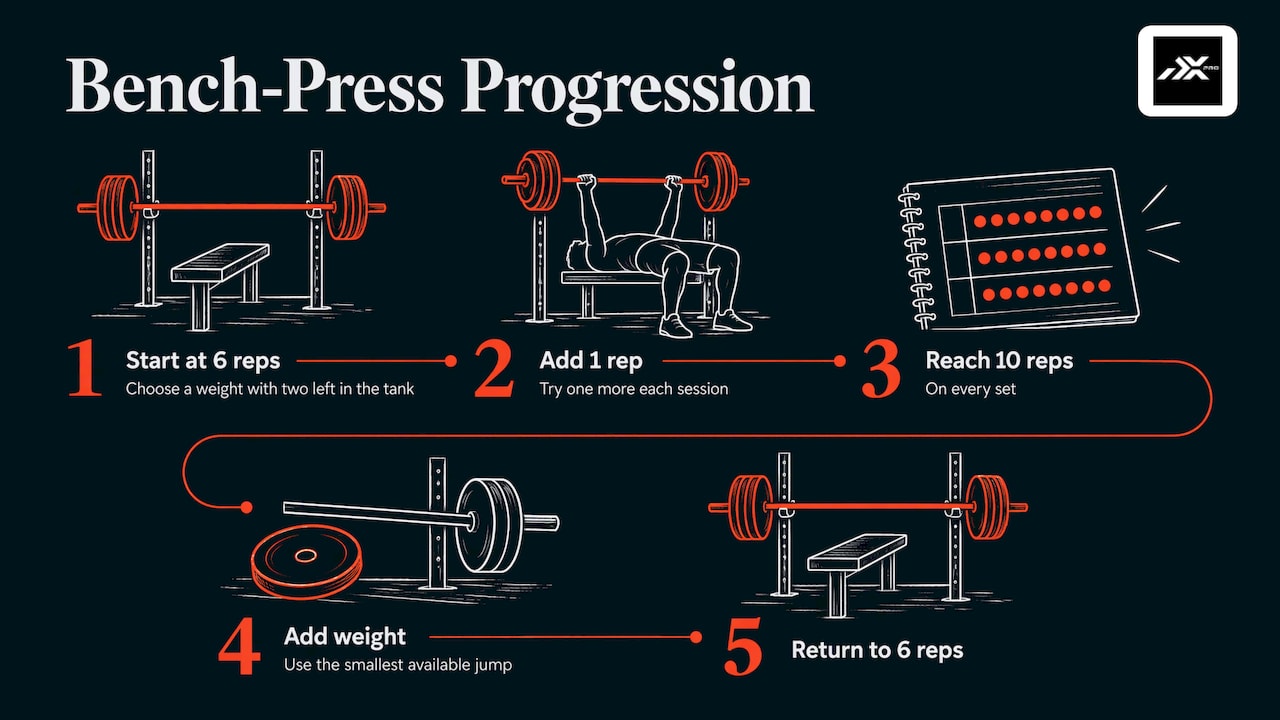
That works until it does not. Some weeks you slept badly, ate poorly or are simply flat. A rule that forces a jump on a bad day is how people stall or get hurt. That is why effort matters as much as the numbers.
Effort: how hard the set felt
Two sets of 8 at the same weight can be very different. One might leave you with three reps in reserve, the other with none. Effort-based training uses that feeling, usually a rating of how many reps you had left, to decide the next step. If a weight felt easy, go up. If it felt like a grind, hold it or repeat it.
This is where most lifters struggle in practice. They write nothing down, or they write the weight but not how it felt, and a month later they cannot tell whether they are progressing. Athlxpro’s programs are built on progressive overload, and the app sets your next weight and reps from the sets you logged last time. You never have to remember last week’s weights.
How to structure your week
There is no single correct split. The research points to total weekly volume and frequency, and several layouts reach the same totals.
- Full body, 2 to 3 days. Each muscle gets hit often, and a missed day costs little. See our beginner lifting plan for a 3-day full-body routine.
- Upper/lower, 2 to 4 days. Good for lifters who want more sets per session without very long workouts. Our upper/lower split guide shows how to set up 2, 3 and 4 day weeks.
- Three-day splits. If you have exactly three days, the 3 day weight training split article compares four plans.
Whichever you choose, put the heaviest lifts early in the session, because the ACSM guidance for strength places them there, when you are freshest. If you want help turning any of these into a full schedule, the strength training planner guide walks through it.
Lifting efficiently when time is short
Most people do not have two hours. The good news from the time-efficiency review is that you can protect progress in short sessions:
- Build sessions around bilateral, multijoint lifts such as squats, presses and rows. They train more muscle per set.
- Use supersets, drop sets or rest-pause sets. The review says these methods can roughly halve training time while keeping volume.
- Aim for at least four weekly sets per muscle group.
- When time is tight, protect weekly volume before worrying about frequency. The review notes that similar gains can occur with once-weekly training when total volume is equal.
The practical trap is logging. Writing sets in a notes app mid-workout eats the minutes you saved. In Athlxpro you log a set in one tap, and a full workout can run on Apple Watch once the plan is on the watch, so your phone can stay in your bag. Our guide to tracking lifts on Apple Watch covers the setup.
Recovery decides whether the plan works
Training is the stimulus. Adaptation happens between sessions. Three habits do most of the work.
Rest days. An ACSM article on recovery suggests 1 to 2 full rest days per week during high-volume training, with active recovery such as walking or yoga on the others.
Sleep. A 2024 network meta-analysis found that resistance training was the most effective non-drug intervention for improving sleep quality in non-elderly adults. So lifting helps sleep, and sleep helps lifting. If your nights are rough, an athlete sleep recovery guide covers habits worth building, and our own article on sleep and muscle recovery goes through the research.
Honest effort. If you are tired, a hard set feels harder at the same weight. That is useful information, not a failure. A good plan responds to it. With Athlxpro’s morning check-in, a bad morning means the app holds the weight or takes a set off, so you keep training without forcing numbers you cannot hit. Only your logged sets and the morning check-in change the plan.
If you have a medical condition, an injury or pain that does not settle, talk to your doctor before changing your training load.
A evidence-based week you can start now
- Pick your days. Anywhere from 1 to 6 days a week works, as long as you reach your weekly sets. Three is a solid starting point for most people.
- Choose 5 to 7 lifts per session. Lead with a heavy compound lift.
- Set your targets. Strength focus: at least 80% of 1RM for 2 to 3 sets. Size focus: spread at least 10 sets per muscle across the week.
- Rate every set. Note how many reps you had left.
- Apply one progression rule. Add a rep or a small amount of weight when the rating says the last session was manageable.
- Review monthly. Look at weight and volume trends. If a lift has been flat for three to four weeks, check your sleep, your rest days and your weekly sets before changing the whole program.
The steps are not complicated. Doing them for months without losing the thread is the hard part, and it is the argument for letting an app hold the numbers.
Where Athlxpro fits
Athlxpro is a strength training app for iPhone and Apple Watch. It sets your next weight and reps from the sets you logged, and it adjusts to your morning check-in. You get 577 exercise videos for form, records, awards, XP and levels, and weight and volume charts that make progression visible. Training, food, sleep, steps and heart rate sit on one screen, and Alex, the AI coach, sees them. Apple Health data needs your consent. Athlxpro is a subscription, monthly or yearly, through the App Store. See the monthly and yearly plans on our site.
There are no ads and no ad tracking, and health data is never used for ads. You can export PDF and CSV reports, or a full JSON export, made on your iPhone.
FAQ
Is evidence-based lifting only for advanced lifters?
No. The core ideas are the same for a beginner and a veteran: lift hard enough, do enough weekly sets, progress over time and recover. Beginners simply need smaller jumps and simpler programs. The ACSM guidance stresses fitting the program to your goals and enjoyment.
How many sets per week do I need to build muscle?
The ACSM overview points to at least 10 sets per muscle per week for hypertrophy, which is muscle growth. If you are short on time, the time-efficiency review recommends at least four weekly sets per muscle group as a floor. More sets are not always better, so build up gradually.
Do I need to train to failure?
The research summarized here does not require it. What it supports is heavy enough loads, enough weekly volume and steady progression. Rating how hard each set felt lets you stay close to your limit without grinding every set, which also makes recovery easier.
How long should I rest between sets?
Commonly 3 to 5 minutes for strength work and 1 to 2 minutes for muscle size. The time-efficiency review advises untrained lifters to rest 1 to 2 minutes and trained lifters at least 2 minutes.
Can I train just once a week?
Yes, if the total weekly volume is the same. The same review notes that similar gains can occur with once-weekly training when volume is equated. Most people find 2 or more sessions easier to manage, because the sets are spread out and each session is shorter.
Sources
- American College of Sports Medicine Position Stand on resistance training (2026)
- ACSM Resistance Training Prescription for Muscle Function (2026)
- No Time to Lift? Designing Time-Efficient Training Programs (2021)
- ACSM: Recovery That Keeps You in the Game (2025)
- Effects of nonpharmacological sleep hygiene on sleep (2024)
- Progressive overload guide for youth pitchers
- Athlete sleep recovery guide