
Fitness accountability means having something outside your own mood that expects you to show up: a person who notices, a record that shows the gap, or a plan that already knows what you lifted last time. The research points the same way. Being monitored is a recurring reason people keep exercising, and the strongest setups combine a clear plan, a record of what you did and some form of social presence. A workout app can cover the first two on its own and the third through a community feed.
TL;DR
- Accountability works because someone or something monitors you. In a 2024 review, a quarter of the studies named monitoring as a key part of staying active.
- A training partner can raise attendance sharply: in one field experiment, pairs visited the gym about 35% more often than people training alone.
- Small goals, self-monitoring and feedback are the techniques that show up most often in the evidence on staying motivated.
- The most useful app is the one that removes decisions: it knows last week’s weights, asks how you feel and adjusts.
- Build your system in layers: a written goal, a logged record, a check-in habit and at least one person who can see your progress.
Table of Contents
- What fitness accountability actually means
- What the research says about why it works
- Goals and tracking: the part you control
- Build your accountability system in five steps
- Where a workout app fits
- How Athlxpro handles the accountability jobs
- Make it a habit you can sustain
- Try Athlxpro
- Motivation on the days you do not feel like it
- FAQ
- Sources
What fitness accountability actually means
Most people think of accountability as guilt: a friend texting “are you coming?” That is one version. The broader definition is any mechanism that makes skipping a workout visible and showing up easy.
That mechanism can be:
- A person, such as a training partner, a coach or a friend who asks how the week went.
- A group, such as a lifting crew, a class or an online community where your sessions are seen.
- A record, such as a log that shows three missed weeks as an empty stretch rather than something you can forget.
- A plan, which tells you exactly what today’s session is so there is nothing to negotiate.
The last two are the ones people underrate. A systematic review in the International Journal of Behavioral Medicine noted that accountability appeared as a key theme in how adults describe keeping up physical activity, yet it is rarely mentioned in behavior change theories. In other words, you do not need to be weak-willed to benefit from it. It is simply a part of how consistency works that most training plans leave out.
What the research says about why it works
Being watched keeps you going
The same 2024 review found that about 25% of the included studies reported that having someone monitor them was a key part of continued participation, and that when the monitoring stopped, maintaining activity became difficult. That is a useful warning: motivation that depends on a one-off push fades, while a standing system holds.
Training with someone changes attendance
A field experiment by Gershon, Cryder and Milkman (774 participants) tested a reward that required visiting the gym with a friend. Those participants went about 35% more frequently than people earning a standard individual reward, and a follow-up survey suggested the pairing raised both accountability and enjoyment.
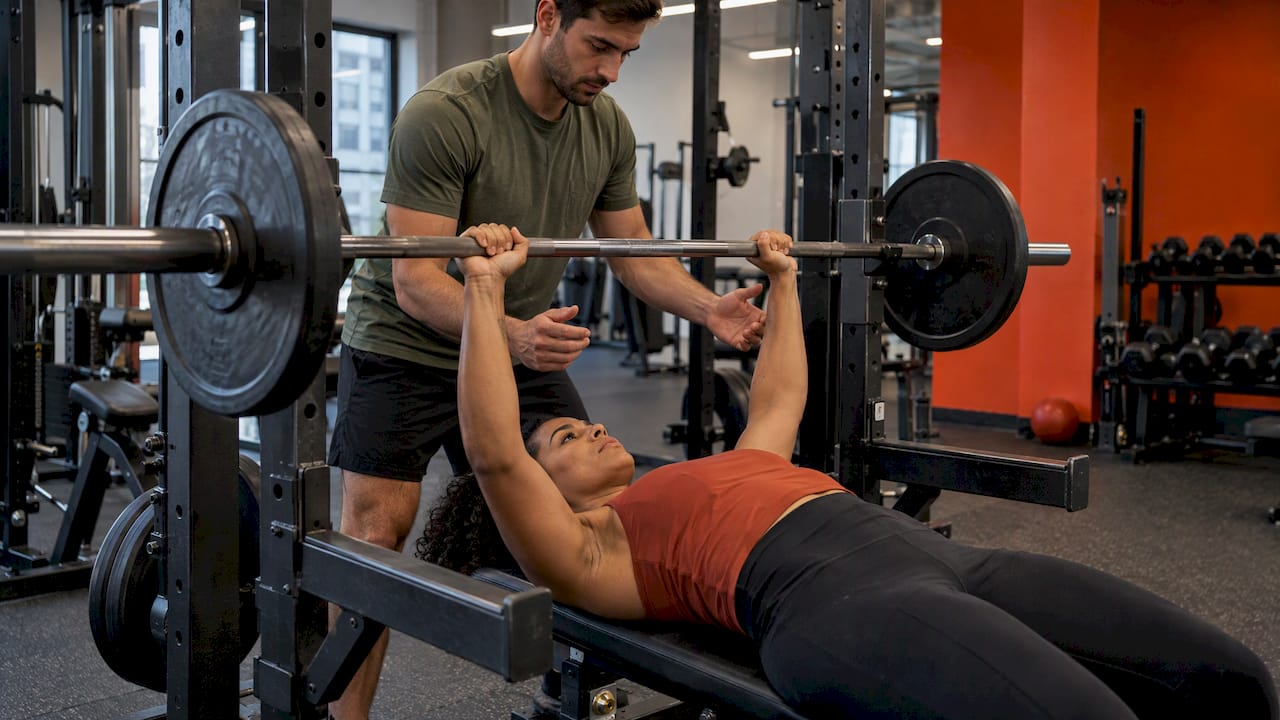
The effect is not limited to young gym-goers. A 2024 JAMA Network Open study, cited by Harvard Health, found that older adults who talked through their exercise plans with peers raised and sustained their activity more effectively than those relying on self-motivation alone. Harvard’s advice for motivation is similar: pick an initial goal, value any time you put in, and find a workout buddy.
Feeling in control matters too
Accountability is not only pressure. A review in Frontiers in Psychology found that when exercise professionals support people’s autonomy, and so meet their basic psychological needs, people are more likely to persist with long-term exercise. The best accountability feels like support for your own plan, not a stranger’s rules.
Goals and tracking: the part you control
Partners are not always available at 6 a.m. The part that is always available is your own record.
A 2023 systematic review of behavior change techniques found low to very low certainty evidence, so treat it as a direction rather than a promise. Even so, it pointed to goal setting improving adherence over three to six months and to self-monitoring with feedback improving adherence over 12 months in people with metabolic syndrome.
A review of fitness technology in sedentary adults described a trial that combined self-monitoring and goal setting to raise daily steps. It produced significant step increases at three months, and the results held three months after the intervention ended. The same authors noted that small goals appear to build momentum that makes larger ones more reachable, and that apps only help when people actually use their goal features, set realistic targets and update them.
A meta-analysis by Knittle and colleagues found that behavioral goal setting, self-monitoring and behavioral practice were associated with beneficial changes in several motivational outcomes. A 2021 review of digital interventions added that graded tasks, social incentives and self-monitoring moderated physical activity.
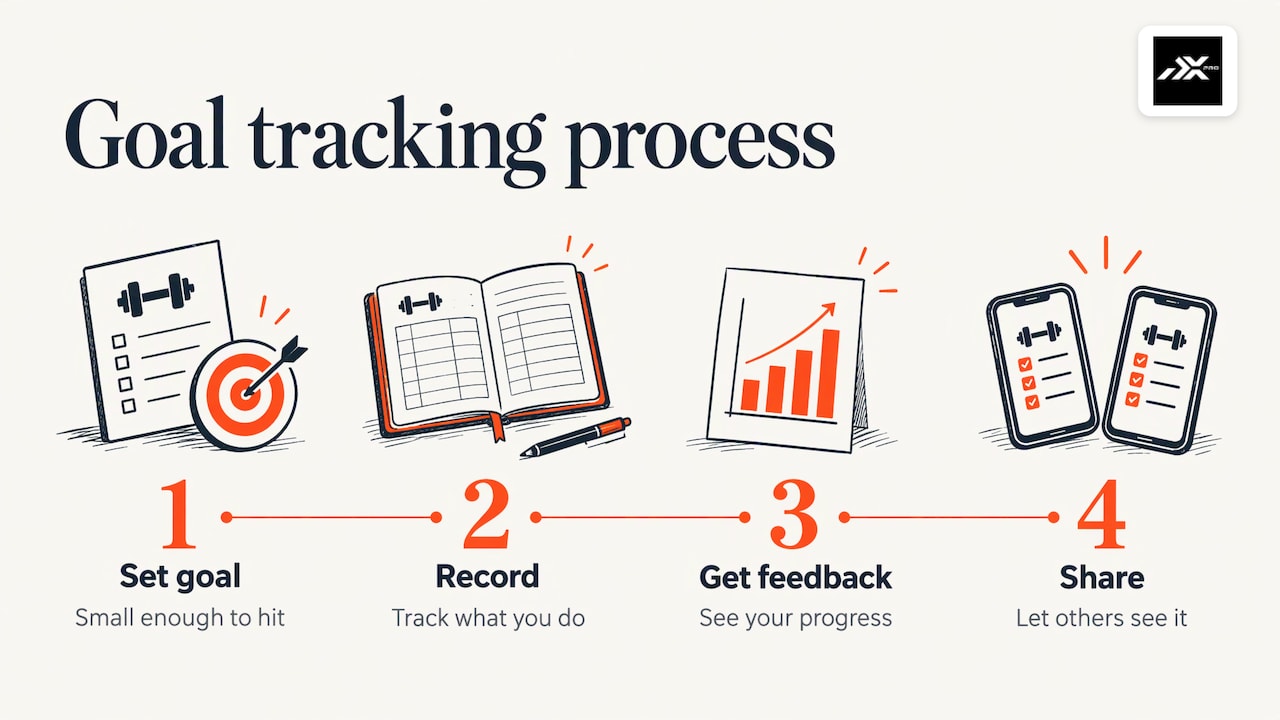
Put together, the pattern is consistent: set a goal small enough to hit, record what you do, get feedback, and let other people see it.
Build your accountability system in five steps
1. Write one goal you can measure
“Get stronger” cannot be missed, so it cannot hold you to anything. “Squat 225 for five by spring” or “train three days a week for eight weeks” can. Pick one, put a date on it, and write it where you will see it.
2. Break it into small targets
The evidence on small goals is the reason to do this. A target like “add one rep to my last set” is reachable every week. Strength training is built for it: progressive overload means adding a little weight or a few reps over time, and a study of 8-week resistance programs found that progressing either repetitions or load can be a viable way to build muscle. Both give you a measurable “win” each session.
3. Log every set
If you track nothing, a bad month leaves no evidence. Logging turns your training into a record you can be held to, by yourself or by someone else. Keep it fast enough that you do it mid-workout. Our guide on how to track workouts covers a simple system for this.
4. Add a check-in that includes how you feel
A rigid plan breaks on a bad day, and then the whole week slips. Effort ratings solve this. A 2025 study in the Journal of Strength & Conditioning Research found that autoregulation methods such as RPE and RIR can maintain training volume while reducing the risk of training to failure. Rating how hard a set felt lets the next session match your actual capacity instead of an arbitrary number.
5. Let someone see it
Share a session with a friend, a group chat or a community. You do not need an audience, just one person who would notice if the log went quiet. A reliable partner beats a large group you never talk to.
Where a workout app fits
An app cannot replace a friend, but it can take over the jobs that make accountability hard to sustain. A 2025 systematic review found that continued, regular use of mobile fitness apps helps people build consistent exercise habits, with reminders and prompts reinforcing the behavior until it becomes part of the daily routine. A 2020 review found that 13 of 14 included studies reported mobile apps were effective in increasing physical activity and healthy habits, and that goal setting, feedback, rewards, educational information and motivational messages were the components linked to better results.
A pilot trial of Fitbit-based techniques found that self-monitoring, goal setting and social comparison promoted readiness and motivation for physical activity, and that combining self-monitoring with goal setting may be important for continuing engagement.
That gives you a practical checklist for any motivational workout app:
| What to look for | Why it matters for accountability |
|---|---|
| A plan that tells you today’s session | Removes the “what should I do?” excuse |
| Fast set logging | Keeps the record complete, so gaps are visible |
| Feedback on your last session | Turns a record into progress you can see |
| Goals and rewards | Gives you small wins to chase |
| A social layer | Lets another person see what you did |
| Reminders and a way to adjust | Keeps you moving on low-energy days |
How Athlxpro handles the accountability jobs
Athlxpro is a strength training app for iPhone and Apple Watch, and it lines up with each row above.
- The plan decides for you. Athlxpro sets your next weight and reps from the sets you logged last time. You never have to remember last week’s numbers.
- Bad mornings do not break the streak. The app adjusts to your morning check-in: on a bad morning it holds the weight or takes a set off, so you still train.
- Logging is quick. You log a set in one tap, and a full workout can run on Apple Watch once the plan is on the watch. See our guide to Apple Watch strength training for how it works at the rack.
- Progress is visible. Records, awards, XP and levels, plus weight and volume charts, show the result of the weeks you showed up.
- Other people can see it. A community feed lets you post a session and see what others lift.
- An AI coach looks at the whole picture. Alex, the AI coach, sees your training, food, sleep, steps and heart rate; the Apple Health data needs your consent. Training, food, sleep, steps and heart rate are on one screen.
Programming itself rests on progressive overload, and only your logged sets and the morning check-in change the plan. If you want to see how an adaptive plan is put together, read our piece on a personalized workout plan, or start with a beginner lifting plan if you are new to lifting. Plans can run up to 6 days a week.
Make it a habit you can sustain
The hard part of accountability is month three, not week one. A few practices keep the system alive.
Keep the goals alive. The fitness technology review stressed that people need to update their goals for tracking to keep paying off. When you hit a target, set the next small one the same day.
Watch recovery as well as effort. Skipped sleep is a common reason a good plan stalls. Our article on sleep and muscle recovery explains what the research says, and it is worth reading before you decide a bad week means you lack discipline.
Notice patterns outside the gym. If you also log meals, writing down how you felt around them can show why some days go badly. This guide to mood and food tracking explains what to log and how to read it. In Athlxpro, food is logged by photo, which is an AI estimate, or by barcode.
Treat reminders as a starting point. Reminders help build the habit, and a plan that already holds your next session makes the reminder concrete: it points to a workout, not a vague intention.
Use the data with a coach if you have one. PDF and CSV reports and a full JSON export are made on your iPhone, so you can share your training history with a coach.
Try Athlxpro
If you want accountability built into the workout itself, Athlxpro puts the plan, the one-tap log, the morning check-in and the community feed in one app for iPhone and Apple Watch. It is a subscription, monthly or yearly, through the App Store, with a one week free trial, then $14.99 per month or $89.99 per year (US prices; other countries see theirs in the App Store). There are no ads and no ad tracking, and health data is never used for ads.
You can see the monthly and yearly plans on the Athlxpro site, then set your first goal and let the app handle next week’s weights.
Motivation on the days you do not feel like it
The question behind most searches for how to stay motivated is really about low days. Motivation is a poor fuel; systems work better. Harvard Health’s guidance fits that: recognize the value of any time and effort, because people often get frustrated when results do not show up quickly, and accepting that fitness is an ongoing journey makes you more likely to keep moving.
In practice, that means lowering the bar on bad days instead of skipping them:
- Do the first warm-up set. Starting is the hard part.
- Take a set off rather than the whole session.
- Hold the weight instead of chasing a record.
- Log it anyway, so the week is not empty.
An adaptive plan does this automatically, which is the point. For more on keeping a clean record on your phone, see our comparison of iPhone workout tracking options, and the strength training planner guide for building a weekly structure.
FAQ
What is fitness accountability?
It is any setup that makes your training visible to someone or something other than your mood: a partner, a group, a coach, a written plan or a logged record. The research suggests that being monitored is a common reason adults keep exercising.
Does a workout accountability partner really help?
The evidence says yes. In a field experiment with 774 participants, people who had to go to the gym with a friend to earn a reward visited about 35% more often than those rewarded individually. Pick someone who trains on a similar schedule and will notice if you skip.
Can a fitness accountability app replace a partner?
An app handles the plan, the log and the feedback, which are the parts that are hard to keep up alone. Athlxpro adds a community feed where you can post a session and see what others lift, so another person can see your progress too.
How do I stay motivated to exercise when I have no energy?
Lower the target, not the habit. Do a lighter session, take a set off, or hold last week’s weight. In Athlxpro, the morning check-in does this for you: on a bad morning it holds the weight or takes a set off.
Sources
- Understanding Adults’ Experiences and Perceptions of How to Maintain Physical Activity (International Journal of Behavioral Medicine, 2024)
- Can Interpersonal Behavior Influence the Persistence and Adherence to Physical Exercise Practice (Frontiers in Psychology, 2018)
- Continued usage of mobile fitness applications (Management Review Quarterly, 2025)
- What can you do to maintain exercise motivation? (Harvard Health)
- Friends with Health Benefits: A Field Experiment (SSRN, 2024)
- Behavior Change Techniques Improve Adherence to Physical Activity (PMC, 2023)
- Behavior Change with Fitness Technology in Sedentary Adults (PMC, 2017)
- Using Mobile Applications to Increase Physical Activity: A Systematic Review (PMC, 2020)
- Deconstructing Fitbit to Specify Behavior Change Techniques (JMIR mHealth and uHealth, 2024)
- The Effects of Percentage-Based, Rating of Perceived Exertion and Repetitions in Reserve Methods (Journal of Strength & Conditioning Research, 2025)
- Progressive overload without progressing load? (2022)
- Mood and Food Tracking: What to Log and How to Read It