
Heart rate during strength training is a useful signal, but a different one from the signal you get in running or cycling. It spikes during a hard set, drops between sets, and the session average depends as much on how long you rest as on how heavy you lift. Read it as a trend and a recovery clue, then pair it with how hard each set felt and what you lifted. That pairing is what turns a number on your wrist into a better next workout.
TL;DR
- During lifting, heart rate rises with load and falls between sets, so the session average mostly reflects your rest periods. There is no official target zone for weights the way there is for cardio.
- In one 2023 study, heart rate during squats averaged 143 bpm at 75% of the lifter’s three-rep max and 129 bpm at 50%.
- Heart rate zones built for running underestimate the aerobic demand of lifting, so use them loosely and judge effort by reps in reserve and how the set felt.
- Wrist sensors can wobble during gripping and heavy lifts. Look at trends over weeks, not single readings.
- Heavy lifts with breath-holding raise blood pressure sharply. Breathe through the effort, and talk to your doctor first if you have a heart condition.
Table of Contents
- What heart rate actually does when you lift
- What numbers to expect
- Why running-style zones fit lifting poorly
- How to monitor heart rate while lifting
- Reading heart rate over weeks, not minutes
- Pair heart rate with effort and a log
- Where Athlxpro fits
- Safety: breathing, blood pressure and when to stop
- FAQ
- Sources
What heart rate actually does when you lift
A lifting session does not look like a jog. Heart rate climbs during a set, peaks around the last reps, then falls while you rest. Plotted over a workout, it looks like a saw. A 40-second set followed by two minutes of rest produces that saw-tooth pattern, which is why the average for the whole session says more about your rest timing than about the weight on the bar.
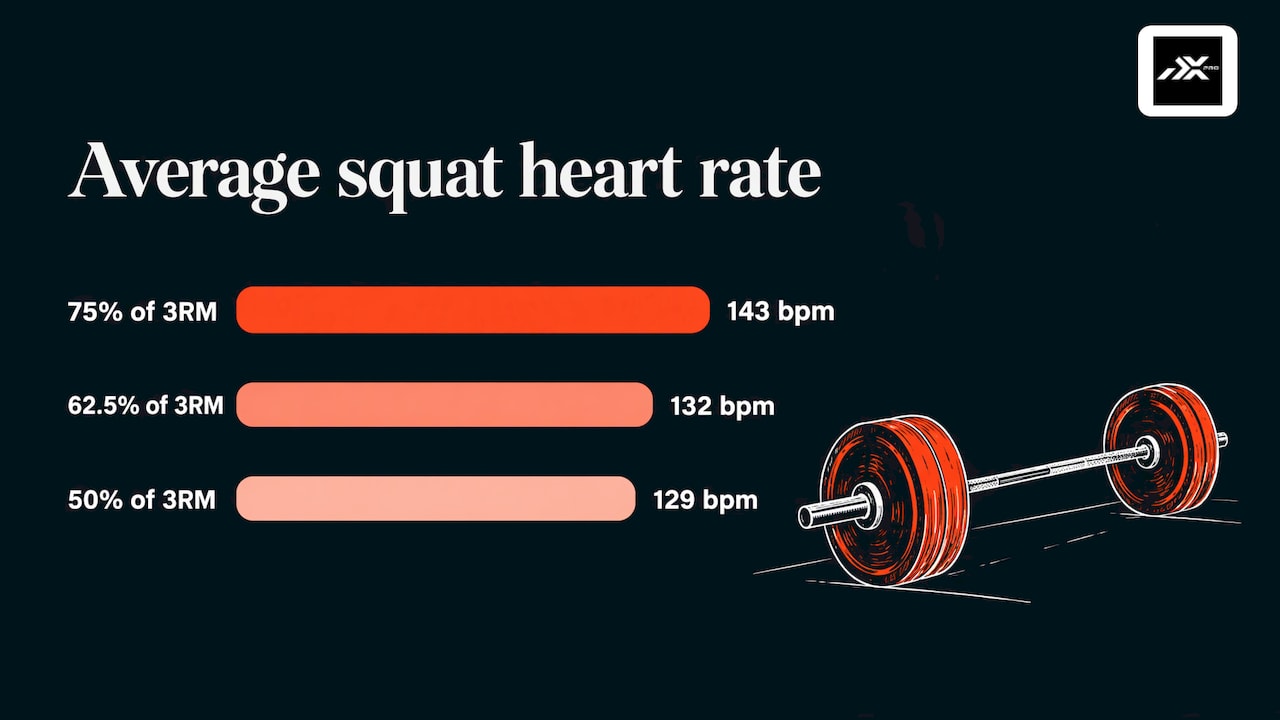
The rise is real and it scales with load. A 2023 cross-over study in Scientific Reports had people do three sets of ten squats at different loads. Heart rate averaged 143 bpm at 75% of their three-rep max, 132 bpm at 62.5% and 129 bpm at 50%, and cardiac output was higher at the heavier load too. The study also found that much of the cardiopulmonary response showed up after the set, in the recovery period, not during it.
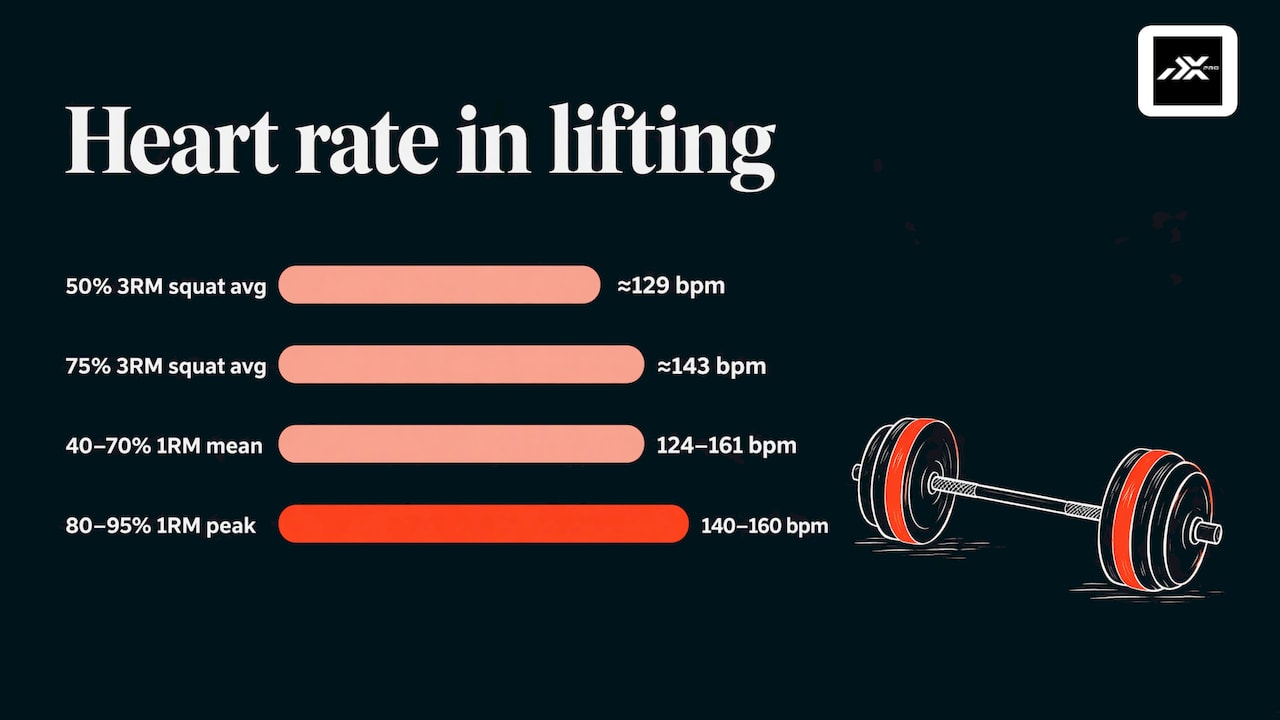
Why does heart rate carry so much of the load? During resistance exercise, cardiac output rises almost entirely through heart rate, because the amount of blood pumped per beat stays about the same or dips slightly. Dynamic leg work at 80 to 95% of your one-rep max typically produces peak heart rates of 140 to 160 bpm, according to the same source.
What numbers to expect
Start with your baseline. The American Heart Association says a normal resting heart rate for most adults is 60 to 100 bpm, and that the 220-minus-age formula is the common way to estimate maximum heart rate, with individual numbers varying with exertion, stress and other factors.
For lifting itself, a few reference points help:
| Situation | Typical heart rate | Source |
|---|---|---|
| Squats at 50% of three-rep max | About 129 bpm | 2023 Scientific Reports study |
| Squats at 75% of three-rep max | About 143 bpm | 2023 Scientific Reports study |
| Lifting at 40 to 70% of one-rep max | Mean of 124 to 161 bpm | Collins et al., 1991 |
| Heavy leg work at 80 to 95% of one-rep max | Peaks of 140 to 160 bpm | Human Kinetics |
These are averages from specific groups. Your own numbers will differ. Heart rate at a given effort changes with age, sex, fitness, movement economy, temperature, dehydration, illness and stress, as the MRC Measurement Toolkit explains. A 130 bpm set on a hot, short-sleep day is not the same signal as 130 on a cool, rested one.
That is why a single “right” average does not exist. If you were hoping for one number to aim at, aim instead to know your own pattern: where your heart rate usually peaks on your heavy compound lifts, how fast it drops in the first minute of rest, and how both shift over weeks.
Why running-style zones fit lifting poorly
Heart rate zones are common in cardio. The American Heart Association puts moderate-intensity exercise at 50 to 70% of maximum heart rate and vigorous activity at 70 to 85%, and suggests beginners start near the low end and build. If you want the broader picture of how five-zone systems and the Karvonen method work, this guide on training heart rate zones with the Karvonen method walks through the arithmetic.
For lifting, though, zones are a rough guide at best. A classic study by Collins and colleagues measured heart rate against oxygen uptake during weight lifting. Lifters at 40 to 70% of one-rep max had mean heart rates of 124 to 161 bpm, or 63 to 82% of maximum, yet that corresponded to only 33 to 47% of maximal oxygen uptake. The relationship between the two is linear but quite different from running or cycling, so the same percentage of max heart rate means a much lower aerobic load when you lift.
In practice, this changes how you use the number:
- Do not chase a zone to judge a lifting set. A set can be brutally hard at a heart rate that would feel easy on a bike.
- Do not read a low average as a weak session. Long rests, short sets and heavy singles all pull the average down while the work is still hard on your muscles.
- Use heart rate for context. It tells you how your body is handling the session, not how much stimulus your muscles got.
For the muscle side of the story, effort is the better yardstick: how close each set came to your limit, and whether you beat last week’s weight or reps. If you want to build that habit, the guide on adding load over time lays out how progression works.
How to monitor heart rate while lifting
There are two common ways to measure heart rate during a workout: an optical sensor on the wrist, such as a smartwatch, and a chest strap that reads the heart’s electrical signal. Optical sensors shine light into the skin and detect blood flow. They work well in steady movement but get messy when your forearm flexes hard around a barbell or dumbbell. The MRC toolkit notes that heart-rate-based assessment is most accurate at moderate and vigorous intensities and least accurate at low ones, which matters because much of a lifting session is low-intensity rest.
Here is how to get the most from whatever you wear:
- Fit it snugly. Wear the watch a finger’s width above the wrist bone, snug enough not to slide during pressing or pulling.
- Warm up first. Let the reading settle before you trust it.
- Compare similar moments. Look at your reading at the end of a heavy set or one minute into rest, not at random points.
- Ignore sudden spikes. If a number jumps in a way that does not match how you feel, treat it as noise, not data.
- Watch the trend. Averaging a few readings across several sessions is far more useful than any one number. A framework for heart rate monitoring in sport stresses that a single heart rate number cannot be interpreted in isolation and should be read with training context.
If you train with an Apple Watch, the Apple Watch strength training guide covers how to track lifts properly, and the iPhone workout tracking overview compares the built-in Apple tools with a dedicated strength app.
Reading heart rate over weeks, not minutes
The most useful heart rate information in strength training usually comes from patterns across days and weeks.
Resting heart rate and recovery
Resting heart rate drifts with fatigue, stress, illness and sleep. A 2009 study in the Journal of Strength and Conditioning Research found that, under controlled conditions, a change of more than 3 bpm in submaximal heart rate, or more than 6 bpm in heart rate recovery, was a meaningful change, pointing to either improved fitness or accumulated fatigue. Note the phrase “under controlled conditions”: same time of day, same warm-up, same test. Casual readings are noisier.
If you want to see how fitness changes your baseline, expect modest effects from lifting alone. A 2018 meta-analysis summarized by one heart-rate resource found that strength training alone did not significantly lower resting heart rate in men and lowered it by about 2 bpm in women, while endurance training lowered it in both. So do not judge your lifting progress by your resting pulse.
Heart rate recovery, the drop after effort, is also only a partial clue. A 2022 analysis of 1,234 cycling protocols found it correlated only moderately with fitness and should not be used as a standalone predictor of performance.
Heart rate variability
Heart rate variability (HRV) is the small beat-to-beat variation in timing. Wearables often measure it during deep sleep or on waking, because HRV has limited use during exercise itself. The same 2024 review notes that a hard training block can lower HRV for a prolonged time, from an hour to several days, and that approaches which train normally when HRV is within your usual range and back off when it falls outside it have shown better adaptations than fixed programming in several applications.
The takeaway is practical. Your own baseline matters more than any population number, and one low reading is a prompt to check how you feel, not a verdict. For background on what supports HRV and its limits as a stand-alone measure of adaptation, see this explainer on improving heart rate variability. Sleep is the lever most people can move first, and the article on sleep and muscle recovery covers what the research says.
As one sports scientist argues in a review of heart rate monitoring, many contradictory findings come from inconsistent methods, so heart rate works best alongside training logs, questionnaires and simple performance tests. That is the right frame for lifters: heart rate is one input, and your log is the other.
Pair heart rate with effort and a log
Here is a simple routine that uses heart rate without depending on it.
- Log every set. Weight, reps and how hard it felt. Without a record, a heart rate number has nothing to be compared with. The guide to what to log in a workout set tracker shows the minimum that is worth recording.
- Rate the effort. After each work set, note how many reps you had left. Two reps in reserve is a hard set that is still controlled.
- Glance at heart rate for context. Note the peak at the end of a heavy set and where it sits about a minute into rest.
- Check in on the day. Sleep, stress and soreness change how a given weight feels. Treat a poor morning as information.
- Review weekly. Look at whether weights and reps are creeping up and whether your heart rate at the same loads is stable or climbing. If you want a system that stays simple, the guide on how to track workouts is a good starting point.
This is also where consistency pays. A heart rate trend means little across a month of erratic training, and the piece on building workout consistency deals with that.
Where Athlxpro fits
Most of what makes heart rate useful in lifting is context: what you lifted last time and how you feel today. That is the part Athlxpro handles. It sets your next weight and reps from the sets you logged, and it adjusts to your morning check-in. On a bad morning it holds the weight or takes a set off. Programs are built on progressive overload, for 1 to 6 days a week.
You log a set in one tap on iPhone, and a full workout can run on Apple Watch once the plan is on the watch. Training, food, sleep, steps and heart rate sit on one screen, and Alex, our AI coach, sees them all. The Apple Health data needs your consent. Only your logged sets and your morning check-in change the plan, so your next session is never based on a number you cannot interpret. Weight and volume charts, records and 577 exercise videos are in the app too. Athlxpro is a subscription, monthly or yearly, through the App Store, and you can see both plans at athlxpro.com.
If you also coach yourself with a planner, the guide to building a strength training planner shows how the pieces fit together.
Safety: breathing, blood pressure and when to stop
Lifting raises blood pressure as well as heart rate, and the effect is sharper when you hold your breath. In the 2023 study above, blood pressure reached about 197/109 mmHg at 62.5% of the lifters’ three-rep max. The authors concluded that pressurized breathing during high-intensity strength training should be avoided, and that only moderate intensity should be used in rehabilitation settings, because breath-holding produces high blood pressure peaks.
Practical points:
- Breathe through the rep. Exhale during the hardest part of the lift where you can, and do not hold your breath through a whole set.
- Rest properly between hard sets. Heart rate should come down noticeably before the next one.
- Build up gradually. Beginners should start at lower intensities and progress, as the American Heart Association advises for any exercise program.
- See a doctor before you start if you have a known heart condition, high blood pressure, or a family history of early heart disease, or if you take medication that affects heart rate.
- Stop and seek medical care if you feel chest pain or pressure, faintness, unusual shortness of breath or an irregular heartbeat during exercise. In an emergency, call your local emergency number.
Heart rate numbers do not replace how you feel. If a reading looks alarming but you feel fine, rest, recheck the fit of your sensor, and bring a persistent pattern to your doctor.
FAQ
What should my heart rate be during strength training?
There is no single target. In research on squats, averages ranged from about 129 to 143 bpm depending on load, and your own numbers will depend on age, fitness, rest length and conditions. Learn your own pattern and track how it changes, instead of aiming at one number.
Why does my heart rate drop so much between sets?
That is normal. Heart rate rises during the set and recovers during rest, which creates a saw-tooth pattern. Longer rests lower the session average without making the training easier on your muscles.
Is a watch or a chest strap better for heart rate while lifting?
Chest straps read the heart’s electrical signal and are generally considered the reference for peaks, while wrist sensors can be thrown off by gripping and forearm tension. For a lifter who cares about trends, a snug watch is usually enough. Use one consistent device so your numbers are comparable.
Can heart rate tell me if I am overtraining?
Not on its own. Changes in resting heart rate, heart rate recovery or HRV can point to fatigue, but they need context such as sleep, stress, training load and how your lifts are going. A sustained drop in performance plus poor recovery is a better reason to cut back than one odd reading.
Sources
- Intensity-dependent cardiopulmonary response during and after strength training, Scientific Reports, 2023
- Relationship of heart rate to oxygen uptake during weight lifting exercise, PubMed, 1991
- Cardiac output and its components, Human Kinetics
- Measurement Toolkit: Heart rate monitors
- Watch your heart rate, but don’t obsess about it, American Heart Association, 2021
- Target Heart Rates Chart, American Heart Association
- Heart Rate During Weight Lifting: Normal Range and Cardio
- Day-to-Day Variation in Heart Rate at Different Levels of Submaximal Exertion, 2009
- Monitoring training status with HR measures, Frontiers in Physiology, 2014
- Heart Rate Monitoring in Team Sports, Frontiers in Physiology, 2018
- Heart Rate Variability Applications in Strength and Conditioning, 2024
- Heart Rate Recovery Is Not a Singular Predictor for Physical Performance, 2022
- Training heart rate zones with the Karvonen method
- How to improve heart rate variability