
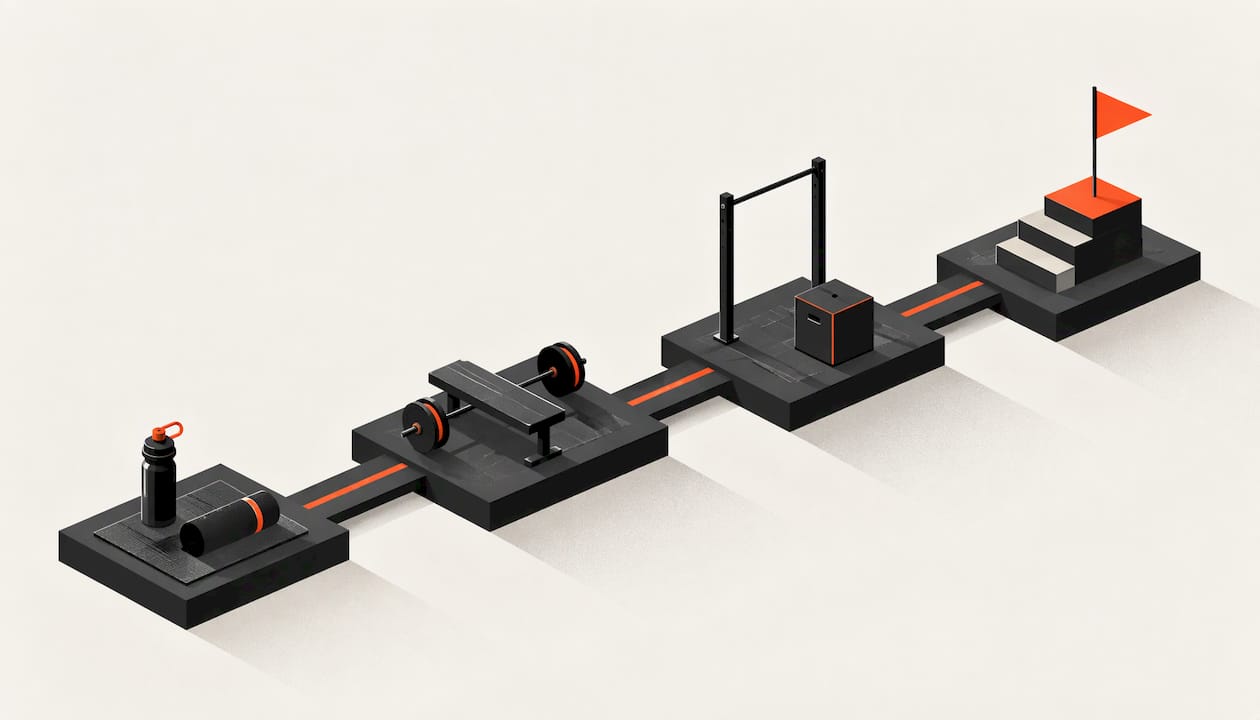
Workout consistency comes down to removing decisions. You keep training when you already know which day you train, what the minimum session is, what weight goes on the bar and what to do after a missed day. The less you have to figure out on the spot, the less motivation you need. That is why a plan that sets your next weight and reps from your last session, and that holds back on a bad morning, makes it easier to keep going. Athlxpro does exactly that on iPhone and Apple Watch.
This guide covers what consistency actually means, why people drop off, how to set a minimum you can always hit, how to track consistency, and how to balance showing up with pushing hard.
TL;DR
- Consistency means showing up on a repeatable schedule and applying the same training stimulus week after week. It does not mean perfect weeks.
- Set a minimum session you can do on your worst day, and a rule for missed days: never skip twice in a row.
- Decide the next workout before you walk in. Last session’s weights and reps should be one glance away, not something you remember.
- Track sessions, weights and reps. Review the trend weekly, not each set.
- Raise intensity slowly and only once the habit holds. Consistency is what makes progress possible.
Table of Contents
- What workout consistency really means
- Why most people fall off
- Start with a minimum you can always hit
- Attach training to something you already do
- The two-day rule for missed sessions
- Make the next session already decided
- How to track workout consistency
- Consistency versus intensity
- A four-week consistency plan
- Handling bad weeks without losing the habit
- Where Athlxpro fits
- FAQ
- Sources
What workout consistency really means
Most people use the word to mean “I never miss.” A more useful definition has two parts: you train often enough on a regular pattern, and each session gives your body the same kind of challenge so it can adapt.
The U.S. National Library of Medicine explains the reasoning in its exercise and physical fitness overview: your body adapts to the activity you do most often, you get stronger when you build up slowly and challenge yourself with slightly heavier weights or a few more minutes, and showing up regularly, even for short sessions, helps you keep making progress.
So consistency has three layers:
- Frequency. You train on a pattern, such as 3 days a week, that fits your life.
- Repeatability. You do the same lifts often enough to measure them and improve them.
- Continuity. One bad week does not erase the pattern.
The third layer is where most people fail, and it is the one you can plan for.
Why most people fall off
Starting is easy. Continuing is the hard part. A British Columbia Medical Journal editorial reports that more than half of adults abandon their New Year resolutions, with 23% giving up before the end of January. The same piece says it takes an average of 66 days to turn a new behavior into a habit. That is more than two months of effort before it starts to feel automatic.
The usual causes are practical:
- The plan is too big. Six hard sessions a week looks great on paper and collapses at the first busy Tuesday.
- Every session starts with a decision. What do I train? How heavy? How many sets? Decision fatigue turns “I’ll go later” into “I skipped.”
- One miss becomes a spiral. A skipped workout turns into a skipped week, then a restart that never happens.
- No visible progress. If you cannot see that last month’s 135 pounds is now 145, effort feels pointless.
Each of these has a fix, and none of them is more willpower.
Start with a minimum you can always hit
The most reliable consistency tool is a floor: a version of the workout so small that even a terrible day cannot defeat it.
Psychology Today’s advice on falling off a routine is to stop relying on motivation and make training easier: shorten the workout, remove setup steps, prepare your gear in advance, and show up even for five minutes to reinforce the habit.
For lifting, a workable floor looks like this:
- Full session: the planned workout, around 45 minutes.
- Short session: the first two or three lifts of the day, with one set fewer on each.
- Floor session: one main lift, two working sets, then you leave.
A floor session still counts. It keeps the pattern intact and it keeps you from walking into next week having “started over.”
Time is rarely the real obstacle. Mayo Clinic Health System suggests aiming for 30 minutes of activity five days a week, and says it can be split into 10 or 15 minute segments. It also recommends scheduling workouts as you would a work meeting and planning ahead, for example by keeping your gym bag with you.
Pick a schedule you can defend
Choose the number of training days honestly. Strength programs work well from 1 to 6 days a week, and the right number is the one you will still be hitting in month four. If you are new, three days is a sound starting point, and our 3-day full-body beginner routine shows how to lay it out. If you want a little more volume as you progress, an upper/lower split works for 2, 3 or 4 day weeks.
Then fix the days and the time. Verywell Health notes that morning exercise is less affected by decision fatigue, and that habits become automatic at a higher rate when performed early in the day. If mornings do not fit your life, pick the slot that is hardest for other things to steal.
Attach training to something you already do
A routine sticks faster when it hangs on an existing one. Packing your gym bag when you pack your lunch, or lifting right after you drop the kids at school, gives the habit a trigger. The idea of habit stacking for fitness is to chain the new behavior to one that already runs on autopilot, so the workout does not depend on remembering.
Two small steps help:
- Put your shoes and bag by the door the night before.
- Pick a first move that takes under a minute, such as opening your workout and doing the warm-up set.
The two-day rule for missed sessions
You will miss workouts. Travel, illness, deadlines and bad sleep are normal. What matters is the rule you use afterward.
Live Science, summarizing research-backed tips, reports a simple rule: never skip planned exercise two days in a row. Life causes missed days, and not missing a second one prevents the downward spiral.
Verywell Health gives the same advice for the day after: don’t stress, get back on track the next day, because consistency over time matters more than perfection.
A few ground rules make this work:
- Do not punish a miss with a double session. Resume the plan where you left off.
- Do not wait for Monday. The next available day is the restart day.
- If the break lasted more than a week or two, return with lighter weights or shorter sessions and stretch before you lift, as the same Verywell guidance suggests, then build back up.
If you are coming back from an injury or a medical issue, check with your doctor before resuming hard training.
Make the next session already decided
Here is where most strength lifters lose consistency without noticing. You walk in, stare at the bar and try to remember what you lifted last Thursday. Was it 185 for 5 or 190 for 4? Did the last rep feel close to failure? That small bit of friction, repeated every session, makes skipping easier.
Progressive overload, gradually asking a little more of your muscles over time, only works if you know last time’s numbers. NIDDK’s guidance on increasing activity says to progress gradually to lower injury risk: first add minutes or days, then intensity, and for strength work, raise repetitions slowly before trying more weight.
Athlxpro takes that decision off your hands. Its programs are built on progressive overload. It adds or drops weight for your next session from the sets you logged last time, so you never have to remember last week’s weights. You log a set in one tap on iPhone or Apple Watch, and a full workout can run on Apple Watch once the plan is on the watch.

The morning check-in matters most for consistency. On a bad morning, the app holds the weight or takes a set off. Your session still happens, and it stays in proportion to how you feel, which is the point of a floor session. Only your logged sets and the morning check-in change the plan.
If you want a deeper look at how adaptive plans are put together, see our guide to a personalized workout plan that adapts and the walkthrough on building a strength training planner.
How to track workout consistency
Tracking turns consistency from a feeling into a fact. When you feel like you have been slacking, the log shows you the real number. When progress seems slow, the log shows a trend you could not see.
NIDDK recommends tracking activity type, duration and how you felt to chart progress, get through setbacks, stay motivated and set new goals. The Association for Applied Sport Psychology goes further in its 13 adherence strategies: keep an exercise journal from the first session, recording weight lifted, distance or time, and chart your improvement weekly or monthly. It also suggests using wearable technology and smartphone apps to see your daily activity progress.
What to record
Keep it short enough that you will do it in the gym:
| What to log | Why it matters |
|---|---|
| Exercise, weight, reps | Shows whether overload is happening |
| Sleep and soreness | Separates a bad day from a real plateau |
| Sessions completed vs planned | Your actual consistency number |
| Missed days and why | Reveals patterns, such as every Thursday |
The metrics worth watching
- Weekly adherence. Sessions done divided by sessions planned. Eight of ten over a month is a strong result.
- Longest gap. The most days between two sessions. If it keeps shrinking, your system is working.
- Volume trend. Total weight lifted per week, viewed over several weeks. A flat line that is not falling is still consistency.
- Records. Personal bests show the payoff of showing up.
Athlxpro keeps these in one place: weight and volume charts, records, awards, XP and levels, and your training, food, sleep, steps and heart rate on one screen. Alex, the AI coach, sees your training, food, sleep, steps and heart rate, so you can ask about your week in plain language. The Apple Health data needs your consent. If you want your history outside the app, PDF and CSV reports and a full JSON export are made on your iPhone.
For the step-by-step method, read how to track workouts with a simple system, and for Apple’s own options see iPhone workout tracking and Apple Watch strength training.
Review once a week
Pick one moment, such as Sunday evening. Look at three things: sessions completed, the lifts that went up and the lifts that stalled. Then set the one adjustment for next week. Reviewing every set invites obsession. Reviewing weekly invites decisions.
Consistency versus intensity
Intensity gets attention, but it is a poor foundation. The BCMJ editorial says intensity can be the enemy of sustainability and that you do not need to push your limits every day. It cites distance-running research that points to a balance of about 80% low-intensity and 20% high-intensity training. That research is about running, but the principle carries over: most of your sessions should be repeatable, and only a few should be hard.
For lifters, it helps to think of effort as a dial:
- Most sets should finish with a rep or two left in reserve.
- Reserve your hardest efforts for the lifts and days where you are fresh.
- Treat a heavy day that goes badly as information, not failure.
A 2017 meta-analysis of 31 studies in the Journal of Strength and Conditioning Research found that strength training above an estimated 87.29% intensity produced diminishing returns. In plain terms, going to your absolute limit every session does not buy proportionally more progress. A clear plan lets you work hard where it counts while keeping the rest of the week sustainable.
Mayo Clinic says the same about the basics: any amount of activity is better than none and consistency is key. More intense activity does burn more calories, but you do not need a large block of time every day.
A four-week consistency plan
If you want a concrete starting point, use this:
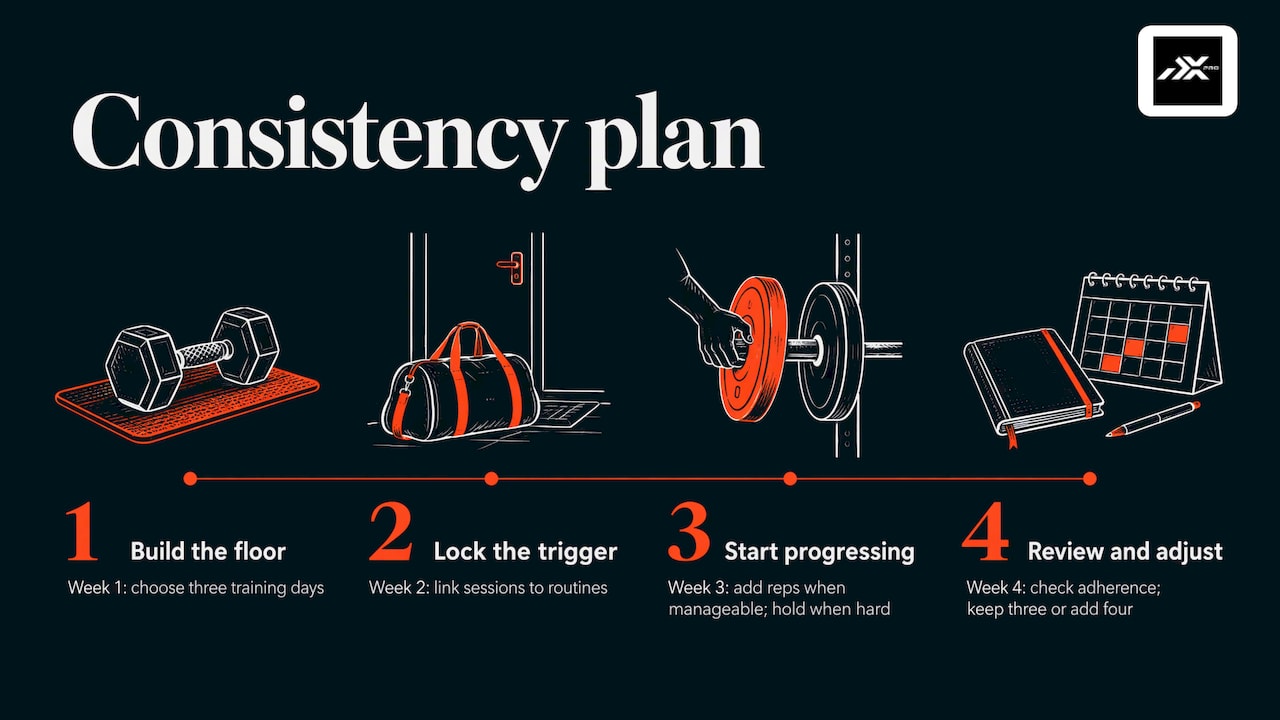
Week 1: Build the floor. Choose 3 training days. Write down your floor session. Do each session even if it is short. Goal: hit all 3 days.
Week 2: Lock the trigger. Tie each session to an existing routine. Prepare your bag the night before. Log every set.
Week 3: Start progressing. Add a rep or a small amount of weight to your main lifts where the last session felt manageable. Hold where it felt hard.
Week 4: Review and adjust. Check adherence, longest gap and your main-lift trend. Decide whether to keep 3 days or add a fourth.
A 66-day average to build a habit means you are not done at week 4. Keep the same structure, and let the numbers show you the progress while the habit forms.
Handling bad weeks without losing the habit
Name your week type in advance. A normal week gets the full plan. A travel or crunch week gets the short session. A recovery week after illness gets the floor session and lighter loads. Deciding this ahead of time means you adapt the plan instead of abandoning it.
Sleep, stress and soreness all shape how a session feels. When you feel off, you have three honest options: do the session as planned, do it lighter, or do the floor version. Skipping entirely should be the last option, not the first. That is where a morning check-in earns its place: it gives you a quick, honest read before you decide.
Where Athlxpro fits
Athlxpro is a strength training app for iPhone and Apple Watch built around the habits in this guide. It plans your next session from the sets you logged last time and your morning check-in, lets you log a set in one tap, and keeps training, food, sleep, steps and heart rate on one screen. Food is logged by photo, as an AI estimate, or by barcode. A community feed lets you post a session and see what others lift, and 577 exercise videos show you how each movement should look. There are no ads and no ad tracking, and health data is never used for ads.
It is a subscription, monthly or yearly, through the App Store, with a one week free trial, then $14.99 per month or $89.99 per year (US prices; other countries see theirs in the App Store). You can start on the Athlxpro site.
If accountability is your weak spot, our guide to fitness accountability covers how to build it around a plan like this.
FAQ
How often should I work out to stay consistent?
Pick the number you can keep through a busy month. For strength training, anywhere from 1 to 6 days a week can work, and three days is a solid base for most people. Mayo Clinic Health System suggests 30 minutes of activity five days a week as a general goal, which can be split into shorter segments.
How do I stay consistent when I have no motivation?
Stop waiting for motivation and make the session smaller. Prepare your gear ahead, shorten the workout and commit to five minutes, as Psychology Today advises. Once you start, the session usually continues. If it does not, a floor session still keeps the habit alive.
What should I do after missing a workout?
Train on the next available day and resume the plan where you left off. Do not make up the missed session with a double workout. The rule to follow is simple: never skip two planned days in a row.
How do I track workout consistency?
Log each session with the exercise, weight and reps, then compare sessions completed with sessions planned each week. A weekly review of that number, plus your main-lift trend, tells you more than any single workout.
Sources
- Exercise and Physical Fitness: MedlinePlus
- Consistency beats intensity, British Columbia Medical Journal
- Stop Falling Off Your Workout Routine, Psychology Today
- Fit a workout into any schedule, Mayo Clinic Health System
- Struggling to Exercise Regularly? 10 Motivating Tips, Verywell Health
- 6 science-backed tips to kickstart your exercise routine, Live Science
- How to Stay Consistent With Workouts When Unmotivated, Verywell Health
- Tips to Keep Moving, NIDDK
- 13 exercise adherence strategies, Association for Applied Sport Psychology
- Comparison of training intensity patterns, Journal of Strength and Conditioning Research
- Exercise: 7 benefits of regular physical activity, Mayo Clinic
- Habit Stacking Fitness: Build Routines That Actually Stick