
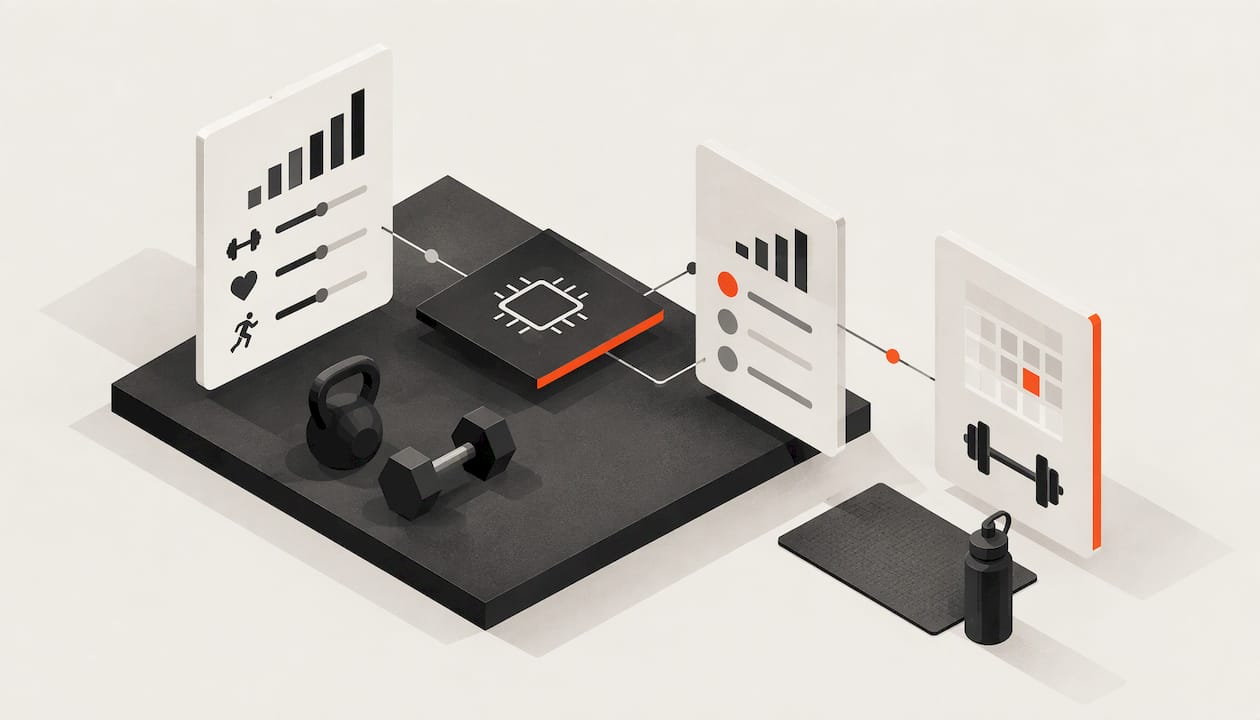
AI fitness coaching is software that turns information about you (your goals, equipment, past performance and how workouts felt) into exercise guidance, then updates that guidance as you keep training. The useful versions do one job well: they tell you what to do next. Research so far is encouraging but early, and no app replaces a doctor or a qualified coach. This guide explains how these apps work, where they help, where they fall short, and how to pick one if you lift.
TL;DR
- An AI fitness coach app uses your goals, equipment, workout results and reported effort to suggest later sessions, and some add wearable data such as heart rate.
- Reviews of the research report some favorable but varied results, mostly on adherence and engagement, and many studies are small or low rigor.
- For strength training, the feature that matters most is a clear next-session target (weight and reps) based on how your last session went.
- Check privacy, export options, how logging feels mid-workout and whether the price is clear before you commit.
- An app does not replace a doctor or a qualified coach, especially for injuries, medical conditions or technique problems.
Table of Contents
- What AI fitness coaching actually is
- How an AI workout coach app plans and adapts training
- What the research says so far
- What AI coaching can and cannot do
- How to choose an AI fitness coach app
- A quick comparison of coaching approaches
- Who gets the most from AI coaching
- Where Athlxpro fits
- How to start in your first two weeks
- FAQ
- Sources
What AI fitness coaching actually is
An AI fitness coach is software that uses details such as your goals, preferred workouts, equipment, performance and reported experience to generate exercise guidance. After each workout, the app takes your feedback, and sometimes wearable data, and customizes what comes next.
The label covers a lot of different technology. A 2026 scoping review of AI-supported exercise, diet and weight-management programs found chatbots, machine learning, computer vision, knowledge-based systems, natural-language processing and large language models. So “AI trainer app” can mean anything from a chat window that answers questions to a rules-driven planner that adjusts your loads.
For a lifter, it helps to sort these tools into three rough types:
- Chat-based coaches. You type a question and get a written answer or a plan.
- Plan generators. You enter goals, days per week and equipment, and the app builds a program.
- Adaptive trackers. You log sessions, and the app uses your results to set the next targets.
Most people who search for an AI workout coach app want the second or third type, because those change what you do in the gym.
How an AI workout coach app plans and adapts training
The logic is simple even when the software is not. The app needs inputs, a rule for turning them into a plan and a feedback loop.
The inputs
Typical inputs are your goal (strength, muscle, general fitness), your experience level, the days you can train, the equipment you have and your history of weights and reps. Many apps also ask how hard a session felt. That effort rating is the single most useful piece of feedback for lifting, because the same weight can be easy one week and brutal the next.
Some apps also pull in wearable data. The New York Times reports that many fitness apps integrate data such as heart rate, mileage and calories burned alongside the feedback you give.
The rule that sets your next session
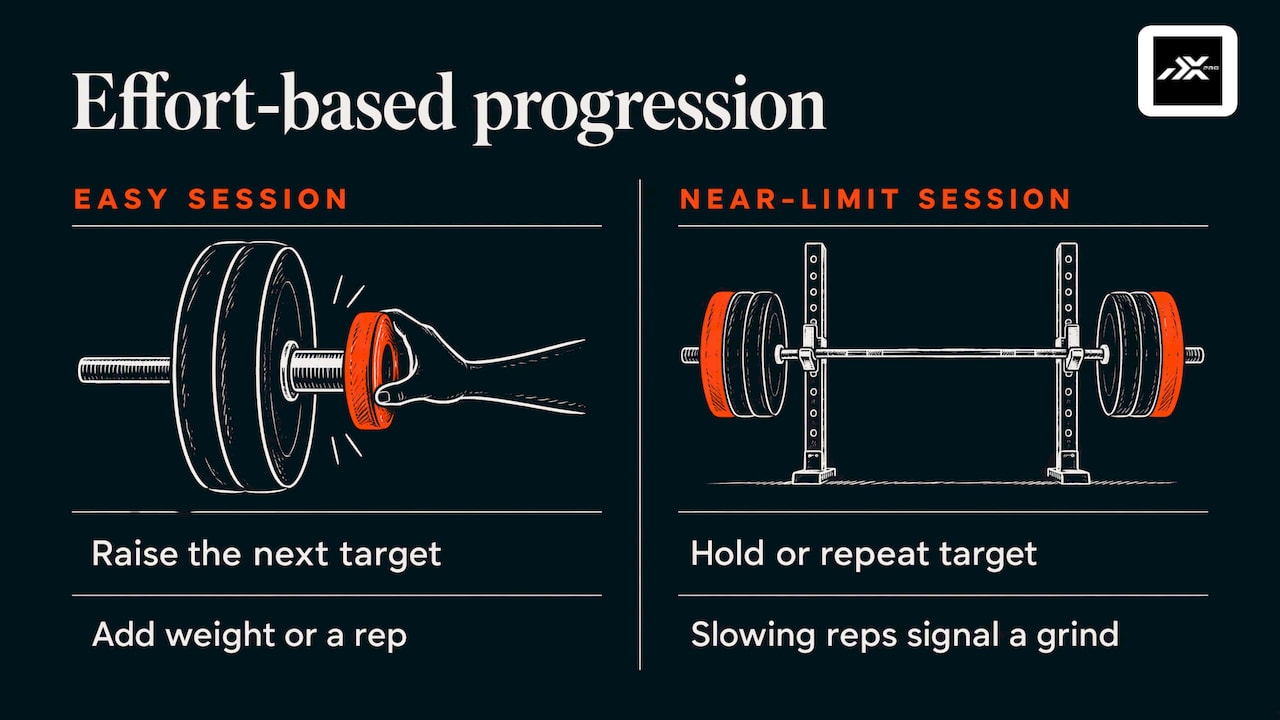
In strength training, the oldest rule is progressive overload: you add a little weight or a rep over time so the work keeps challenging you. Effort-based training adds a check on top: if the last session felt easy, the next target goes up, and if it felt near your limit, the target holds. Our guide to strength training progression walks through how to add load over time by hand, which is what an adaptive app automates.
A worked example. Say you bench pressed 135 lb for 3 sets of 8 and rated the last set as hard but clean. A sensible next target might be the same weight for 8 reps again, or a small jump if all sets felt comfortable. If you rated it as a grind with slowing reps, the sensible target is to hold or repeat. The value of software here is not magic. It is that it remembers last week’s numbers and applies the rule the same way every time.
The feedback loop
Every session you log becomes the input for the next one. If the app only generates a plan once and never changes it, it is a program, not a coach. If it responds to what you actually did, it is closer to what people mean by adaptive coaching.
What the research says so far
The honest summary: promising, uneven and young.
- The 2026 scoping review of eight studies reported some favorable or modest outcomes in adherence, activity participation, dietary behavior, engagement and weight-related measures, with results that varied across studies.
- A Frontiers review published in October 2026 describes AI uses in exercise such as personalization, monitoring, prediction and decision support for professionals. It calls for controlled studies, external validation and longer follow-up.
- A 2025 review in the Journal of Medical Internet Research covered 20 studies of large-language-model exercise and health coaching. It reported a median rigor score of 2.5 out of 5 and rated 55% of the studies as low rigor.
What this means for you: use AI coaching as a tool that can help you stay organized and consistent, and expect the evidence base to keep growing. Treat any app that promises guaranteed results with caution.
Can ChatGPT be your fitness coach?
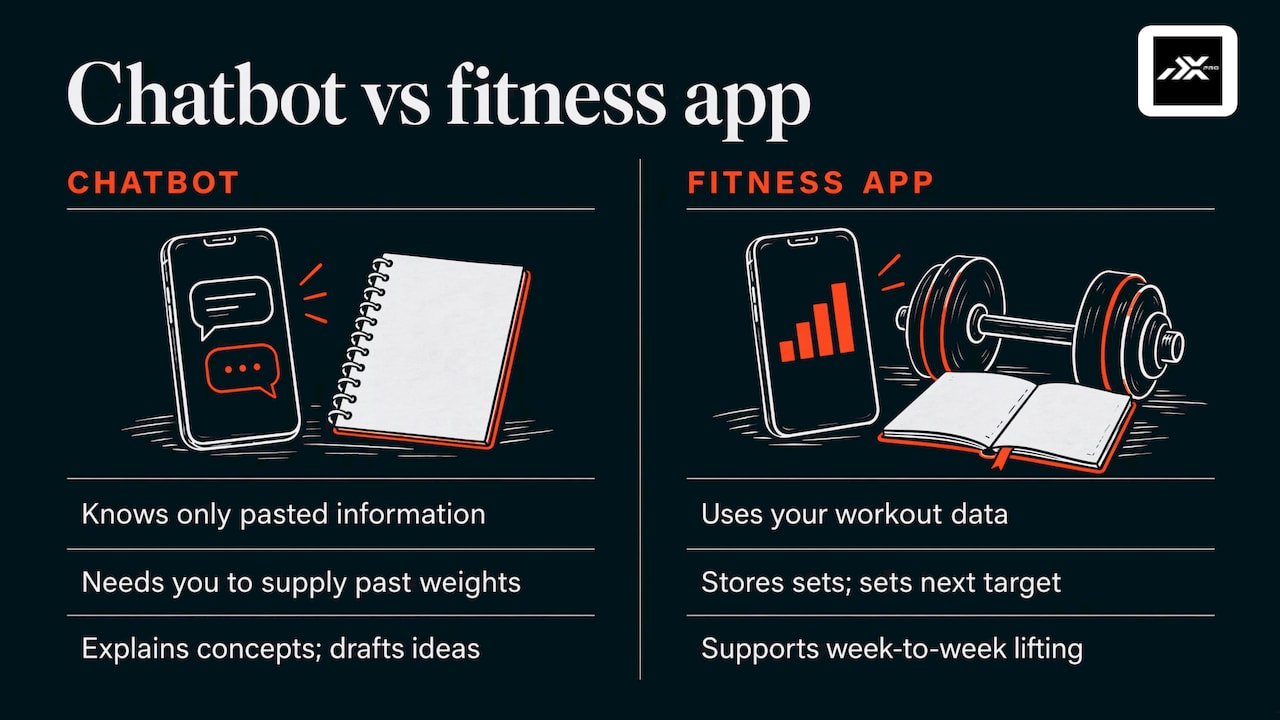
People ask this a lot. A general chatbot predicts text from existing data, while a dedicated fitness app uses your own workout data in its algorithms. A chatbot only knows what you paste into the conversation, so you have to remember and supply last week’s weights yourself.
A 2025 BMC Public Health case study compared GPT-4 with human coaches on personalization, effectiveness, safety and comprehensiveness and found no statistically significant differences on those measures. Its authors still concluded that GPT-4 could not fully replace human coaches, pointing to limits in real-time technique correction and emotional support.
That is the practical line. Chat tools can explain concepts and draft ideas. For week-to-week lifting, a tool that stores your sets and sets your next target removes the memory work.
What AI coaching can and cannot do
Where it helps
- Removes uncertainty. You open the app and see the weight and reps to aim for.
- Keeps a record. Logged sets build the history that makes good targets possible.
- Adjusts to your effort. Rating how a session felt gives the plan something real to react to.
- Fits a busy schedule. Less time planning means more time lifting.
A small 2026 qualitative study with eight participants found that perceived autonomy and self-determination could support motivation, while rigid or controlling AI programs could undermine it. Look for an app that lets you stay in charge of your training rather than one that dictates every move.
Where a human still matters
The same study’s participants valued human emotional interaction, and the authors note the small, mostly Swedish sample limits how far the findings apply. The GPT-4 case study above points to real-time technique correction as a gap. If you have an injury, pain during lifts, a medical condition, are pregnant, or are returning after a long break, talk with your doctor first. If you want hands-on form coaching, work with a qualified coach in person. An app is not a replacement for either.
What the research team behind a chat-coach prototype said
The GPTCoach paper tested a conversational prototype with 16 participants. It found the conversational style could feel supportive and non-judgmental, while proactive use of health data was more variable. The authors state that they did not examine long-term use, so the results do not show sustained effectiveness. Conversation is pleasant, but a plan that reacts to your logged numbers is what moves a barbell.
How to choose an AI fitness coach app
Use this checklist, in this order.
1. What changes your plan?
Find out exactly which inputs adjust your next session. For lifting, the best answer is simple: your last weights and reps and how hard it felt. Be wary of vague claims like “adapts to you” with no explanation. Our guide to a personalized workout plan that adapts lays out what a plan should respond to.
2. How fast is logging?
If logging takes longer than the rest between sets, you will stop doing it. Look for quick set entry and a version that works on your wrist. See what to record in our workout set tracker guide, and how to track lifts on a watch in Apple Watch strength training.
3. Does it match how you train?
Check the number of training days it supports, the exercise library and whether it has video demonstrations. Beginners especially need clear exercise guidance. If you are starting out, a simple 3-day full-body routine shows what a manageable week looks like.
4. Privacy and data control
A 2026 JMIR foresight study raises privacy and surveillance, unequal access and the trade-off between personalization and user agency as possible consequences of AI in diet and exercise apps. Read the privacy policy for what the app collects, whether it shares data for advertising and whether you can export your own records. Prefer apps that say plainly that health data is not used for ads.
5. Cost and billing
Most apps charge a monthly or yearly subscription. Look at the price on the store page before you start, and know how to cancel in your App Store settings. A yearly plan usually costs less per month than a monthly one, but only commit once you know the app fits your routine.
6. Nutrition and recovery
Some apps log food, sleep and activity next to your training. That can help you see the whole picture. If you also want help with meals, a resource like these athlete meal plans with weight-adjusted macros shows how food targets can scale with body weight.
A quick comparison of coaching approaches
| Approach | What it gives you | Best for | Watch for |
|---|---|---|---|
| Chat-based AI | Answers and draft plans on request | Learning concepts | You supply your own history |
| Plan generator | A full program from your inputs | Starting a routine | May not change after week one |
| Adaptive tracker | Next weights and reps from your results | Steady lifting progress | Needs consistent logging |
| Qualified human coach | Technique feedback and accountability | Form, injuries, competition prep | Higher cost, scheduling |
Many lifters combine them: an adaptive tracker for the daily numbers and a qualified coach for periodic form checks.
Who gets the most from AI coaching
Beginners get clear instructions on what to lift and how much, which removes the biggest early barrier. Fitness enthusiasts get structure without building spreadsheets. Athletes chasing personal records benefit from a clean history of every top set, which makes it easier to see trends. Busy people save the planning time. In every case the key habit is the same: log honestly, rate your effort honestly and let the numbers do their job. For more on a simple routine, see how to track workouts and our piece on fitness accountability.
Where Athlxpro fits
Athlxpro is a strength training app for iPhone and Apple Watch. It plans your next session from the weights and reps you logged last time, so you do not have to remember last week’s numbers. You log a set in one tap on iPhone or Apple Watch, and your progress builds into charts, records and reports. It is built on progressive overload, and it is offered as a monthly or yearly subscription through the App Store.
If you want a next-session target without the spreadsheet, you can see Athlxpro on iPhone and Apple Watch and pick the plan that suits you. If you use an Apple device already, our guide to iPhone workout tracking explains what the built-in tools do and where a dedicated strength app adds more. For planning your weeks, the strength training planner guide is a good companion.
How to start in your first two weeks
- Pick a goal and a schedule you can keep. Training 1 to 6 days a week is a workable range, and fewer sessions done consistently beat an ambitious plan you drop.
- Enter your real starting weights. Choose loads you can lift with clean form, not your all-time best.
- Log every set. The app can only set good targets from complete data.
- Rate effort honestly. A rating that is always “easy” or always “hard” gives the plan nothing to work with.
- Review after two weeks. Look at your charts. If the targets feel consistently off, adjust your inputs or talk to a qualified coach about your program.
FAQ
How much does AI fitness coaching cost?
Most AI fitness coach apps charge a monthly or yearly subscription, and prices vary widely by app. Check the store listing for the current amount and billing period before you subscribe. Compare that against what you need: a next-session planner is a different product from a full coaching service.
Is an AI trainer app as good as a human trainer?
They do different things. An app is strong at remembering your numbers, applying progression rules and being available any time. A human coach can watch your technique, notice pain and offer in-person support. Research comparing a language model to coaches found promise but concluded it could not fully replace human coaches.
Can a beginner use an AI workout coach app?
Yes, as long as the app gives clear exercise guidance and sensible starting loads. Start light, learn the movements and log everything. If you have a medical condition or an injury, check with your doctor before you begin.
Will an app tell me if my form is wrong?
Most lifting apps do not assess your form in real time, and research flags real-time technique correction as a limit of AI coaching. Use exercise videos to learn the movement, record yourself to compare, and see a qualified coach if you are unsure.
Sources
- AI Fitness Trainers Are Here. Are They Useful? (The New York Times)
- Personalization of Training and Weight Reduction Using AI: scoping review (PubMed Central)
- Artificial intelligence applications in exercise and physical activity (Frontiers in Public Health)
- Evaluation of LLM exercise and health coaching (Journal of Medical Internet Research, 2025)
- GPT-4 as a virtual fitness coach: a case study (BMC Public Health)
- User Perceptions of AI-Driven Coaching in Fitness (DiVA)
- GPTCoach: Towards LLM-Based Physical Activity Coaching (arXiv)
- Anticipating the Impact of AI on Diet and Exercise Apps (JMIR, 2026)